A molecular ripcord for chemical reactions
April 6, 2009 A molecular ripcord for chemical reactions

Enlarge

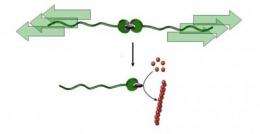
A catalyst can be switched from a dormant to an active state by pulling on a polymer chain, a "molecular ripcord". Credit: Rint Sijbesma

Researchers at Eindhoven University of Technology (the Netherlands) have developed an entirely new method for starting chemical reactions. For the first time they used mechanical forces to control catalytic activity - one of the most fundamental concepts in chemistry. This allowed them to initiate chemical reactions with mechanical force. This discovery paves the way to developing materials capable of repairing themselves under the influence of mechanical tension. The results of their research will be published online on 6 April 2009 in the new international journal Nature Chemistry.

The research team (Dr. Alessio Piermattei, Dr. Karthik Sivasubramanian and Dr. Rint Sijbesma) of the Institute for Complex Molecular Systems (ICMS) and the Department of Chemical Engineering and Chemistry, both at TU/e, is the first to have demonstrated that a catalyst can be switched from a dormant to an active state (see illustration) by pulling on a polymer chain, a "molecular ripcord." The researchers were able to use this catalyst to initiate a variety of , including polymerizations (formation of polymer chains from small molecular building blocks called monomers).

This discovery paves the way to creating self-repairing materials that strengthen under the influence of mechanical stress. If a material were to tear, for example, this would simultaneously break the metal complex in half, thereby activating the catalyst, and the material would be instantly repaired.

This work will also lead to research into other applications in which it should be possible to turn chemical reactions on and off as desired. Potential applications include the injection molding of plastic objects, where the technique could be used to simplify processing, or microscale chemical synthesis.

The researchers packed a catalytically active metal ion completely in using two molecular caps (ligands). They attached two polymer chains to these caps, creating a long chain with a metal complex in the center. These complexes were dissolved in a liquid that was irradiated with ultrasound, causing bubbles to form in the liquid. When these bubbles imploded, they created an extremely strong current that stretched the chains and ultimately broke its weakest link - the metal complex - in two. The cap on one end was now broken off from the active metal ion, which allowed the metal ion to become catalytically active. In other words, it could now accelerate chemical reactions.

Source: Eindhoven University of Technology


print this article email this article download pdf blog this article bookmark this article     Stumble it Digg this share on Facebook retweet share on Reddit add to delicious
Rate this story - 4 /5 (2 votes)


April 6, 2009 all stories

Comments: 0

4 /5 (2 votes)
  • Stumble this up

  • Digg this

  • share this

  • hide
  • Related Stories

  • Mechanics meets chemistry in new way to manipulate matter
    created Mar 21, 2007 | popularity not rated yet | comments 0
  • Modeling the Chemical Reactions of Nanoparticles
    created Mar 27, 2006 | popularity not rated yet | comments 0
  • When liquid crystals with a metal center are 'shaking hands'
    created Mar 14, 2005 | popularity not rated yet | comments 0
  • New catalysts promise faster, cleaner and more efficient research platform
    created Nov 16, 2008 | popularity not rated yet | comments 0
  • 'Yanking' Chemical Bonds with Molecular Wires Speeds Reactions
    created Mar 15, 2006 | popularity not rated yet | comments 0


  • hide
  • Relevant PhysicsForums posts

  • Specific Heat experiment
    created 1hour ago
  • MO diagram of NO
    created 12 hours ago
  • limiting reagent
    created 15 hours ago
  • preparation of acetanilide
    created 15 hours ago
  • More from Physics Forums - Chemistry

Other News

Sandia CR5

Machine Converts CO2 into Gasoline, Diesel, and Jet Fuel

Chemistry / Biochemistry

created Nov 23, 2009 | popularity 4.6 / 5 (31) | comments 20

(PhysOrg.com) -- Researchers at Sandia National Laboratories have built a machine that uses the sun's energy to convert carbon dioxide waste from power plants into transportation fuels such as gasoline, diesel, ...


New hydrogen-storage method discovered

New hydrogen-storage method discovered

Chemistry / Materials Science

created Nov 22, 2009 | popularity 4.3 / 5 (42) | comments 15

Scientists at the Carnegie Institution have found for the first time that high pressure can be used to make a unique hydrogen-storage material. The discovery paves the way for an entirely new way to approach ...


New chemical reaction offers opportunities for drug development

Chemistry / Biochemistry

created Nov 26, 2009 | popularity not rated yet | comments 2

Researchers led by Conway Fellow, Professor Pat Guiry have solved a chemistry problem that has stumped researchers worldwide for more than a decade. The results have earned the group the cover story of the leading scientific ...


Research sheds light on workings of anti-cancer drug

Chemistry / Analytical Chemistry

created Nov 26, 2009 | popularity not rated yet | comments 0

(PhysOrg.com) -- The copper sequestering drug tetrathiomolybdate (TM) has been shown in studies to be effective in the treatment of Wilson disease, a disease caused by an overload of copper, and certain metastatic cancers. ...


Chemists get custom-designed microscopic particles to self-assemble in liquid crystal

Chemists get custom-designed microscopic particles to self-assemble in liquid crystal

Chemistry / Materials Science

created Nov 25, 2009 | popularity 5 / 5 (5) | comments 0

(PhysOrg.com) -- The scientists anticipate their "LithoParticles" will have significant applications in photonics, optical communications and other areas.