Solar car aims to put rivals in the shade
April 6, 2009
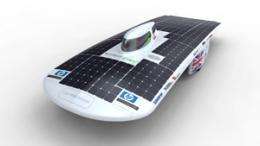
Capable of 60mph using the same power as a hairdryer, Cambridge University Eco Racing's new solar racing car showcases cutting-edge environmentally-friendly technology, applicable to the next generation of electric vehicles. (Image produced by Lovegrove Studio.)
(PhysOrg.com) -- Plans for a solar-powered racing car which will cruise at 60mph using the same power as a hairdryer have been unveiled by students at Cambridge University.
The car, codenamed "Bethany", will be completed this summer and is being touted as Britain's brightest hope for the World Solar Challenge - a gruelling 3,000 km race across the Australian Outback.
Its power will come from solar energy captured by a 6m² covering of high-efficiency silicon cells. Underneath this solar "skin", however, the car will essentially be an ultra-efficient electric vehicle, which designers say could provide a model for other forms of green transportation.
"At a time when the automotive industry is being forced to look at a low-carbon future, our vehicle demonstrates the enormous potential of energy-efficient electric vehicle technologies," Anthony Law, manager of the student group Cambridge University Eco Racing (CUER), which is building the car, said.
"Transportation currently accounts for about 35% of the UK's energy use, so this is obviously an area in which we can have a big impact on climate change."

Cambridge University Eco Racing's new solar racing car will undertake a 3000km journey through the Australian Outback during the World Solar Challenge 2009 and the team hopes will set a new British record for success in the race. (Image produced by Lovegrove Studio.)
Using computer simulation software, the car's aerodynamics, rolling resistance, weight and electrical efficiency have all been optimised to minimise its energy requirements. It will also be fitted with an energy-efficient hub motor, a control system to provide battery management and an electric braking system which generates energy.It will weigh just 170kg and its creators estimate that it will require up to 50 times less power than a normal petrol-fuelled vehicle.
CUER has already designed the UK's first road-legal solar-powered car, which was driven from Land's End to John O'Groats last year. The new vehicle should be finished in June. It will then be road-tested extensively before being shipped to Australia for October's World Solar Challenge race from Darwin to Adelaide.
Its creators hope that the innovations in Bethany's design will enable it to put in the best ever performance by a UK-manufactured vehicle, even though the team will be up against university and corporate teams that boast seven-figure budgets, dwarfing the students' own of about £200,000.
Four student drivers will pilot the vehicle across the Outback, working in four-hour shifts to cope with the intense heat, a task that requires months of training. During the race, however, the drivers will only have to steer the car and stay alert, as it will be fitted with an advanced cruise control system which will automatically adjust its speed according to road conditions and weather forecasts.
Some seventy-five students from across the University have been involved in designing or building the vehicle, supported by a network of corporate sponsors, academics and specialist advisors.
-
Cambridge University Eco Racing solar car drive across Britain
Jun 11, 2008 |
not rated yet |
0
-
Sleek new MIT solar car heads to the races
Feb 25, 2009 |
not rated yet |
0
-
Mirror technology propels 2007 U-M Solar Car team
Oct 15, 2007 |
not rated yet |
0
-
Solar Cars Driving Towards A Hydrogen Future
Sep 26, 2005 |
not rated yet |
0
-
Green machine drives for ultra fuel savings
Apr 19, 2005 |
not rated yet |
0
-
Engineers build first sub-10-nm carbon nanotube transistor
Feb 01, 2012 |
4.9 / 5 (31) |
30
-
Something old, something new: Evolution and the structural divergence of duplicate genes
Jan 31, 2012 |
4.6 / 5 (7) |
1
-
The hidden nanoworld of ice crystals: Revealing the dynamic behavior of quasi-liquid layers
Jan 30, 2012 |
5 / 5 (3) |
1
-
Stock market network reveals investor clustering
Jan 27, 2012 |
3.9 / 5 (23) |
8
-
Of microchemistry and molecules: Electronic microfluidic device synthesizes biocompatible probes
Jan 26, 2012 |
5 / 5 (1) |
0
-
Calling function with no input argument
10 hours ago
-
Force free body diagram problem on gym equipment
11 hours ago
-
Empirical data regarding shower heads and water
19 hours ago
-
feed hold button on CNC lathe
Feb 09, 2012
-
RFAC in Fortran
Feb 09, 2012
-
dynamics 2/32
Feb 08, 2012
- More from Physics Forums - General Engineering
More news stories
Google users warned of threat to smartphone wallets
Users of Google smartphone wallets were being warned on Friday that there is a way to crack pass codes intended to thwart thieves from going on illicit shopping sprees.
3 hours ago |
5 / 5 (1) |
0
Anonymous knocks CIA website offline (Update)
The website of the Central Intelligence Agency was inaccessible on Friday after the hacker group Anonymous claimed to have knocked it offline.
4 hours ago |
5 / 5 (6) |
10
New error-correcting codes guarantee the fastest possible rate of data transmission
Error-correcting codes are one of the triumphs of the digital age. Theyre a way of encoding information so that it can be transmitted across a communication channel such as an optical fiber o ...
Technology / Computer Sciences
13 hours ago |
5 / 5 (4) |
5
|
New power source discovered
(PhysOrg.com) -- Researchers at the Massachusetts Institute of Technology (MIT) and RMIT University have made a breakthrough in energy storage and power generation.
Technology / Energy & Green Tech
12 hours ago |
4.8 / 5 (19) |
7
|
Small modular reactor design could be a 'SUPERSTAR'
(PhysOrg.com) -- Though most of today's nuclear reactors are cooled by water, we've long known that there are alternatives; in fact, the world's first nuclear-powered electricity in 1951 came from a reactor ...
Technology / Energy & Green Tech
12 hours ago |
4.3 / 5 (11) |
20
|
Complex wiring of the nervous system may rely on a just a handful of genes and proteins
Researchers at the Salk Institute have discovered a startling feature of early brain development that helps to explain how complex neuron wiring patterns are programmed using just a handful of critical genes. ...
Putting the squeeze on planets outside our solar system
(PhysOrg.com) -- Using high-powered lasers, scientists at Lawrence Livermore National Laboratory and collaborators discovered that molten magnesium silicate undergoes a phase change in the liquid state, abruptly ...
The power of estrogen -- male snakes attract other males
A new study has shown that boosting the estrogen levels of male garter snakes causes them to secrete the same pheromones that females use to attract suitors, and turned the males into just about the sexiest ...
NASA sees wide-eyed cyclone Jasmine
Cyclone Jasmine's eye has opened wider on NASA satellite imagery, as it moves through the Southern Pacific Ocean.
Humans may have helped the decline of African rainforests 3000 years ago
(PhysOrg.com) -- Large areas of rainforests in Central Africa mysteriously disappeared over three thousand years ago, to be replaced by savannas. The prevailing theory has been that the cause was a change ...
NASA sees Giovanna reach cyclone strength, threaten Madagascar
Tropical Storm 12S built up steam and became a cyclone on February 10, 2012 as NASA's Terra satellite passed overhead. Residents of east-central Madagascar should prepare for this cyclone to make landfall ...

Apr 07, 2009
Rank: 5 / 5 (1)
Apr 09, 2009
Rank: not rated yet