New method for magnetic manipulation of cells
April 6, 2009 New method for magnetic manipulation of cells

Enlarge

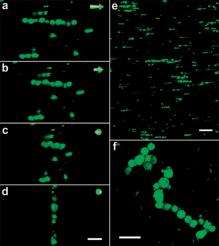
These images reveal cells chained in BSA-ferrofluid. Images (a) through (d) are of cells under a magnetic field forming oriented linear chains. The arrow indicates the direction of the magnetic field. Image (e) is a low magnification view of cells under magnetic field. Image (f) is a view of cell chains one hour after the magnetic field has been removed.

(PhysOrg.com) -- Magnetic technology could help address a major problem that bioengineers face as they try to create new tissue: getting human cells to not only form structures, but to stimulate the growth of blood vessels to nourish their growth.

A team of investigators from Case Western Reserve University, Duke University and University of Massachusetts, Amherst, created an environment where suspended within a special liquid solution acted like molecular sheep dogs, nudging free-floating to form chains in response to external magnetic fields. These chains, the researchers said, could potentially be integrated into approaches for creating human tissues and organs.

These cells not only naturally adhere to each other upon contact, the researchers said, but the aligned cellular configurations that form may promote or accelerate the creation and growth of tiny .

“The cells have receptors on their surfaces that have an affinity for other cells,” said Melissa Krebs, a third-year biomedical engineering graduate student at Case Western Reserve University. “They become sticky and attach to each other. When get together in a linear fashion, as they did in our experiments, it may help them to organize into tiny tubules.”

The iron-containing used by the researchers are suspended within a liquid known as a ferrofluid. One of the unique properties of these ferrofluids is that they become highly magnetized in the presence of external magnetism, which allows researchers to readily manipulate the chain formation by altering the strength of the magnetic field.

At the end of the process, the nanoparticles are simply washed away, leaving a linear chain of cells. That the cells remain alive, healthy, and relatively unaltered without any harmful effects from the process is one of the major advances of the new approach over other strategies using magnetism.

“Others have tried using magnetic particles either within or on the surface of the cells,” explained Randall Erb, a fourth-year graduate student in the laboratory of Benjamin Yellen, assistant professor of Mechanical Engineering and Materials Science, at Duke University’s Pratt School of Engineering and Krebs’ brother. “However, the iron in the nanoparticles can be toxic to cells. Also, the process of removing the nanoparticles afterward can be harmful to the cells and their function.”

The key ingredient for these studies was the synthesis of non-toxic ferrofluids. Researchers developed a method for coating the magnetic nanoparticles with bovine serum albumin (BSA), a protein derived from cow blood. BSA is a stable protein used in many experiments because it is biochemically inert. In these experiments, the BSA shielded the cells from the toxic iron.

“The other main benefit of our approach is that we are creating three-dimensional cell chains without any sophisticated techniques or equipment,” Krebs said. “Any type of tissue we’d ultimately want to engineer will have to be three-dimensional.”

For their experiments, the researchers used human umbilical vein endothelial cells. Others types of cells have also been used, and it appears to the researchers that this new approach can work with any type of cell.

“While still in the early stages, we have shown that we can form oriented cellular structures,” said Eben Alsberg, assistant professor of Biomedical Engineering and Orthopaedic Surgery at Case Western Reserve. “The next step is to see if the spatial arrangement of these cells in three dimensions will promote vascular formation. A major current hurdle in tissue engineering is vascularization, and we hope that this technology may help to address the problem.”

The research, appearing online in advance of the May publication of Nanoletters, a journal published by the American Chemical Society, was supported by the National Institutes of Health, the National Science Foundation and Case Western Reserve University.

Provided by Case Western Reserve University (news : web)


print this article email this article download pdf blog this article bookmark this article     Stumble it Digg this share on Facebook retweet share on Reddit add to delicious
Rate this story - 4.7 /5 (7 votes)

Rank Filter

Move the slider to adjust rank threshold, so that you can hide some of the comments.


Display comments: newest first

  • thorn - Apr 08, 2009
    • Rank: 1 / 5 (1)
    Very interesting. Me thinks we move into a new age of human definition. Once again using our livestock. Will it change us again? Propabably. But's that's how we mammals like it, adapt or bye, bye.
  • out7x - Apr 09, 2009
    • Rank: 1 / 5 (1)
    Isnt blood a ferrofluid? How does the iron concentration compare with this ferrofluid-BSA mixture?
  • barakn - Apr 17, 2009
    • Rank: 3 / 5 (2)
    No, blood is not a ferrofluid, seeing as how it does not "become highly magnetized in the presence of external magnetism"

April 6, 2009 all stories

Comments: 3

4.7 /5 (7 votes)
  • Stumble this up

  • Digg this

  • share this

  • hide
  • Related Stories

  • Magnetic nano-'shepherds' organize cells
    created Mar 31, 2009 | popularity not rated yet | comments 0
  • Sophisticated nano-structures assembled with magnets (Video)
    created Feb 18, 2009 | popularity not rated yet | comments 0
  • Researchers use magnetism to target cells to animal arteries
    created Jan 07, 2008 | popularity not rated yet | comments 0
  • Widely used iron nanoparticles exhibit toxic effects on neuronal cells
    created Mar 28, 2007 | popularity not rated yet | comments 0
  • Magnetism shepherds microlenses to excavate 'nanocavities'
    created Mar 30, 2006 | popularity not rated yet | comments 0


  • hide
  • Relevant PhysicsForums posts

  • Selenocysteine in pH=7
    created Nov 26, 2009
  • What is the formula for calculating the speed of thought?
    created Nov 26, 2009
  • What does word "absorption" mean in the intestine?
    created Nov 26, 2009
  • What is transpulmonary pressure?
    created Nov 24, 2009
  • Is there a gay gene?
    created Nov 23, 2009
  • Super quick question about Starling forces?
    created Nov 22, 2009
  • More from Physics Forums - Biology

Other News

Nanowire Formation

Nanowires key to future transistors, electronics

Nanotechnology / Nanophysics

created Nov 26, 2009 | popularity 4.8 / 5 (8) | comments 1

(PhysOrg.com) -- A new generation of ultrasmall transistors and more powerful computer chips using tiny structures called semiconducting nanowires are closer to reality after a key discovery by researchers ...


Water droplets direct self-assembly process in thin-film materials

Nanotechnology / Nanomaterials

created Nov 23, 2009 | popularity 5 / 5 (4) | comments 2

You can think of it as origami - very high-tech origami. Researchers at the University of Illinois have developed a technique for fabricating three-dimensional, single-crystalline silicon structures from thin films by coupling ...


Using superconducting probes to get a picture of what it's like inside CNTs

Nanotechnology / Nanophysics

created Nov 20, 2009 | popularity 4.4 / 5 (9) | comments 0

(PhysOrg.com) -- "Carbon nanotubes are exciting for fundamental physics, and for potential technological applications," Nadya Mason tells PhysOrg.com. "However, we are generally limited in the way that we can study them. ...


Peptides control crystal growth with 'switches, throttles and brakes'

Peptides control crystal growth with 'switches, throttles and brakes'

Nanotechnology / Bio & Medicine

created Nov 23, 2009 | popularity 4.8 / 5 (5) | comments 0

(PhysOrg.com) -- By producing some of the highest resolution images of peptides attaching to mineral surfaces, scientists have a deeper understanding how biomolecules manipulate the growth crystals. This research ...


Fast, easy, and highly sensitive arsenic detection with gold nanoparticles

Nanotechnology / Nanomaterials

created Nov 25, 2009 | popularity 5 / 5 (1) | comments 0

(PhysOrg.com) -- Mention of arsenic poisoning usually brings to mind underhanded murder. However, the danger of arsenic poisoning from contaminated drinking water is far greater. Low concentrations of arsenic are found in ...