Young adults at future risk of Alzheimer's have different brain activity
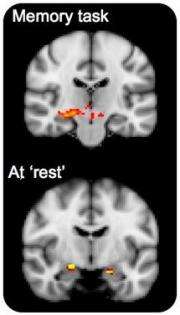
(PhysOrg.com) -- Young adults with a genetic variant that raises their risk of developing Alzheimer's Disease show changes in their brain activity decades before any symptoms might arise, according to a new brain imaging study by scientists from the University of Oxford and Imperial College London. The results may support the idea that the brain's memory function may gradually wear itself out in those who go on to develop Alzheimer's.
The research, published today in the journal Proceedings of the National Academy of Sciences, provides clues as to why certain people develop Alzheimer's Disease (AD) and it may be a step towards a diagnostic test that identifies individuals at risk. The degenerative condition is the most common cause of dementia and it affects around 417,000 people in the UK.
The APOE4 genetic variant is found in about a quarter of the population. Not everyone who carries the variant will go on to develop AD, but people who inherit one copy of APOE4 have up to four times the normal risk of developing the late-onset variety of the disease. People who have two copies have around ten times the normal risk.
The researchers behind today's study stress that most carriers of APOE4 will not go on to develop Alzheimer's and carriers should not be alarmed by the study's findings.
Differences in the region of the brain involved in memory, known as the hippocampus, have previously been shown in middle-aged and elderly healthy carriers of APOE4. However, the new Oxford University and Imperial study is the first to show hyperactivity in the hippocampus of healthy young carriers. It is also the first to show that APOE4 carriers' brains behave differently even at 'rest'.
The study used functional Magnetic Resonance Imaging (fMRI) carried out at the University of Oxford to compare activity inside the brains of 36 volunteers, with 18 carrying at least one copy of the APOE4 gene and 18 non-carriers acting as controls.
All the volunteers in the study were aged between 20 and 35 and all performed normally on tasks designed to test their cognitive skills.
The researchers looked at how the volunteers' brains behaved while they were resting and also while they were performing a memory-related task. Even when the APOE4 carriers were resting, the researchers could see that carriers and non-carriers each had distinct patterns of brain activity. The fMRI scans showed visible differences in how the hippocampus was relating to the rest of the brain.
The researchers will now carry out a similar study of patients with mild cognitive impairment to explore how these differences in patterns of brain activity in young people may be associated with later changes.
Dr Clare Mackay, the lead author of the study from the Department of Psychiatry and the Centre for Functional Magnetic Resonance Imaging of the Brain at the University of Oxford, said: "We have shown that brain activity is different in people with this version of the gene decades before any memory problems might develop. We've also shown that this form of fMRI, where people just lie in the scanner doing nothing, is sensitive enough to pick up these changes. These are exciting first steps towards a tantalising prospect: a simple test that will be able to distinguish who will go on to develop Alzheimer's."
Dr Christian Beckmann, another author of today's study from the Division of Neurosciences and Mental Health at Imperial College London, added: "Our brains are always active - our minds wander even when we're not carrying out specific tasks. We were surprised to see that even when the volunteers carrying APOE4 weren't being asked to do anything, you could see the memory part of the brain working harder than it was in the other volunteers. Not all APOE4 carriers go on to develop Alzheimer's, but it would make sense if in some people, the memory part of the brain effectively becomes exhausted from overwork and this contributes to the disease. This theory is supported by studies that have found the opposite pattern in people who have developed Alzheimer's, with these people showing less activity than normal in the memory part of the brain."
Source: Imperial College London (news : web)


