Mass spec technique analyzes defensive chemicals on seaweed surfaces for potential drugs
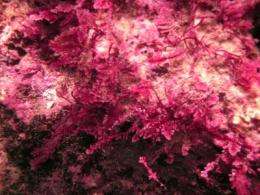
A new analytical technique is helping scientists learn how organisms as simple as seaweed can mount complex chemical defenses to protect themselves from microbial threats such as fungus. Known as desorption electrospray ionization mass spectrometry (DESI-MS), the technique for the first time allows researchers to study unique chemical activity taking place on the surfaces of these organisms.
Understanding this surface chemistry could one day allow scientists to borrow and adapt some of those defensive chemical compounds for use against cancer, HIV, malaria, drug-resistant bacteria and other diseases of humans. In a paper scheduled to be published online in the journal Proceedings of the National Academy of Sciences, researchers from the Georgia Institute of Technology describe a sophisticated chemical defense system that uses 28 different compounds to protect a species of seaweed against a single fungus.
"Plants and animals in the wild use chemistry as way to fight with one another," said Julia Kubanek, a professor in Georgia Tech's School of Biology. "Using this new technology, scientists can listen in on this fight to perhaps learn from what's going on and steal some of the strategies for human biomedical applications."
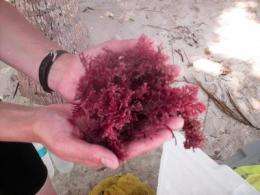
As part of a long-term project sponsored by the Natural Institutes of Health, Georgia Tech scientists have been cataloging and analyzing natural compounds from more than 800 species found in the waters surrounding the Fiji Islands. They have been particularly interested in Callophycus serratus, an abundant species of red seaweed that seems particularly successful - and adept at fighting off microbial infections.
Using the DESI-MS technique, the researchers analyzed recently-collected samples of the seaweed and found groups of potent anti-fungal compounds in light-colored microscopic surface patches covering what may be wounds on the surface of the seaweed. In laboratory testing, these bromophycolide compounds and callophycoic acids effectively inhibited the growth of Lindra thalassiae, a common marine fungus.
"It is possible that the alga is marshalling its defenses and displaying them in a way that blocks the entry points for microbes that might invade and cause disease," Kubanek said. "Seaweeds don't have B cells, T cells and immune responses like humans do. But instead they have some chemical compounds in their tissues to protect them."
Though all the seaweed they studied was from a single species, the researchers were surprised to find two distinct groups of anti-fungal chemicals. From one seaweed subpopulation, dubbed the "bushy" type for its appearance, 18 different anti-fungal compounds were identified. In a second group of seaweed, the researchers found 10 different anti-fungal compounds - all different from the ones seen in the first group.
"This species is producing some unique chemical compounds that other seaweeds don't produce, and it is producing a large number of compounds, each of which has a role to play in the overall defense against the fungus," Kubanek noted. "We think the compounds work together in an additive way."
Though chemically different, the compounds are structurally related and seem to arise from a similar metabolic pathway in the seaweed. Why one species of simple organism would produce 28 different anti-fungal compounds remains a mystery, though Kubanek believes the chemicals may also have other uses that are not yet understood.
The compounds have been tested for potential activity against drug-resistant bacteria, cancer, HIV, malaria and other human health threats. So far, preliminary testing suggests they have anti-malarial effects.
The DESI-MS technique allowed the researchers for the first time to analyze chemical activity occurring on the surface of the seaweed. Earlier techniques allowed identification of chemicals in the organism's tissue, but being able to confirm their location on the surface - the first line of defense against infection - confirms the role they play as defensive chemicals.
In DESI-MS, a charged stream of polar solvent is directed at the surface of a sample under study at ambient pressure and temperature. The spray desorbs molecules, which are then ionized and delivered to the mass spectrometer for analysis.
"This technique allows us to examine intact organisms and see how the chemical compounds are distributed," Kubanek explained. "For our research with seaweed, this is important because we'd like to understand how an organism distributes these compounds to protect itself from enemies."
In addition to Kubanek, others researchers contributing to the study included Leonard Nyadong, Asiri Galhena, Tonya Shearer, E. Paige Stout, R. Mitchell Parry, Mark Kwasnik, May Wang, Mark Hay, and Facundo Fernandez - all from Georgia Tech - and Amy Lane, now at Scripps Institution of Oceanography. Beyond the National Institutes of Health support, the research has also been sponsored by the National Science Foundation.
For the future, Kubanek and a graduate student are working to modify the most promising of the anti-malarial compounds, replacing some oxygen atoms for nitrogen atoms and bromine for chlorine and fluorine. The hope is to create a compound more potent against the malaria organism with less toxicity for humans.
"We are doing reaction chemistry using these 28 compounds as a starting point," she explained. "Learning about how other species avoid diseases may give us something we can use to avoid or treat our own diseases."
Source: Georgia Institute of Technology


