Wall Street rocket scientists crash to Earth
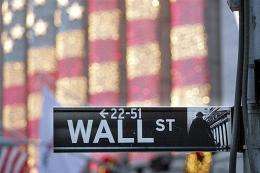
April 7, 2009 by Sebastian Smith An outside view of the New York Stock Exchange on Wall Street

Enlarge

An outside view of the New York Stock Exchange on Wall Street. There's a reason Wall Street resembles a rocket experiment gone wrong: rocket scientists helped make it happen. Known as quants, these are the mathematicians and physicists who devised the financial instruments and computer programs fueling stock markets' spectacular rise and collapse.

There's a reason Wall Street resembles a rocket experiment gone wrong: rocket scientists helped make it happen.

Known as quants, these are the mathematicians and physicists who devised the financial instruments and computer programs fueling stock markets' spectacular rise and collapse.

And while in good times they became financial rock stars, quants -- short for quantitative analysts -- are now being cast as villains of an industry that abandoned its values.

"They thought they could make it easier to make money, one New York investment manager, speaking on condition of anonymity, told AFP. "They thought you don't need to do your homework anymore."

Trained at leading universities like MIT, Harvard and Oxford, quants apply the logic and number-crunching powers of physics to the mess of money.

Some qaunts use mathematical modeling to analyze risk, some juggle huge quantities of economic data to understand price trends. Some run hedge funds. Some design ultra-complex securities and derivatives.

Peter Kolm, a former quant at Goldman Sachs and now associate professor at New York University's prestigious Courant Institute of Mathematical Sciences, says atoms and dollars aren't so different.

"The mathematics, the structure is similar," he said.

"Any fusion process, heat flow, how heat spreads in a room, or spreads on a particular surface ... there's similar behavior in the probability of how prices change over time."

Quants entered markets in the late 1970s, becoming in huge demand by the 1990s.

They earned big salaries to produce ever-more exotic and jealously guarded products dubbed "black boxes."

Thousands of hedge funds -- about seven percent of the total -- were based entirely on quant products, using intricate, split-second calculations to take multiple positions.

There were plenty of warnings.

Two of the most exalted quants -- Robert Merton and Myron Scholes -- won the 1997 Nobel economic science prize for their work on , but their hedge fund Long Term Capital Management collapsed a year later.

And as far back as 2003, Warren Buffet described quant instruments as "financial weapons of mass destruction."

Yet few listened: geeks were kings and their micro-chip alchemy was infallible.

"Everybody in the world thought they could come up with a model," said economics analyst Joel Naroff. "People knew they were taking larger bets, but the assumption was the bets were backed by mathematics."

The hottest quant products were Collateralized Debt Obligations (CDOs) and similar instruments like CMOs that turned high-risk toxic housing debt into seemingly safe bonds.

Quants literally appeared to have found a way to beat the system, turning the bad money of subprime mortgages into risk-free profit.

The mathematics was so complex that even traders had trouble understanding what they were selling. But the products worked.

"You put chicken in the grinder and out comes sirloin," veteran quant Michael Osinski recalled in last week's New York magazine.

But for all the dazzling algorithms, the quants had left out one crucial element: the possibility that the housing market might stop rising.

Which is what happened. House price fell, subprime mortgage holders defaulted en masse, and the entire economy slid into today's all-encompassing financial crisis.

Marc Pado, a US market strategist at Cantor Fitzgerald, says the disaster shows what happens when automated programs replace humans.

"It was like putting a plane on automatic pilot. Everything is great while it works," he said.

"But as with anything computerized, it doesn't have human judgment. It's all based on what has been plugged into the formula. People say they thought it was a science, but (trading) is not a science -- that's the point."

Kolm defends quants, pointing out that traders, not quants make the judgement calls.

"Who put the blind faith in it? These were the business people calling the shots," Kolm said.

Traders didn't even want to hear about possible dangers, he said.

"Business people are going to say the same thing. They say it's profitable. Why is it risky? So you're going to be the bad guy at the party.... There are situations where risk mangers who blow the whistle, they essentially get shown the door."

Competition to enter the Courant Institute's course is down, but still intense, with 660 applicants chasing 30 places, compared to 900 eyeing 35 spots last year, Kolm said.

Still, these future Wall Street whizzes will likely learn humility instead of the old hubris.

"What makes a really good quant," Kolm said, "is someone who understands the model really well -- and who understands what can go wrong."

(c) 2009 AFP


print this article email this article download pdf blog this article bookmark this article     Stumble it Digg this share on Facebook retweet share on Reddit add to delicious
Rate this story - 4.2 /5 (13 votes)

Rank Filter

Move the slider to adjust rank threshold, so that you can hide some of the comments.


Display comments: newest first

  • Corban - Apr 07, 2009
    • Rank: 5 / 5 (1)
    No, this disaster shows what happens when experts use tools but didn't read the manual for limitations.
  • UncleJohn - Apr 07, 2009
    • Rank: 4.7 / 5 (3)
    I'm sorry but I must disagree. As an amateur rocketeer, I and everyone I know, take extreme care to insure the success of every launch. This is why Nasa builds redundancy into every system. In rocket science, success is in only achieved at the end of the mission, not at apogee like the stock market. There is a big difference between rocket science and quantitative analysis.
  • mjporter - Apr 07, 2009
    • Rank: 5 / 5 (1)
    No kidding UncleJohn! I'm a graduating senior planning on going into aerospace. If I were the type to be easily offended...that comparison would offend me!
  • marjon - Apr 07, 2009
    • Rank: 5 / 5 (1)
    GIGO still applies. The more complicated the model, the easier it is to screw up, to paraphrase Mr. Scott.
  • GrayMouser - Apr 07, 2009
    • Rank: 5 / 5 (1)
    I was a 'rocket scientist' (at least I worked on the R&D for the shuttle, IUS, and some other items) and went in to the computer industry. If rocket science was done on the same level of competency as computer science we would still be trying to get something off the ground.
  • PaulLove - Apr 07, 2009
    • Rank: not rated yet
    The larger problem was when the finance people started to game the system. The models work fine for high risk lending but not for deliberately bad lending. I have friends who work/worked in the banking industry. You can make a high risk loan but if individuals come in to apply for a high risk loan and don't qualify then 30 days later you let them come in and make a stated income loan (thats where with little to no proof you let them just tell you what they make and the loan is calculated from there). The loan officer draws a commission because he made/exceeded goal. Then the loans are packaged into bundles and sold. The problem is that it wasn't high risk loans being bundled to consolidate and distribute risk they were defaulted loans before the signature was finished on the contract.
  • googleplex - Apr 07, 2009
    • Rank: not rated yet
    Well there is a big difference.
    Financial markets are bounded by the rules of pyschology i.e. inherently irrational and of limitless scope.
    Whereas the laws of the Universe are inherently rational and the scientific method applies. The assumptions of economics are not perfect e.g. perfect knowledge etc.
    This is the exact reason why financial philosophers like Soros and his reflexivity are winners. Buffett takes another approach in only investing in simply bounded / limited scope investments. The scientific method is too reductionist to be applied to financial markets in the long term.
    This financial unwinding will continue to be profitible for people willing to consider the whole system. We are literally off the charts and in the unknown. Yet people like Soros/Buffet have a clear course.
  • docknowledge - Apr 08, 2009
    • Rank: not rated yet
    Also an ex-rocket scientist, and also think the comparison is critically off-base.


    There are three things about the stock market people don't want to believe: 1) It's a competition: If you make money, it usually means that somebody else loses money. 2) Heuristics that work in one situation don't in another. The heuristics change partly because it is a competition. When everybody knows them: the playing field becomes too even. 3) There's no investment without risk. People want to hear that it's risk free to invest in businesses that they know almost nothing about, when obviously that's more risky than investing in something they have a good understanding of.

    Most people just want to follow the "smart" crowd, make their money, and withdraw from life (aka retire). Life doesn't work that way.
  • axemaster - Apr 08, 2009
    • Rank: not rated yet
    "There's a reason Wall Street resembles a rocket experiment gone wrong: rocket scientists helped make it happen."

    In what way does this look anything like a rocket experiment?
  • NeilFarbstein - Apr 13, 2009
    • Rank: 1 / 5 (1)
    It's hard to believe the quants didn't realize the housing market might contract. They didn't warn investors since they were greedy. Now the whole housing market is close to collapse and that will hurt everybody, even the Quants and their patrons.
  • epitemologist - Apr 26, 2009
    • Rank: not rated yet
    Was there any macromodelisation done to see the effects on the larger socioeconomic scales?. Micromodels like these have a purpose but as previously stated, garbage-in, garbage-out.

    Typical case of shortsightedness that can only be resumed into one word: "greed".

    I also agree, rocket science has nothing to do with this.
  • googleplex - Apr 29, 2009
    • Rank: not rated yet
    It's hard to believe the quants didn't realize the housing market might contract. They didn't warn investors since they were greedy. Now the whole housing market is close to collapse and that will hurt everybody, even the Quants and their patrons.

    The impending collapse/unwinding was widely known in the industry before it finally burst. It was a question of when it would burst rather than if. I had been out of the US markets for at least 2 or 3 years prior to bursting. The only remarkable thing was that it went on so long. Admittedly I have some experience having been a financial forecasting consultant. Bubbles are easy to identify but the exact bursting date is hard to predict. I only ever made money by selling too early!


April 7, 2009 all stories

Comments: 12

4.2 /5 (13 votes)
  • Stumble this up

  • Digg this

  • share this

  • hide
  • Related Stories

  • Full extent of financial crisis still not known, Purdue expert says
    created Oct 09, 2008 | popularity not rated yet | comments 0
  • The crash of 2008: A mathematician's view
    created Dec 09, 2008 | popularity not rated yet | comments 0
  • Predicting politics: Professors model prediction markets
    created Jan 19, 2009 | popularity not rated yet | comments 0
  • Subprime lending not main trigger of real estate bubble
    created Jul 30, 2008 | popularity not rated yet | comments 0
  • Economists: Tough measures needed to cure economic ills
    created Oct 07, 2008 | popularity not rated yet | comments 0


  • hide
  • Relevant PhysicsForums posts

  • any technique or "trick" for finding the coefficient
    created 2 hours ago
  • MATH SYMBOL... Help Figure?
    created 4 hours ago
  • subject with the hairiest calculations?
    created 5 hours ago
  • How Do i Solve For X???
    created 6 hours ago
  • How can I turn this into formula?
    created 11 hours ago
  • recursive function equals xmod3 for all x in N
    created 12 hours ago
  • More from Physics Forums - General Math

Other News

Growth in secular attitudes leaves Americans room for belief in God

Other Sciences / Social Sciences

created Oct 31, 2009 | popularity 4 / 5 (6) | comments 118

(PhysOrg.com) -- The nature of the American religious experience is changing as a rising number of people report having no formal religious affiliation, even though the number of Americans who say they pray is increasing, ...


Forest clearances sealed ancient civilisation's downfall

Forest clearances sealed ancient civilisation's downfall

Other Sciences / Archaeology & Fossils

created Nov 02, 2009 | popularity 4.9 / 5 (9) | comments 6

(PhysOrg.com) -- An ancient South American civilisation which disappeared around 1,500 years ago helped to cause its own demise by damaging the fragile ecosystem that held it in place, a study has found. ...


Oscar Pistorius

New study further disputes notion that amputee runners gain advantage from protheses

Other Sciences / Other

created Nov 04, 2009 | popularity 5 / 5 (4) | comments 5

A study by six researchers, including a University of Colorado at Boulder associate professor and his former doctoral student, shows that amputees who use running-specific prosthetic legs have no performance ...


Racial segregation key factor in subprime lending

Other Sciences / Economics

created Nov 06, 2009 | popularity 3 / 5 (2) | comments 3

(PhysOrg.com) -- New study examines impact of segregation on the prevalence of high-cost loans in U.S. metro areas. Subprime loans disproportionately located in segregated areas.


New theory on fairness in economics targets CEO pay

Other Sciences / Economics

created Nov 03, 2009 | popularity 4.3 / 5 (11) | comments 3

(PhysOrg.com) -- Chief executives in 35 of the top Fortune 500 companies were overpaid by about 129 times their "ideal salaries" in 2008, according to a new type of theoretical analysis proposed by a Purdue University researcher ...