How the retina works: Like a multi-layered jigsaw puzzle of receptive fields
April 7, 2009 How the retina works: Like a multi-layered jigsaw puzzle of receptive fields

Enlarge

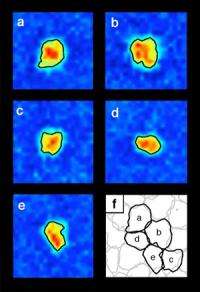
Each neuron in the retina views the world through a small, irregularly shaped window. These regions fit together like pieces of a puzzle, preventing "blind spot" and excessive overlap that could blur our perception of the world. Credit: Image: Courtesy of Dr. Jeffrey Gauthier, Salk Institute for Biological Studies

About 1.25 million neurons in the retina -- each of which views the world only through a small jagged window called a receptive field -- collectively form the seamless picture we rely on to navigate our environment. Receptive fields fit together like pieces of a puzzle, preventing "blind spots" and excessive overlap that could blur our perception of the world, according to researchers at the Salk Institute for Biological Studies.

In the April 7 issue of the journal Public Library of Science, Biology, the scientists say their findings suggest that the nervous system operates with higher precision than previously appreciated and that apparent irregularities in individual may actually be coordinated and finely tuned to make the most of the world around us.

Previously, the observed irregularities of individual receptive fields suggested that the collective visual coverage might be uneven and irregular, potentially posing a problem for high-resolution vision. "The striking coordination we found when we examined a whole population indicated that neuronal circuits in the may sample the visual scene with high precision, perhaps in a manner that approaches the optimum for high-resolution vision," says senior author E.J. Chichilnisky, Ph.D., an associate professor in the Systems Neurobiology Laboratories.

All reaching the brain is transmitted by retinal ganglion cells. Each of the 20 or so distinct ganglion cell types is thought to transmit a complete visual image to the brain, because the receptive fields of each type form a regular lattice covering visual space. However, within each regular lattice, the individual cells' receptive fields have irregular and inconsistent shapes, which could potentially result in patchy coverage of the visual field.

To understand how the visual system overcomes this problem, postdoctoral researcher and first author Jeffrey L. Gauthier, Ph.D., used a microscopic electrode array to record the activity of ganglion cells in isolated patches of retina, the tissue lining the back of the eye.

After monitoring hundreds of ganglion cells over several hours, he distinguished between different cell types based on their light response properties. "Often people record from many cells simultaneously but they don't know which cell belongs to which type," says Gauthier. Without this information, he says, he wouldn't have been able to observe that the receptive fields of neighboring cells of a specific type interlock, complementing each others' irregular shapes.

"The receptive fields of all four cell types we examined were precisely coordinated," he says, "but we saw no coordination between cells of different types, emphasizing the importance of clearly distinguishing one cell type from another when studying sensory encoding by a population of neurons."

Source: Salk Institute (news : web)


print this article email this article download pdf blog this article bookmark this article     Stumble it Digg this share on Facebook retweet share on Reddit add to delicious
Rate this story - 5 /5 (3 votes)

Rank Filter

Move the slider to adjust rank threshold, so that you can hide some of the comments.


Display comments: newest first

  • Stein - Apr 07, 2009
    • Rank: not rated yet
    Hello Dr Jefferey

    Very Interesting!

    Does that mean that the each different type or shape responds to a different light frequency?

    What frequencies are associated with each type or shape.

    Are the discs of each shape made from different chemical compositions?

    If so what elements are present in the molecules of the receptor discs of a, b, c, d and e neurons?

    Cheers Zwei Stein

April 7, 2009 all stories

Comments: 1

5 /5 (3 votes)
  • Stumble this up

  • Digg this

  • share this

  • hide
  • Related Stories

  • New Type of Retinol Cell Discovered in Primates
    created Oct 30, 2007 | popularity not rated yet | comments 0
  • How Much the Eye Tells the Brain
    created Jul 26, 2006 | popularity not rated yet | comments 0
  • Discovery of retinal cell type ends 4-decade search
    created Oct 09, 2007 | popularity not rated yet | comments 0
  • Cells with double vision: How one and the same nerve cell reacts to two visual areas
    created Feb 17, 2009 | popularity not rated yet | comments 0
  • Distinguishing between 2 birds of a feather
    created Aug 08, 2008 | popularity not rated yet | comments 0


  • hide
  • Relevant PhysicsForums posts

  • Improving the brain through chemistry
    created Nov 07, 2009
  • Sleep / REM Sleep and homeostasis
    created Nov 07, 2009
  • The Biceps Reflex
    created Nov 05, 2009
  • Consequenses of striking a Vein and an artery?
    created Nov 05, 2009
  • More from Physics Forums - Medical Sciences

Other News

The upside of feeling down

The upside of feeling down

Medicine & Health / Psychology & Psychiatry

created 3 hours ago | popularity 3 / 5 (2) | comments 1

A chill wind chases you into the door of your local newsagent. Rain is drumming down outside. As you pay for your newspaper, you briefly notice a number of strange items on the checkout counter - a matchbox ...


Implantable Glucose Sensor Could Spell Relief for Millions of Diabetics (w/ Video)

Implantable Glucose Sensor Could Spell Relief for Millions of Diabetics (w/ Video)

Medicine & Health / Research

created 4 hours ago | popularity not rated yet | comments 0

(PhysOrg.com) -- UConn researchers have developed a tiny wireless device that can be inserted under a patient?s skin to monitor blood glucose levels over a period of several months.


Words, gestures are translated by same brain regions, says new research

Medicine & Health / Neuroscience

created 8 hours ago | popularity 5 / 5 (2) | comments 0

Your ability to make sense of Groucho's words and Harpo's pantomimes in an old Marx Brothers movie takes place in the same regions of your brain, says new research funded by the National Institute on Deafness and Other Communication ...


Diet switching can activate brain's stress system, lead to 'withdrawal' symptoms

Medicine & Health / Research

created 5 hours ago | popularity not rated yet | comments 0

In research that sheds light on the perils of yo-yo dieting and repeated bouts of sugar-bingeing, researchers from The Scripps Research Institute have shown in animal models that cycling between periods of eating sweet and ...


Mood improves on low-fat, but not low-carb, diet plan

Medicine & Health / Health

created 6 hours ago | popularity 5 / 5 (1) | comments 0

After one year, a low-calorie, low-fat diet appears more beneficial to dieters' mood than a low-carbohydrate plan with the same number of calories, according to a report in the November 9 issue of Archives of Internal Me ...