Quake predictability still distant dream, say seismologists
April 7, 2009 by Richard Ingham and Anne Chaon No proven method exists to accurately predict earthquakes, seismologists said

Enlarge

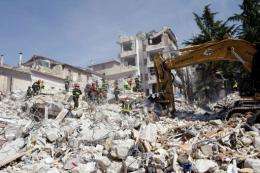
Rescuers search the remains of a building that collapsed in the earthquake in the Italian city of L'Aquila, on April 07, 2009. Claims by an Italian technician to have foretold the devastating quake prompted seismologists on Tuesday to shake their heads in sadness and skepticism.

Claims by an Italian technician to have foretold the devastating quake which struck central Italy prompted seismologists on Tuesday to shake their heads in sadness and skepticism.

No proven method exists, they said, for predicting earthquakes with any accuracy -- and the best way to save lives from Earth's wrath is to beef up construction standards and educate people about seismic risk.

"No scientist, as far as I am aware, anywhere around the world, has been able to predict an , in terms of saying exactly, when, where and how big it will be," Brian Baptie, a seismologist with British Geological Survey (BGS) in Edinburgh, told AFP.

"We know where earthquakes occur in certain parts of the world, we know for instance that earthquakes occur down the spine of Italy, in the .

"But saying when and crucially how big they will be is beyond us at the moment. Prediction at the moment is just not possible."

Hours after the quake struck Italy's Abruzzo region on Monday, inflicting a death toll that on Tuesday rose beyond the 200 mark, Giampaolo Giuliani, a technician at the National Institute of Astrophysics, unleashed a storm.

He said he had predicted the event by detecting a surge in emissions of gas that leaked from stressed rocks, but his warning had been stifled by the authorities.

Remy Bossu, a researcher at the European-Mediterranean Seismological Centre (EMSC), said the idea of using radon, a radioactive gas naturally sequestered by certain rocks, as a telltale for impending quakes dated back to the 1970s.

"So far, nothing has been proven," he said.

"You have to know exactly what you are measuring," he said. "Radon emissions depend on many factors. For instance, if atmospheric pressure falls, it's easier for radon to escape from the earth's crust. It's very difficult to make a coherent comparison of emission levels."

"There are lots of people who are looking at radon levels in the world, and so far they have not been able to establish a correlation" with earthquake occurrence, said Yann Kinger of the Institute for the Physics of the Globe in Paris (IPGP).

In Monday's quake, "something must have happened in the Earth's crust for the radon concentrations to have changed," he said. "But was it pure coincidence that the earthquake happened just afterwards, or was there a connection?"

Other prediction methods that have been tried, tested and found flawed include using geo-electric sensors to measure large induced currents of electricity in rocks; monitoring flows of groundwater in seismic zones; and even using animals as zoological soothsayers.

Sometimes intriguing data emerge, but they have never developed into anything of use.

"To evacuate a civilian population, you have to know with high accuracy and reliability where the quake is going to occur, its magnitude and when it's going to happen," said Bossu.

"In addition, you have to be warned sufficiently early to get things organised. You don't evacuate a city in just 20 minutes."

At present, all seismologists can do is warn that a well-researched seismic zone is at risk of a bust at some point in coming years or decades.

Baptie said the picture was not entirely pessimistic.

More knowledge was accumulating as to how a major quake transmits energy to other parts of Earth's crust, building up pressure -- and thus the likelihood of a fault rupture -- elsewhere.

In long faults, this "domino" effect was demonstrated after the December 26, 2004 earthquake that unleashed the Indian Ocean tsunami.

Within months, it was followed, as predicted by Northern Ireland seismologist John McCloskey, by another massive temblor along the same fault west of Sumatra.

In the absence of a predictive tool, Baptie pleaded for strengthening and enforcing building standards and educating people in seismic zones about the danger.

"The type of places that are really at risk are these mega-cities in developing countries," he said. "They are at serious risk of a large earthquake that could cause a huge amount of damage."

(c) 2009 AFP


print this article email this article download pdf blog this article bookmark this article     Stumble it Digg this share on Facebook retweet share on Reddit add to delicious
Rate this story - 2 /5 (2 votes)

Rank Filter

Move the slider to adjust rank threshold, so that you can hide some of the comments.


Display comments: newest first

  • am_Unition - Apr 07, 2009
    • Rank: 2 / 5 (1)
    I think we all understand just how important science is when human lives are on the table. Research on earthquake prediction receives nowhere near enough funding in consideration of what can be gained from refining our abilities to recognize warning signs.

    Google "earthquake precursor VLF ionosphere" and behold a wealth of studies indicating the proper avenues for pursuing quake predictions.
  • THEY - Apr 07, 2009
    • Rank: 2 / 5 (1)
    ==="No scientist, as far as I am aware, anywhere around the world, has been able to predict an earthquake, in terms of saying exactly, when, where and how big it will be," Brian Baptie, a seismologist with British Geological Survey (BGS) in Edinburgh, told AFP.===
    ==="To evacuate a civilian population, you have to know with high accuracy and reliability where the quake is going to occur, its magnitude and when it's going to happen," said Bossu.===


    Of course you can't predict an earthquake with 100% certainty. Nor do you want to cause panic amongst the public, but if you do it properly, you can definitely warn people of heightened risk. I wouldn't pull my kid from school, leave my job and run to the hills if someone said we could have an earthquake, but I definitely would make sure my car was full of gas, and make sure I have enough perishable food for a few days. And avoid the high death risk areas for sure!

    There are MANY indicators. But since no one can predict with 100% certainty, they brush it off. This is pure ignorance. They SHOULD offer this man an apology.
  • weewilly - Apr 07, 2009
    • Rank: 2 / 5 (1)
    What a shame to have these things occur and take us by surprise. We need so much more in studying these natural disasters and it begins with prioritizing our allocations of manpower and monies. Since earthquakes are found all over the world but in more concentrated techtonic plate areas that seems to be a good place to stay away from if you can. At least not to move there. I'm listening and looking at the History Channel right now and they are talking about the earthquake history of Los Angeles California. 13 million people live there and they still expect a big one to occur. Well people like to live in big metropolitan areas for work or plearure of the arts etc... Its a gamble isn't it? We haven't done enough sciece to correct, cure or prevent many modern problems we have. Wow, so much work has to be done. When will we do it?
  • out7x - Apr 09, 2009
    • Rank: 1 / 5 (1)
    We have the technology to predict quakes. Multi-component geophones, 3D seismic arrays, geomechanical measurements in wells. Stress fields can be measured. The cost is the obstacle.

April 7, 2009 all stories

Comments: 4

2 /5 (2 votes)
  • Stumble this up

  • Digg this

  • share this

  • hide
  • Related Stories

  • Mountain spine is a quake hotspot
    created Apr 06, 2009 | popularity not rated yet | comments 0
  • New hazard estimates could downplay quake dangers
    created Apr 16, 2008 | popularity not rated yet | comments 0
  • Prelude to an earthquake?
    created Dec 09, 2005 | popularity not rated yet | comments 0
  • Ill. earthquake a wake-up call
    created Apr 20, 2008 | popularity not rated yet | comments 0
  • Earthquake in Illinois could portend an emerging threat
    created Apr 24, 2008 | popularity not rated yet | comments 0


  • hide
  • Relevant PhysicsForums posts

  • The IPCC and the term "most"
    created 12 hours ago
  • Is global warming a fact?
    created 13 hours ago
  • Random variability of wind patterns
    created Nov 23, 2009
  • Record precipitation in the UK
    created Nov 22, 2009
  • How to move cloud from one time to another..
    created Nov 22, 2009
  • Which countries around the world cause the most destruction to the rain forest
    created Nov 21, 2009
  • More from Physics Forums - Earth

Other News

New computer-developed map shows more extensive valley network on Mars

New computer-developed map shows more extensive valley network on Mars

Space & Earth / Space Exploration

created 12 hours ago | popularity 4.5 / 5 (8) | comments 0

New research adds to the growing body of evidence suggesting the Red Planet once had an ocean.


Supervolcano eruption -- in Sumatra -- deforested India 73,000 years ago

Supervolcano eruption -- in Sumatra -- deforested India 73,000 years ago

Space & Earth / Earth Sciences

created 14 hours ago | popularity 4.3 / 5 (10) | comments 2

A new study provides "incontrovertible evidence" that the volcanic super-eruption of Toba on the island of Sumatra about 73,000 years ago deforested much of central India, some 3,000 miles from the epicenter, ...


Is global warming unstoppable?

Space & Earth / Environment

created 23 hours ago | popularity 3.9 / 5 (25) | comments 25

In a provocative new study, a University of Utah scientist argues that rising carbon dioxide emissions - the major cause of global warming - cannot be stabilized unless the world's economy collapses or society builds the ...


Spitzer Telescope Observes Baby Brown Dwarf

Spitzer Telescope Observes Baby Brown Dwarf

Space & Earth / Astronomy

created 11 hours ago | popularity 4.9 / 5 (8) | comments 0

(PhysOrg.com) -- NASA's Spitzer Space Telescope has contributed to the discovery of the youngest brown dwarf ever observed -- a finding that, if confirmed, may solve an astronomical mystery about how these ...


Scientist: Leak of climate e-mails appalling

Space & Earth / Environment

created 17 hours ago | popularity 3.2 / 5 (10) | comments 8

(AP) -- A leading climate change scientist whose private e-mails are included in thousands of documents that were stolen by hackers and posted online said Sunday the leaks may have been aimed at undermining next month's ...