Altered gene can increase risk of schizophrenia
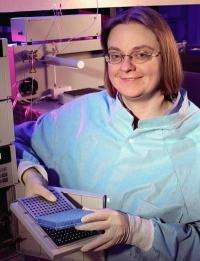
(PhysOrg.com) -- Rutgers geneticist Linda Brzustowicz and her colleagues have identified a specific DNA change that is likely to increase risk for developing schizophrenia in some people. It provides a potential mechanism that may be a point of entry for drug therapy, consistent with the growing trend of personalized medicine.
The research findings are reported in the April issue of the American Journal of Psychiatry (AJP). An accompanying editorial highlights the significance of this work.
Brzustowicz, a professor of genetics at Rutgers, The State University of New Jersey, and board-certified psychiatrist, said that the research has demonstrated a functional DNA change that increases gene expression. This conclusion is based on its presence in the genes of a Canadian study population of 24 families where multiple individuals had been diagnosed with schizophrenia. The gene in question, NOS1AP, previously known as CAPON, is one which Brzustowicz has been studying for six years.
The paper also presents an innovative statistical method, Posterior Probability of Linkage Disequilibrium (PPLD). This is the work of co-author Veronica Vieland of The Research Institute at Nationwide Children's Hospital, Columbus, Ohio. The new analytical technique quantifies the statistical evidence for association, in this case between the altered gene and schizophrenia. The researchers evaluated 60 variants of the gene or single nucleotide polymorphisms (SNPs).
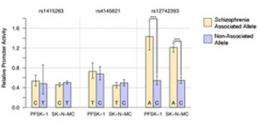
"Our use of the PPLD was really helpful in sorting the evidence. It showed that of the 60 SNPs we were evaluating, three had a much higher probability of association with the illness," Brzustowicz said. "This paved the way for our next step - doing a functional analysis using cells grown in culture - which is much more labor intensive. We had reduced our 60 candidates down to a short list of three, which greatly simplified this next step."
Each of the three candidate SNPs was introduced into separate cultures of identical cloned cells derived from human brain tissue. The cultures differed only in which of the SNP variants was introduced. The challenge was to measure the quantity of overexpression, that is, how much excess protein was being produced by each of the three variants.
To each culture the researchers also added DNA that contained the gene that produces the enzyme which makes a firefly glow, along with human regulatory DNA which would control the production of that enzyme. The three kinds of DNA (the SNP, the firefly and the human regulatory) were all joined together prior to insertion into the brain-derived cells. Thus, the amount of expression of each SNP would be reflected (via the regulatory DNA) in the intensity of the light produced. An instrument known as a luminometer measured the glow produced and showed a dramatic increase in gene expression in one variant over the others. These results echo the increased expression of NOS1AP that has been observed in postmortem brain samples from individuals with schizophrenia.
Bonnie Firestein, a professor in Rutgers' Department of Cell Biology and Neuroscience, though not an author on the AJP paper, is conducting complementary research. She is investigating the consequences of increased expression of the NOS1AP gene. Firestein is looking at this gene in cells in culture and examining how the overexpression of this protein alters the way neurons branch.
Identifying this specific functional genetic variant is an important step, but there are qualifiers. Schizophrenia is not a single-gene disorder, and there are environmental factors that are also important. "It is not as though, if you have this altered gene, you will get the disease," said Brzustowicz.
The frequency of this variant in the general population is more than 40 percent. Approximately 1 percent of the general population has schizophrenia but not all of those with the illness will have this altered gene. Brzustowicz estimates that the frequency of the altered gene in people with schizophrenia is going to be higher than the average in the general population. For example, the frequency of this variant in people with schizophrenia in the Canadian families is 55 percent.
To refine this estimate, Brzustowicz and her team will be looking at the altered gene's frequency in DNA samples from the National Institute of Mental Health collection of cell lines housed in the Rutgers University Cell and DNA Repository. The collection includes samples drawn from large populations of Asian, Caucasian, African American and Hispanic individuals with schizophrenia.
Source: Rutgers University (news : web)


