Tiny super-plant can clean up animal waste, be used for ethanol production
April 7, 2009
Tiny super-plant can clean up animal waste and be used for ethanol production

Enlarge

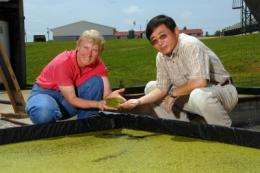
Drs. Anne Stomp and Jay Cheng pose at a test facility where they have been growing duckweed using animal wastewater. Credit: Roger W. Winstead, North Carolina State University

Researchers at North Carolina State University have found that a tiny aquatic plant can be used to clean up animal waste at industrial hog farms and potentially be part of the answer for the global energy crisis. Their research shows that growing duckweed on hog wastewater can produce five to six times more starch per acre than corn, according to researcher Dr. Jay Cheng. This means that ethanol production using duckweed could be "faster and cheaper than from corn," says fellow researcher Dr. Anne-Marie Stomp.

"We can kill two birds - biofuel production and wastewater treatment - with one stone - duckweed," Cheng says. Starch from duckweed can be readily converted into ethanol using the same facilities currently used for corn, Cheng adds.

Corn is currently the primary crop used for in the United States. However, its use has come under fire in recent years because of concerns about the amount of energy used to grow corn and commodity price disruptions resulting from competition for corn between ethanol manufacturers and the food and feed industries. Duckweed presents an attractive, non-food alternative that has the potential to produce significantly more ethanol feedstock per acre than corn; exploit existing corn-based ethanol production processes for faster scale-up; and turn pollutants into a fuel production system. The duckweed system consists of shallow ponds that can be built on land unsuitable for conventional crops, and is so efficient it generates water clean enough for re-use. The technology can utilize any nutrient-rich wastewater, from livestock production to municipal wastewater.

Large-scale hog farms manage their animal waste by storing it in large "lagoons" for biological treatment. Duckweed utilizes the nutrients in the wastewater for growth, thus capturing these nutrients and preventing their release into the environment. In other words, Cheng says, "Duckweed could be an environmentally friendly, economically viable feedstock for ethanol."
Tiny super-plant can clean up animal waste and be used for ethanol production
Enlarge

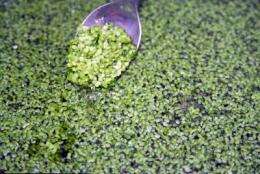
The tiny duckweed plant not only cleans up waste from industrial farms, but produces five to six times more starch per acre than corn. Starch is what is used to produce ethanol. Credit: Mike Yablonski

"There's a bias in agriculture that all the crops that could be discovered have been discovered," Stomp says, "but duckweed could be the first of the new, 21st century crops. In the spirit of George Washington Carver, who turned peanuts into a major crop, Jay and I are on a mission to turn duckweed into a new industrial crop, providing an innovative approach to alternative fuel production."

Cheng, a professor of biological and agricultural engineering, co-authored the research with Stomp, associate professor of forestry, and post-doctoral research associate, Mike Yablonski. The research, which is funded by the North Carolina Biofuels Center, was presented March 21 at the annual conference of the Institute of Biological Engineering in Santa Carla, Calif.

Cheng and Stomp are currently establishing a pilot-scale project to further investigate the best way to establish a large-scale system for growing duckweed on animal wastewater, and then harvesting and drying the duckweed.

Source: North Carolina State University

Filter


Move the slider to adjust rank threshold, so that you can hide some of the comments.


Display comments: newest first

moj85
Apr 07, 2009

Rank: not rated yet
Interestingly delicious. But can farmers 'grow' their own crop of Duckweed and sell it? Or would this be a combined facility that takes shipped animal wastewater?
Sean_W
Apr 07, 2009

Rank: not rated yet
If this plant uses up the nutrients more quickly does that mean the waste ponds would cause less of an odor problem?
jimbo92107
Apr 07, 2009

Rank: 5 / 5 (1)
Gol Dang it! Who threw duckweed in my hog water?
MadLintElf
Apr 07, 2009

Rank: 5 / 5 (2)
Duckweed is all over, just stop by a local pond in the summer. Grows very fast, and is easy to care for (you do nothing).

As for the odor problem, the plant lives off the organic waste, so as a result the odor would be less.

Additionally, the duck weed serves as a cover for the pond, reducing evaporation (and hence the odor).

HarshMistress
Apr 07, 2009

Rank: not rated yet
What about winter?
rwlent
Apr 07, 2009

Rank: 5 / 5 (1)
This system is incomplete. First run your hog wastes through biodigesters so as not to waste the energy. This produces biogas, mainly methane, and a solution with all the original fertility of the hog wastes. Now grow the duckweed. Ferment the duckweed to get ethanol then feed the wastes from the fermentation to animals, probably hogs. Now pass the hog wastes back to the biodigester. Elegant, no?

R. Lent
rwlent
Apr 07, 2009

Rank: not rated yet
Note: Duckweed is a tiny, floating, flowering plant, not an algae.

R Lent
nkalanaga
Apr 07, 2009

Rank: not rated yet
I like your idea. True recycling! Since the waste from corn ethanol production is used as livestock feed, there's no reason the waste from duckweed shouldn't work as well.
rwlent
Apr 08, 2009

Rank: not rated yet
Since the wastes from any ethanol fermentation process contains great amounts of yeast cells, it's a great animal feed.
Sonhouse
Apr 11, 2009

Rank: not rated yet
What happens if the world turns vegan?
JDB
Apr 15, 2009

Rank: not rated yet
World turning Vegan?

rwlent's suggestion will work on human waste as well, I'm sure...

"Awwww, Mom, recycled wastewater and duckweed starch for dinner again!?!"
Rank 5 /5 (18 votes)
Relevant PhysicsForums posts
  • AAS or Colorimeter method to determine zinc in a plant.
    createdFeb 11, 2012
  • Stoichiometry
    createdFeb 10, 2012
  • Boiling and melting point of impure substances
    createdFeb 10, 2012
  • Safe nitrogen compound to decompose a 500 deg C in a furnace?
    createdFeb 09, 2012
  • [ask]electron inside drinking water
    createdFeb 08, 2012
  • How to avoid formation of Lithium Chromate ???
    createdFeb 08, 2012
  • More from Physics Forums - Chemistry

More news stories

Hydrogen from acidic water: Researchers develop potential low cost alternative to platinum for splitting water

A technique for creating a new molecule that structurally and chemically replicates the active part of the widely used industrial catalyst molybdenite has been developed by researchers with the Lawrence Berkeley ...

Chemistry / Materials Science

created Feb 09, 2012 | popularity 4.8 / 5 (15) | comments 21 | with audio podcast

Fool's gold may prove an unlikely alternative to overexploited catalytic materials

Catalytic materials, which lower the energy barriers for chemical reactions, are used in everything from the commercial production of chemicals to catalytic converters in car engines. However, with current catalytic materials ...

Chemistry / Materials Science

created Feb 10, 2012 | popularity 4.4 / 5 (8) | comments 8 | with audio podcast

Research provides octagonal window of opportunity for carbon capture

(PhysOrg.com) -- Filtering carbon dioxide, a greenhouse gas, from factory smokestacks is a necessary, but expensive part of many manufacturing processes. However, a collaborative research team from the National ...

Chemistry / Materials Science

created Feb 08, 2012 | popularity 5 / 5 (1) | comments 5 | with audio podcast

Flexible paper robots

(PhysOrg.com) -- These inexpensive robots can stretch, bend and twist under control, and lift objects up to 120 times their own weight. Being soft, they can apply gentle and even pressure, and adapt to varied ...

Chemistry / Materials Science

created Feb 09, 2012 | popularity 5 / 5 (5) | comments 4 | with audio podcast

New form of hafnium oxide developed

(PhysOrg.com) -- A novel material developed by researchers at the University of Cambridge is opening up new possibilities for next generation electronic and optoelectronic devices, and paving the way for further ...

Chemistry / Materials Science

created Feb 07, 2012 | popularity 4.6 / 5 (5) | comments 4 | with audio podcast


Google might launch Drive for cloud storage soon

(PhysOrg.com) -- Google's next big move, according to the Wall Street Journal, is a cloud storage service called Drive. Hardly first to the plate, Google is simply catching up to introducing its cloud reposi ...

Latin America mining boom clashes with conservation

Latin America is experiencing a mining boom as prices rise fuelled by a hike in global demand, but the region is also being hit by a wave of violent protests, strikes and rallies by environmentalists.

Walney offshore wind farm is world's biggest (for now)

(PhysOrg.com) -- The Walney wind farm on the Irish Sea--characterized by high tides, waves and windy weather--officially opened this week. The farm is treated in the press as a very big deal as the Walney ...

Love a click away in Indonesia's Twitter Republic

He was a geeky kid from Yogyakarta, she a glamorous city girl in Jakarta. In a country with one of the world's most vibrant social networking scenes they fell in love on Twitter.

GPS court ruling leaves US phone tracking unclear

A US Supreme Court decision requiring a warrant to place a GPS device on the car of a criminal suspect leaves unresolved the bigger issue of police tracking using mobile phones, legal experts say.

Europeans protest controversial Internet pact

Tens of thousands of people marched in protests in more than a dozen European cities Saturday against a controversial anti-online piracy pact that critics say could curtail Internet freedom.