New security and medical sensor devices made possible by metallic nanostructures
April 7, 2009 New security and medical sensor devices made possible by metallic nanostructures

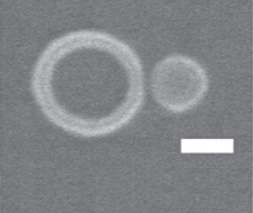
An image of the metallic ring and disk. The scale bar shows 200 nanometres.

(PhysOrg.com) -- Scientists have designed tiny new sensor structures that could be used in novel security devices to detect poisons and explosives, or in highly sensitive medical sensors, according to research published tomorrow (8 April) in Nano Letters.

The new 'nanosensors', which are based on a fundamental science discovery in UK, Belgian and US research groups, could be tailor-made to instantly detect the presence of particular molecules, for example poisons or explosives in transport screening situations, or proteins in patients' blood samples, with high sensitivity.

The researchers were led by Imperial College London physicists funded by the Engineering and Physical Sciences Research Council. The team showed that by putting together two specific 'nanostructures' made of gold or silver, they can make an early prototype device which, once optimised, should exhibit a highly sensitive ability to detect particular chemicals in the immediate surroundings.

The nanostructures are each about 500 times smaller than the width of a human hair. One is shaped like a flat circular disk while the other looks like a doughnut with a hole in the middle. When brought together they interact with very differently to the way they behave on their own. The scientists have observed that when they are paired up they scatter some specific colours within white light much less, leading to an increased amount of light passing through the structure undisturbed. This is distinctly different to how both structures separately. This decrease in the interaction with light is in turn affected by the composition of molecules in close proximity to the structures. The researchers hope that this effect can be harnessed to produce sensor devices.

Lead researcher on the project Professor Stefan Maier from Imperial's Department of Physics, and an Associate of Imperial's Institute for Security Science and Technology, said:

"Pairing up these structures has a unique effect on the way they scatter light - an effect which could be very useful if, as our computer simulations suggest, it is extremely sensitive to changes in surrounding environment. With further testing we hope to show that it is possible to harness this property to make a highly sensitive nanosensor."

Metal nanostructures have been used as before, as they interact very strongly with light due to so-called localised plasmon resonances. But this is the first time a pair with such a carefully tailored interaction with light has been created.

The device could be tailored to detect different chemicals by decorating the nanostructure surface with specific 'molecular traps' that bind the chosen target molecules. Once bound, the target molecules would change the colours that the device absorbs and scatters, alerting the sensor to their presence. The team's next step is to test whether the pair of nanostructures can detect chosen substances in lab experiments.

Professor Maier concludes: "This study is a beautiful example of how concepts from different areas of physics fertilise each other - in essence our nanosensor system is a classical analogue of electromagnetically induced transparency, a famous phenomenon from quantum mechanics."

Source: Imperial College London (news : web)


print this article email this article download pdf blog this article bookmark this article     Stumble it Digg this share on Facebook retweet share on Reddit add to delicious
Rate this story - not rated yet


April 7, 2009 all stories

Comments: 0

not rated yet
  • Stumble this up

  • Digg this

  • share this

  • hide
  • Related Stories

  • Gold, DNA Combination May Lead To Nano-Sensor
    created Jul 01, 2008 | popularity not rated yet | comments 0
  • 'T-ray' breakthrough signals next generation of security sensors
    created Feb 05, 2008 | popularity not rated yet | comments 0
  • Researchers Create DNA-Based Sensors for Nano-Tongues and Nano-Noses
    created Sep 15, 2005 | popularity not rated yet | comments 0
  • NASA Nanotechnology Space Sensor Test Successful in Orbit
    created Jun 18, 2007 | popularity not rated yet | comments 0
  • Study shows nanoshells ideal as chemical nanosensors
    created Jan 11, 2005 | popularity not rated yet | comments 0


  • hide
  • Relevant PhysicsForums posts

  • Light velocity, wavelength, and frequency
    created 6 hours ago
  • knowledge of physics advances
    created 7 hours ago
  • Gravitation and Electromagnetism
    created 8 hours ago
  • Electric field between 2 plates
    created 9 hours ago
  • More from Physics Forums - General Physics

Other News

Understanding mechanical properties of silicon nanowires paves way for nanodevices

Understanding mechanical properties of silicon nanowires paves way for nanodevices

Nanotechnology / Nanomaterials

created 5 hours ago | popularity 5 / 5 (1) | comments 0

Silicon nanowires are attracting significant attention from the electronics industry due to the drive for ever-smaller electronic devices, from cell phones to computers. The operation of these future devices, ...


carbon fiber

Ultra-Long Carbon Nanotubes Could Serve as Future Transmission Lines

Nanotechnology / Nanomaterials

created Nov 10, 2009 | popularity 4.8 / 5 (19) | comments 13

(PhysOrg.com) -- When it comes to carbon nanotubes, the majority of research so far has focused on small-scale applications. But now, a team of researchers from Rice University has created carbon nanotubes ...


Argonne 'homegrown' hybrid solar cell aims for low-cost power

Argonne 'homegrown' hybrid solar cell aims for low-cost power

Nanotechnology / Nanomaterials

created Nov 10, 2009 | popularity 4 / 5 (9) | comments 3

(PhysOrg.com) -- Scientists at the U.S. Department of Energy’s (DOE) Argonne National Laboratory have refined a technique to manufacture solar cells by creating tubes of semiconducting material and then "growing" ...


New Digital 'Electronics' Concept May Continue Moore's Law

New Digital 'Electronics' Concept May Continue Moore's Law

Nanotechnology / Nanophysics

created Nov 05, 2009 | popularity 4.6 / 5 (62) | comments 9

(PhysOrg.com) -- Computers of the future could be operating not on electrons, but on tiny waves traveling through an electron "fluid," if a new proposal is successful. The new circuit design, recently introduced ...


Research helps overcome barrier for organic electronics

Research helps overcome barrier for organic electronics

Nanotechnology / Nanomaterials

created Nov 10, 2009 | popularity 4.9 / 5 (8) | comments 0

(PhysOrg.com) -- Electronic devices can't work well unless all of the transistors, or switches, within them allow electrical current to flow easily when they are turned on. A team of engineers has determined ...