Largest Attempt in History to Understand Tornadoes Slated to Begin
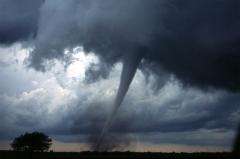
April 7, 2009 tornado

Image: U.S. National Oceanic and Atmospheric Administration, via Wikimedia

An ambitious project to explore the origin, structure and evolution of tornadoes will take place from May 10-June 13, 2009, across the central United States.

The project, VORTEX2 (V2), is the largest attempt in history to study tornadoes, and will involve more than 50 scientists and 40 research vehicles, including 10 mobile radars.

Verification Of Rotation in Tornadoes EXperiment 2 (VORTEX2) is funded by the National Science Foundation (NSF) and the National Oceanic and Atmospheric Administration (NOAA), and involves scientists from NOAA, 10 universities and three non-profit organizations.

Researchers will sample the super-cell thunderstorms that often form over more than 900 miles of the central Great Plains.

Areas of focus include southern South Dakota, western Iowa, eastern Colorado, Nebraska, Kansas, the Texas panhandle and western Oklahoma.

"An important finding from the original VORTEX experiment was that tornadoes happen on smaller time and space scales than scientists had thought," said Stephan Nelson, NSF program director for physical and dynamic meteorology.

"New advances from VORTEX2 will allow for a more detailed sampling of a storm's wind, temperature and moisture environment, and lead to a better understanding of why tornadoes form--and how they can be more accurately predicted."

The original VORTEX program, operated in the central Great Plains during 1994 and 1995, documented the entire life cycle of a tornado for the first time in history.

Recent improvements in severe weather warning statistics may be partly due to the application of VORTEX findings.

V2 will build on the progress made during VORTEX and further improve tornado warning skills and short-term severe weather forecasts.

Data collected from VORTEX2 will help researchers understand how the large-scale environment of thunderstorms is related to tornado formation, according to Louis Wicker, meteorologist at NOAA's National Severe Storms Laboratory and a V2 co-principal investigator.

Participating scientists and students are from organizations throughout the United States and three countries, including the Center for Severe Weather Research, Rasmussen Systems, NOAA National Severe Storms Laboratory, OU/NOAA Cooperative Institute for Mesoscale Meteorological Studies, NSF-sponsored National Centers for Atmospheric Research, Penn State University, University of Oklahoma, Texas Tech University, Lyndon State College, University of Colorado, Purdue University, North Carolina State University, University of Illinois, University of Massachusetts, University of Nebraska, and Environment Canada and the Australian Bureau of Meteorology.

Provided by NSF


print this article email this article download pdf blog this article bookmark this article     Stumble it Digg this share on Facebook retweet share on Reddit add to delicious
Rate this story - 4.3 /5 (4 votes)

Rank Filter

Move the slider to adjust rank threshold, so that you can hide some of the comments.


Display comments: newest first

  • mharratsc - Apr 07, 2009
    • Rank: 1 / 5 (1)
    "New advances from VORTEX2 will allow for a more detailed sampling of a storm's wind, temperature and moisture environment, and lead to a better understanding of why tornadoes form--and how they can be more accurately predicted."

    I'm sure there is NO chance that they will measure voltage equalization between the foul weather field and the upper atmosphere, so all of their attempts towards "understanding" are once again going to leave them "surprised by the results of their experiments"... sigh.

April 7, 2009 all stories

Comments: 1

4.3 /5 (4 votes)
  • Stumble this up

  • Digg this

  • share this

  • hide
  • Related Stories

  • Rapid-Scanning Doppler on Wheels Keeps Pace with Twisters
    created Jun 01, 2005 | popularity not rated yet | comments 0
  • Scientists Unravel Midwest Tornado Formation
    created Apr 01, 2005 | popularity not rated yet | comments 0
  • Scientists Unravel Midwest Tornado Formation
    created Nov 08, 2005 | popularity not rated yet | comments 0
  • Deadly storms underscore new research finding: Mid-South is most vulnerable region to tornadoes
    created Feb 08, 2008 | popularity not rated yet | comments 0
  • Study: New radar system cut tornado deaths
    created Jun 29, 2005 | popularity not rated yet | comments 0


  • hide
  • Relevant PhysicsForums posts

  • The IPCC and the term "most"
    created Nov 23, 2009
  • Is global warming a fact?
    created Nov 23, 2009
  • Random variability of wind patterns
    created Nov 23, 2009
  • Record precipitation in the UK
    created Nov 22, 2009
  • More from Physics Forums - Earth

Other News

No Wheel Stall in Diagnostic Drive

Spirit Mars Rover: No Wheel Stall in Diagnostic Drive

Space & Earth / Space Exploration

created 3 hours ago | popularity 5 / 5 (1) | comments 0

(PhysOrg.com) -- On Sol 2095 (Tuesday, Nov. 24), Spirit performed a set of diagnostic actions related to a stall of the right-rear wheel on the previous drive, three days earlier.


Monster Waves on the Sun are Real

Monster Waves on the Sun are Real (w/ Video)

Space & Earth / Astronomy

created 2 hours ago | popularity 5 / 5 (6) | comments 0

Sometimes you really can believe your eyes. That's what NASA's STEREO (Solar Terrestrial Relations Observatory) spacecraft are telling researchers about a controversial phenomenon on the sun known as the "solar ...


Cosmic 'dig' reveals vestiges of the Milky Way's building blocks

Cosmic 'Dig' Reveals Vestiges of the Milky Way's Building Blocks

Space & Earth / Astronomy

created 7 hours ago | popularity 5 / 5 (11) | comments 1

(PhysOrg.com) -- Peering through the thick dust clouds of our galaxy's "bulge" (the myriads of stars surrounding its center), a team of astronomers has unveiled an unusual mix of stars in the stellar grouping ...


Oceanic crust formation is dynamic after all

Oceanic crust formation is dynamic after all

Space & Earth / Earth Sciences

created 6 hours ago | popularity 4.5 / 5 (2) | comments 0

Imagine the Earth's crust as the planet's skin: Some areas are old and wrinkled while others have a fresher, more youthful sheen, as if they had been regularly lathered with lotion.


Climate experts debate strategies for reducing atmospheric carbon and future warming

Climate experts debate strategies for reducing atmospheric carbon and future warming

Space & Earth / Environment

created 3 hours ago | popularity 3 / 5 (4) | comments 2

(PhysOrg.com) -- Reducing carbon dioxide to safe levels may require extracting carbon from the air, says Cornell climate researcher.