Nanofarming technology harvest biofuel oils without harming algae
April 7, 2009
Nanofarming technology harvest biofuel oils without harming algae

Enlarge

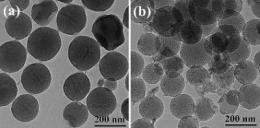
This micrograph shows the sponge-like mesoporous nanoparticles developed by researchers at Ames Laboratory to harvest biofuel oils from algae without harming the organisms. Credit: U.S. Dept. of Energy's Ames Laboratory

Algae is widely touted as the next best source for fueling the world's energy needs. But one of the greatest challenges in creating biofuels from algae is that when you extract the oil from the algae, it kills the organisms, dramatically raising production costs. Now researchers at the U.S. Department of Energy's Ames Laboratory and Iowa State University have developed groundbreaking "nanofarming" technology that safely harvests oil from the algae so the pond-based "crop" can keep on producing.

Commercialization of this new technology is at the center of a Cooperative Research and Development Agreement between the Ames Laboratory and Catilin, a nano-technology-based company that specializes in production. The agreement targets development of this novel approach to reduce the cost and of the industrial processing of non- food source biofuel feedstock. The three-year project is being funded with $885,000 from DOE's Office of Energy Efficiency and Renewable Energy, and $216,000 from Catilin and $16,000 from Iowa State University in matching funds.

The so-called "nanofarming" technology uses sponge-like mesoporous to extract oil from the . The process doesn't harm the algae like other methods being developed, which helps reduce both production costs and the production cycle. Once the algal oil is extracted, a separate and proven solid catalyst from Catilin will be used to produce ASTM (American Society for Testing and Materials) and EN certified biodiesel.
Nanofarming technology harvest biofuel oils without harming algae
Enlarge

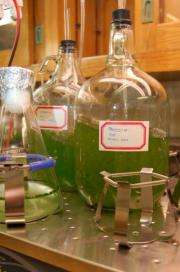
Researchers at the Ames Laboratory are growing several strains of algae to test nanofarming technology that uses sponge-like mesoporous nanoparticles to extract biofuel oils from the organisms. Credit: U.S. Dept. of Energy's Ames Laboratory

The potential of algae for fuel is tremendous as up to 10,000 gallons of oil may be produced on a single acre of land. The DOE estimates that if algae fuel replaced all the petroleum fuel in the United States, it would require only 15,000 square miles, which is a few thousand square miles larger than Maryland. This is less than one-seventh the area devoted to corn production in the United States in 2000.

The driving force behind this combination of nanotechnology and biofuels is Ames Laboratory Chemical and Biological Sciences Program Director Victor Lin. Since 2000, Lin, who is also a chemistry professor at Iowa State University, has been leading research on using nanotechnology to dramatically change the production process of biodiesel. This successful technology led Lin to found Catilin one and a half years ago.

"By combining nanotechnology, chemistry and catalysis, we have been able to find solutions that have not been considered to date," Lin said. "Ames Laboratory and Iowa State University offer valuable research capabilities and resources that will play a key role in this exciting collaboration with Catilin."

According to Marek Pruski, Ames Laboratory senior physicist and co- investigator on the project, phase one and two of the project will cover the culturing and selection of microalgae as well as the development of the specific nanoparticle-based extraction and catalyst technologies for the removal of algal oil and the production of biodiesel, respectively. Phase three will focus on scale-up of the catalyst and pilot plant testing on conversion to biodiesel.

"When we ultimately put together this exceptional extraction technology with Catilin's existing solid biodiesel catalyst, we will dramatically increase the reality of renewable energy," said Catilin's CEO, Larry Lenhart. "Given the Obama administration's objectives, the timing is perfect."

Source: Ames Laboratory

4.9 /5 (16 votes)  

Filter


Move the slider to adjust rank threshold, so that you can hide some of the comments.


Display comments: newest first

NeilFarbstein
Apr 07, 2009

Rank: 1 / 5 (4)
Kill Algae
solar thermal can supply gigawatts of energy now.
powercosmic
Apr 08, 2009

Rank: 5 / 5 (1)
Neil, slow down there sonny.

Solar thermal may be able to help with the production of liquid fuels but it cannot replace them.

daveib6
Apr 10, 2009

Rank: 5 / 5 (1)
true fossil fuel independence will require all kinds of sustainable energy production, from Solar thermal, photovoltaics, wind, geothermal, algae biofuel, etc. Food based biofuel (e.g. corn) doesn't fit that bill and needs to be ended, but it sounds like algae biofuel just might work.
Rank 4.9 /5 (16 votes)
Relevant PhysicsForums posts
  • Mitosis
    created5 hours ago
  • Stem cell question.
    created6 hours ago
  • Protease cleavage
    created13 hours ago
  • Pertubance in a model
    created19 hours ago
  • Cancer drugs and Alzheimer's, Oh my!
    createdFeb 09, 2012
  • Squishing cells
    createdFeb 09, 2012
  • More from Physics Forums - Biology

More news stories

What lies beneath: Mapping hidden nanostructures

The ability to diagnose and predict the properties of materials is vital, particularly in the expanding field of nanotechnology. Electron and atom-probe microscopy can categorize atoms in thin sheets of material, ...

Nanotechnology / Nanophysics

created 17 hours ago | popularity 5 / 5 (3) | comments 1

New kind of solar cell could capture significantly more energy than current cells

New solar cells could increase the maximum efficiency of solar panels by over 25%, according to scientists from the University of Cambridge.

Nanotechnology / Nanophysics

created Feb 08, 2012 | popularity 4.5 / 5 (12) | comments 14 | with audio podcast

Nanoshell whispering galleries improve thin solar panels

Visitors to Statuary Hall in the U.S. Capitol Building may have experienced a curious acoustic feature that allows a person to whisper softly at one side of the cavernous, half-domed room and for another on ...

Nanotechnology / Nanomaterials

created Feb 07, 2012 | popularity 4.3 / 5 (6) | comments 6 | with audio podcast

'Dark plasmons' transmit energy

Microscopic channels of gold nanoparticles have the ability to transmit electromagnetic energy that starts as light and propagates via "dark plasmons," according to researchers at Rice University.

Nanotechnology / Nanophysics

created Feb 09, 2012 | popularity 4.8 / 5 (9) | comments 1 | with audio podcast

Revealing how a battery material works

Since its discovery 15 years ago, lithium iron phosphate (LiFePO4) has become one of the most promising materials for rechargeable batteries because of its stability, durability, safety and ability to deliver ...

Nanotechnology / Nanomaterials

created Feb 08, 2012 | popularity 5 / 5 (5) | comments 0 | with audio podcast


Anonymous knocks CIA website offline (Update)

The website of the Central Intelligence Agency was inaccessible on Friday after the hacker group Anonymous claimed to have knocked it offline.

New error-correcting codes guarantee the fastest possible rate of data transmission

Error-correcting codes are one of the triumphs of the digital age. They’re a way of encoding information so that it can be transmitted across a communication channel — such as an optical fiber o ...

Humans may have helped the decline of African rainforests 3000 years ago

(PhysOrg.com) -- Large areas of rainforests in Central Africa mysteriously disappeared over three thousand years ago, to be replaced by savannas. The prevailing theory has been that the cause was a change ...

Google users warned of threat to smartphone wallets

Users of Google smartphone wallets were being warned on Friday that there is a way to crack pass codes intended to thwart thieves from going on illicit shopping sprees.

New power source discovered

(PhysOrg.com) -- Researchers at the Massachusetts Institute of Technology (MIT) and RMIT University have made a breakthrough in energy storage and power generation.

Small modular reactor design could be a 'SUPERSTAR'

(PhysOrg.com) -- Though most of today's nuclear reactors are cooled by water, we've long known that there are alternatives; in fact, the world's first nuclear-powered electricity in 1951 came from a reactor ...