Researchers shine light on compact fluorescent bulb problems
April 7, 2009 Queen's researchers shine light on compact fluorescent bulb problems

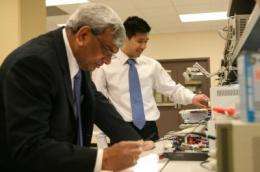
This is Professor Praveen Jain, Electrical and Computer Engineering, and Ph.D. candidate John Lam, Queen's University. Credit: Jeff Drake

Long touted as an energy-saving alternative for home lighting, compact fluorescent lightbulbs (CFLs) now have the potential to be even more efficient, as well as dimmable, thanks to research at Queen's University.

Adopted by householders as a longer-lasting, energy efficient alternative to the traditional incandescent lightbulb, compact fluorescents consume one-third of the and last 1,000 times longer than incandescent bulbs.

However, the Queen's researchers were motivated to solve two problems with CFLs -- they don't work with dimmer switches, and, more importantly, their is compromised because of a problem known as poor power factor. In effect, only part of the energy a CFL consumes is used to power the bulb, resulting in wasted power.

"Consumer-grade CFLs need to be compact and inexpensive. Until now, the complicated circuitry needed to power these bulbs most efficiently has been too large and too costly for consumer-grade compact fluorescents," says professor of Electrical and Computer Engineering Praveen Jain, Canada Research Chair in Power Electronics and a world expert on electronic power supplies. "In its current form, the household CFL takes away the very benefit to the that it was supposed to provide."

The Queen's innovation is timely, Dr. Jain adds, since widespread use of today's less efficient CFLs would reduce expected benefits to the global power grid. Many countries, including Australia and the European Union, have already begun phasing out incandescent bulbs in favor of the compact fluorescents. (Europe and Asia have established minimum standards for power factor for CFLs over 25 watts, but Canada and the U.S., which plan to ban incandescent by 2012, have not.)

The global market for compact fluorescents is estimated at $80 billion.

The poor power factor already has had an impact on commercial users of CFLs, who are charged for the extra power consumed by the current compact fluorescents. As for dimmability, Dr. Jain says it too is an efficiency issue and not just a nuisance for consumers. "In fact, when a CFL is used with a dimmer switch, its bulb can burn out sooner than expected," he says.

The solutions emerged when John Lam, a PhD candidate working with Dr. Jain, developed a compact, simplified circuitry and controller design that overcomes the power problem while also meeting consumers' need for a dimmable, inexpensive CFL. "Understanding the significance of the problem motivated me to work hard at finding a solution," Mr. Lam says.

The two main challenges were making the technology directly replaceable with existing designs, and economical to produce, says Dr. Jain. "We were able to develop a more power-efficient, dimmable and cost-effective CFL technology that can truly replace the power-hungry incandescent light bulbs. This makes it very attractive to the consumer market."

The work was carried out at Queen's Centre for Energy and Power Electronics Research (EPowER), which tackles key problems in the area of energy conservation and brings those solutions to industry.

PARTEQ Innovations, the technology transfer office of Queen's, will work with major CFL manufacturers to bring the technology to market.

Source: Queen's University


print this article email this article download pdf blog this article bookmark this article     Stumble it Digg this share on Facebook retweet share on Reddit add to delicious
Rate this story - 4.1 /5 (14 votes)

Rank Filter

Move the slider to adjust rank threshold, so that you can hide some of the comments.


Display comments: newest first

  • jamesrm - Apr 07, 2009
    • Rank: not rated yet
    For more info
    http://tinyurl.com/dm6nzn

    Regards
    James
  • phlipper - Apr 08, 2009
    • Rank: not rated yet
    CFLs contain mercury and we haven't come up with effective ways recycle them. I don't think these are the answer. I'm going back to incandescent, for now. I'm wondering if LCDs will eventually be up to the lighting tasks.
  • phlipper - Apr 08, 2009
    • Rank: not rated yet
    I meant Liquid Crystal...
  • phlipper - Apr 08, 2009
    • Rank: not rated yet
    I meant LED!!....I'll wake up, eventually.
  • daverdeam - Apr 08, 2009
    • Rank: not rated yet
    You mean OLED

April 7, 2009 all stories

Comments: 5

4.1 /5 (14 votes)
  • Stumble this up

  • Digg this

  • share this

  • hide
  • Related Stories

  • U.S. urges using compact fluorescent bulbs
    created Oct 03, 2007 | popularity not rated yet | comments 0
  • Are we trading energy conservation for toxic air emissions?
    created Oct 01, 2008 | popularity not rated yet | comments 0
  • Efficient 'can' lights open opportunities for energy savings
    created Jun 16, 2005 | popularity not rated yet | comments 0
  • 'Light within a light' offers CFL efficiency with incandescent bulb shape
    created Dec 12, 2008 | popularity not rated yet | comments 0
  • Silicon Light Bulbs to Compete with Fluorescent Bulbs
    created Mar 06, 2008 | popularity not rated yet | comments 0


  • hide
  • Relevant PhysicsForums posts

  • CFP: ISNN2010 (June 6-10, 2010; Shanghai, China)
    created 3 hours ago
  • Secret Knock Detecting Lock
    created 12 hours ago
  • Gas engine running on Veggie oil - need help
    created 12 hours ago
  • Egg drop contest
    created 15 hours ago
  • More from Physics Forums - General Engineering

Other News

What computer science can teach economics

What computer science can teach economics

Technology / Computer Sciences

created 1minute ago | popularity not rated yet | comments 0

(PhysOrg.com) -- Computer scientists have spent decades developing techniques for answering a single question: How long does a given calculation take to perform? Constantinos Daskalakis, an assistant professor ...


Eco-friendly building techniques don't have to significantly raise construction costs

Technology / Energy

created 1hour ago | popularity 4.5 / 5 (2) | comments 1

Home builder Lance Schmidt hears it all the time: Green building costs more. But he and his colleagues are out to prove otherwise.


Framed for child porn -- by a PC virus

Framed for child porn -- by a PC virus

Technology / Internet

created 19 hours ago | popularity 5 / 5 (6) | comments 3

(AP) -- Of all the sinister things that Internet viruses do, this might be the worst: They can make you an unsuspecting collector of child pornography.


A system of space solar power system (SSPS)

Japan eyes solar station in space as new energy source

Technology / Energy

created Nov 08, 2009 | popularity 4.7 / 5 (15) | comments 21

It may sound like a sci-fi vision, but Japan's space agency is dead serious: by 2030 it wants to collect solar power in space and zap it down to Earth, using laser beams or microwaves.


Dartmouth professor finds that iconic Oswald photo was not faked

Professor finds that iconic Oswald photo was not faked (w/ Video)

Technology / Computer Sciences

created Nov 05, 2009 | popularity 3.8 / 5 (9) | comments 38

(PhysOrg.com) -- Dartmouth Computer Scientist Hany Farid has new evidence regarding a photograph of accused John F. Kennedy assassin Lee Harvey Oswald. Farid, a pioneer in the field of digital forensics, digitally ...