Cable's answer to online's ad success: targeting
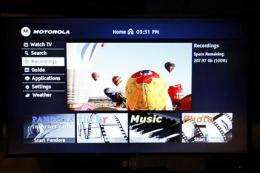
(AP) -- You're watching Jon Stewart's "The Daily Show," when suddenly you see a commercial for the Mustang convertible you've been eyeing - with a special promotion from Ford, which knows you just ended your car lease.
A button pops up on the screen. You click it with the remote and are asked whether you want more information about the car. You respond "yes." Days later, an information packet arrives at your home, the address on file with your cable company.
This is the future of cable TV advertising: personal and targeted.
Cable TV operators are taking a page from online advertising behemoths like Google Inc. to bring these so-called "addressable" ads onto the television.
"It hasn't really been done on TV before," said Mike Eason, chief data officer of Canoe Ventures, a group formed by the nation's six largest cable operators to launch targeted and interactive ads on a national platform starting this summer.
They're betting they can even one-up online ads because they also offer a full-screen experience - a car commercial plays much better on your TV than on your PC. As such, they hope to charge advertisers more.
The stakes are high: Cable companies get only a small portion of the $182 billion North American advertising market. Eason said the cable operators, which sell local ads on networks like Comedy Central, get roughly 10 percent of the commercial time on those channels. With targeting, they are hoping to expand that.
But they have to tread carefully. Privacy advocates worry the practice opens the door to unwanted tracking of viewing habits so ads can target consumers' likes or dislikes. They also fear it could lead to discrimination, such as poorer households getting ads for the worst auto-financing deals because they are deemed credit risks.
"You've got to tell people you're doing it and you've got to give people a way to say no," said Pam Dixon, executive director of World Privacy Forum in Carlsbad, Calif. "Otherwise, it's just not fair."
By the end of the year, Canoe will start rolling out ads that let consumers request information, such as the hypothetical one for the Mustang, industry executives said. Cable operators involved are Comcast Corp., Cox Communications Inc., Time Warner Cable Inc., Charter Communications Inc., Cablevision Systems Corp. and Bright House Networks.
Initially, over the next two months, they'll tailor ads by demographic profile of a community, such as age and income. So households in a youth-oriented neighborhood might get pitches for concerts, while those in higher-income areas might get exotic travel ads. Previously, cable could only target an entire metropolitan area or town.
Ultimately, cable will target down to the ZIP code and individual household, although when that will happen isn't clear.
That means eventually, while you and your neighbor could be watching "Iron Chef" on Food Network at the same time, you might see a commercial for golf clubs, because you had tuned to The Golf Channel earlier, while your neighbor would see an ad for Disney vacations, because she has young children who like to watch Nickelodeon.
Experian, a data collection and credit scoring company, will cull profile data and match them with information advertisers have on their consumers. The advertiser won't know who will get the ads. Advertisers can also provide a customer list to Experian, which then can make a match. So an ad can be targeted toward someone who just ended a lease with Ford.
Niche ads aren't new to television. Advertisers have long pitched beer and cars on sports programs and cosmetics on the female-heavy Hallmark Channel.
But cable hasn't been able to get more specific until now.
With better targeting, advertisers might pay more to run the same ad, but they'll be reaching the audience most likely to buy, increasing the effectiveness. Advertisers will also be better able to measure how wisely their marketing dollars get spent, by keeping track of who responds. These are areas TV hasn't done as well as online.
Canoe says it has already developed the technology and will start deploying it in May. The cable companies' movement toward standardizing their systems on a common platform will aid in the deployment of these ads. What remains to be worked out are financial issues such as how cable operators and cable networks will share revenue.
There are signs that targeting works.
Cablevision has just completed an ad trial involving 100,000 homes in Brooklyn, N.Y., in which it sold additional services to its own customers. For instance, someone who only subscribes to cable TV might get ads for adding phone and Internet services. Cablevision said it saw a double-digit percentage increase in sales in areas with targeted ads.
The company will roll out targeted ads to 500,000 homes in the New York area this summer.
But privacy advocates such as Dixon worry that customers might not have a way to disable cable's tracking of their viewing habits, and won't likely have the option of another cable operator to buy from.
"If you're sitting at home watching a cable TV box, you're stuck," Dixon said. "You're looking at a version of television that no one else is getting. That's a big deal."
But Eason said despite its flaws, this is where TV advertising is heading - measurable ads. "This is the future for measurement on television," he said.
©2009 The Associated Press. All rights reserved. This material may not be published, broadcast, rewritten or redistributed.


