Wild chimpanzees exchange meat for sex
April 8, 2009
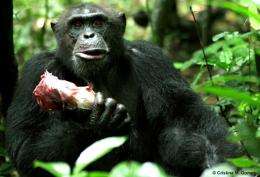
Sagu, an adult male chimpanzee, holding the rib case of a red colobus he caught. Photo by Cristina M. Gomes
Wild female chimpanzees copulate more frequently with males who share meat with them over long periods of time, according to a study led by researchers from the Max Planck Institute for Evolutionary Anthropology in Germany, published in the open-access, peer-reviewed journal PLoS ONE April 8.
How females choose their mating partners and why males hunt and share meat with them are questions that have long puzzled scientists. Evidence from studies on human hunter-gatherer societies suggest that men who are more successful hunters have more wives and a larger number of offspring. Studies on wild chimpanzees, humans' closest living relative, have shown that male hunters frequently share meat with females who did not participate in the hunt. One of the hypotheses proposed to explain these findings is the meat-for-sex hypothesis, whereby males and females exchange meat for mating access. However, there has been little evidence in both humans and chimpanzees to support it.
In recent research conducted in the Taď National Park, Côte d'Ivoire, Cristina M. Gomes and Christophe Boesch show that females copulate more frequently with males who share meat with them on at least one occasion, compared with males who never share meat with them, indicating that sharing meat with females improves a males' mating success. Although males were more likely to share meat with females who had sexual swellings (i.e., estrous females), excluding all sharing episodes with estrous females from the analysis, did not alter the results. This indicates that short term exchanges alone (i.e., within the estrous phase of the female) cannot account for the relationship between sharing meat and mating success.
According to Gomes, "Our results strongly suggest that wild chimpanzees exchange meat for sex, and do so on a long-term basis. Males who shared meat with females doubled their mating success, whereas females, who had difficulty obtaining meat on their own, increased their caloric intake, without suffering the energetic costs and potential risk of injury related to hunting."
She adds, "Previous studies might not have found a relationship between mating success and meat sharing because they focused on short-term exchanges; or perhaps because in those groups access to females was driven by male coercion so females rarely chose their mating partners."
Boesch concluded, "Our findings add to the ever-growing evidence suggesting that chimpanzees can think in the past and the future and that this influences their present behavior."
"These findings are bound to have an impact on our current knowledge about relationships between men and women; and similar studies will determine if the direct nutritional benefits that women receive from hunters in human hunter-gatherer societies could also be driving the relationship between reproductive success and good hunting skills," concludes Gomes.
More information: Gomes CM, Boesch C (2009) Wild Chimpanzees Exchange Meat for Sex on a Long-Term Basis. PLoS ONE 4(4): e5116. doi:10.1371/journal.pone.0005116, http://dx.plos.org … pone.0005116
-
Male chimpanzees prefer mating with old females
Nov 20, 2006 |
not rated yet |
0
-
Female chimps keep the bullies at bay
Mar 07, 2007 |
not rated yet |
0
-
Mating that causes injuries
Feb 20, 2009 |
not rated yet |
0
-
Despite 'peacenik' reputation, bonobos hunt and eat other primates too
Oct 13, 2008 |
not rated yet |
0
-
Key 'impact hunters' catalyze hunting among male chimpanzees
Feb 01, 2008 |
not rated yet |
0
-
Engineers build first sub-10-nm carbon nanotube transistor
Feb 01, 2012 |
4.9 / 5 (33) |
30
-
Something old, something new: Evolution and the structural divergence of duplicate genes
Jan 31, 2012 |
4.6 / 5 (7) |
1
-
The hidden nanoworld of ice crystals: Revealing the dynamic behavior of quasi-liquid layers
Jan 30, 2012 |
5 / 5 (4) |
1
-
Stock market network reveals investor clustering
Jan 27, 2012 |
3.9 / 5 (23) |
8
-
Of microchemistry and molecules: Electronic microfluidic device synthesizes biocompatible probes
Jan 26, 2012 |
5 / 5 (2) |
0
-
Factors affecting beet root cell membrane
14 hours ago
-
Stem cell question.
Feb 10, 2012
-
Protease cleavage
Feb 10, 2012
-
Pertubance in a model
Feb 10, 2012
-
Cancer drugs and Alzheimer's, Oh my!
Feb 09, 2012
-
Squishing cells
Feb 09, 2012
- More from Physics Forums - Biology
More news stories
A mitosis mystery solved: How chromosomes align perfectly in a dividing cell
Although the process of mitotic cell division has been studied intensely for more than 50 years, Whitehead Institute researchers have only now solved the mystery of how cells correctly align their chromosomes during symmetric ...
10 hours ago |
4.3 / 5 (16) |
0
|
Researchers find extensive RNA editing in human transcriptome
In a new study published online in Nature Biotechnology, researchers from BGI, the world's largest genomics organization, reported the evidence of extensive RNA editing in a human cell line by analysis of RNA-seq data, demons ...
10 hours ago |
5 / 5 (4) |
0
|
The proteins ensuring genome protection
Researchers from the University of Geneva (UNIGE), Switzerland, have discovered the crucial role of two proteins in developing a cell 'anti-enzyme shield'. This protection system, which operates at the level of molecular ...
10 hours ago |
5 / 5 (3) |
0
|
Entire genome of extinct human decoded from fossil
(PhysOrg.com) -- In 2010, Svante Pääbo and his colleagues presented a draft version of the genome from a small fragment of a human finger bone discovered in Denisova Cave in southern Siberia. The ...
Feb 07, 2012 |
4.7 / 5 (60) |
51
|
Why are there so few fish in the Earth's oceans?
(PhysOrg.com) -- A Stony Brook University researcher has found that, contrary to popular belief, there are not plenty of fish in the sea.
Feb 08, 2012 |
4.2 / 5 (18) |
27
|
Scientists discover molecular secrets of 2,000-year-old Chinese herbal remedy
For roughly two thousand years, Chinese herbalists have treated Malaria using a root extract, commonly known as Chang Shan, from a type of hydrangea that grows in Tibet and Nepal. More recent studies suggest that halofuginone, ...
New method to examine batteries -- MRI from the inside
There is an ever-increasing need for advanced batteries for portable electronics, such as phones, cameras, and music players, but also to power electric vehicles and to facilitate the distribution and storage of energy derived ...
Google might launch Drive for cloud storage soon
(PhysOrg.com) -- Google's next big move, according to the Wall Street Journal, is a cloud storage service called Drive. Hardly first to the plate, Google is simply catching up to introducing its cloud reposi ...
Lab study raises questions over nano-particle impact
Tests involving chickens have raised questions about the impact on health from engineered nano-particles, the ultra-fine grains commonly used in drugs and processed foods, scientists said on Sunday.
Starve a virus, feed a cure? Findings show how some cells protect themselves against HIV
A protein that protects some of our immune cells from the most common and virulent form of HIV works by starving the virus of the molecular building blocks that it needs to replicate, according to research published online ...
Overeating may double risk of memory loss
New research suggests that consuming between 2,100 and 6,000 calories per day may double the risk of memory loss, or mild cognitive impairment (MCI), among people age 70 and older. The study was released today and will be ...
Apr 08, 2009
Rank: 4.8 / 5 (5)
Apr 08, 2009
Rank: 5 / 5 (2)
Isn't this redundant?
Apr 08, 2009
Rank: 4 / 5 (1)