Entangled Light in Bose-Einstein Condensates
April 8, 2009 By Lisa Zyga Entangled Light in Bose-Einstein Condensates

Enlarge

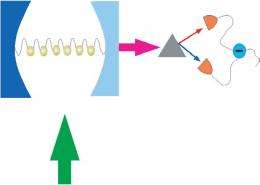
In Ng and Bose’s proposed scheme, a BEC trapped in an optical cavity is continuously driven by a laser that emits photons in pairs of two different frequencies. The BEC mediates entanglement between the two light modes, which are emitted through a one-sided mirror. A prism separates the two modes, and a homodyne detection confirms the entanglement. Image credit: Ng and Bose.

(PhysOrg.com) -- When physicists entangle light, they usually use nonlinear crystals as the source. However, it’s difficult to control the entanglement generation process in a bulk crystal, and so scientists have been looking for a more fundamental source of entangled light. Now, they may have found a candidate: Bose-Einstein condensates.

Physicists Ho-Tsang Ng and Sougato Bose of the University College London have recently proposed a method to generate entangled light using a Bose-Einstein condensate trapped in an optical cavity. If the system works, it would enable researchers to control the degree of . Entangled light, which is regarded as the ideal entity for sharing entanglement between distant parties, has many future applications in quantum communications. Ng and Bose’s study is published in the .

“I would say that the significance of the work is two-fold: firstly, it provides an immediate application of a novel setup (namely the BEC in a cavity) that has been recently realized in experiments,” Bose told PhysOrg.com. “Secondly, it is the application of a mesoscopic system to do something which is normally done using a macroscopic system such as a crystal.”

A Bose-Einstein condensate (BEC) is a group of atoms that are cooled to near absolute zero, which causes the atoms’ wavelengths to increase and overlap so that the group acts like a single atom. Although the atomic cluster has a relatively large size, it’s considered to be a single quantum state and it obeys quantum laws.

In their study, Ng and Bose propose trapping a BEC in an optical cavity, where the ultra-cold atoms are trapped in a periodic potential. This scheme ensures that every atom will experience exactly the same interaction with the light field, resulting in very strong atom-photon coupling. As the physicists note, strong atom-photon couplings are extremely useful for performing quantum information processing before decoherence sets in, which has the potential for applications such as long-lived quantum memory and quantum networks for light-matter interfaces.

In this case, the strong atom-photon coupling provides a method for realizing entangled light. In the configuration, a laser continuously emits pairs of photons of two different frequencies into the trapped BEC. Acting as a medium, the BEC mediates entanglement between the two photons’ cavity (light) modes. As the quantum-correlated light modes decay, they leak out of the cavity through a one-sided mirror.

“Each atom in the BEC, being in exactly the same wavefunction, will experience exactly the same light field,” Bose explained. “They will all thereby have precisely the same interaction with the light field, unlike the case for a thermal gas, for which different atoms will be in different velocities and positions and may interact differently with the light field. All the atoms will thus go on doing the same process, namely taking a photon from the laser and churning out two photons of different frequencies. This process makes the different frequencies of light quantum mechanically correlated or entangled.”

Since detecting light entanglement inside the cavity is very difficult (and not very useful, since the entangled modes should be well separated in space), the scientists explain that it’s necessary to detect entanglement in the light leaking out of the cavity. Outside of the cavity, a prism splits the leaked light into two different frequencies. Once separated, a homodyne detection measures and verifies the entanglement. The scientists expect that their proposal could be experimentally realized with current technology.

The main advantage of generating entangled light with a BEC compared with bulk crystals is the control offered by the BEC method. By adjusting the strength of the atom-photon couplings, Ng and Bose explain how to control the degree of entanglement: a large number of atoms and decreased cavity decay optimizes the entanglement.

“Potentially, here the degree of entanglement could be higher and it could be less noisy,” Bose said.

More information: Ng, H T and Bose, S. “Entangled light from Bose-Einstein condensates.” New Journal of Physics, 11 (2009) 043009.


Join PhysOrg.com on Facebook!
Follow PhysOrg.com on Twitter!

Copyright 2009 PhysOrg.com.
All rights reserved. This material may not be published, broadcast, rewritten or redistributed in whole or part without the express written permission of PhysOrg.com.


print this article email this article download pdf blog this article bookmark this article     Stumble it Digg this share on Facebook retweet share on Reddit add to delicious
Rate this story - 4.4 /5 (16 votes)

Rank Filter

Move the slider to adjust rank threshold, so that you can hide some of the comments.


Display comments: newest first

  • QubitTamer - Apr 08, 2009
    • Rank: not rated yet
    Is Dr. Sougato Bose a descendant of Dr. Satyendra Nath Bose? Anyone?
  • yyz - Apr 08, 2009
    • Rank: not rated yet
    This seems to be a novel and perhaps more efficient way to entangle photons. Must find paper.
  • earls - Apr 08, 2009
    • Rank: 5 / 5 (2)
    Qubit, Bose did have two male children, but I can't seem to find any connection... His email if you're really interested: sougato.bose@qubit.org

    yyz, the paper is here: http://www.iop.or...4/043009

    I'm curious about what kind of applications this could be used for...
  • QubitTamer - Apr 08, 2009
    • Rank: not rated yet
    Qubit, Bose did have two male children, but I can't seem to find any connection... His email if you're really interested: sougato.bose@qubit.org

    Thanks. Lol my pseudonym and his domain...!

    yyz, the paper is here: http://www.iop.or...4/043009


    I'm curious about what kind of applications this could be used for...

  • Velanarris - Apr 08, 2009
    • Rank: 5 / 5 (1)

    I'm curious about what kind of applications this could be used for...

    As far as I'm aware information transmission and quantum computing.

    According to some material I'm reading, possibly, superconductivity down the line.
  • yyz - Apr 09, 2009
    • Rank: not rated yet
    @ earls, thanks for the link. It provided much valuable information.
  • theccexperiment - Apr 17, 2009
    • Rank: 3 / 5 (1)
    One of my favorite stories.
    http://www.scifi....aw1.html
    Once found a house that had mirrors encircling the house, leaning against the foundations. From then on, we called it the slow-glass house.

    Science fiction predicts all that science discovers. I remember being excited in the mid-90's when BE Condensate was discovered. I knew it could change the world.
  • nilbud - Apr 19, 2009
    • Rank: 1 / 5 (1)
    Science fiction actually does a very poor job of predicting discoveries or usage patterns. Videophones would be one example.
  • Velanarris - Apr 20, 2009
    • Rank: 3.5 / 5 (2)
    Science fiction actually does a very poor job of predicting discoveries or usage patterns. Videophones would be one example.
    Really?

    You'd be fairly wrong on that. You already have a host of systems like go to meeting and webex which are just one step shy of a videophone system. Don't forget the newer Microsoft Office Communicator package. That is a full fledged mobile office setup, videophone included.

    So far Sci-Fi has been dead on the money.
  • nilbud - Apr 20, 2009
    • Rank: not rated yet
    Absolutely not the case I have a 3G videophone which cost under %u20AC30 and so do most people and yet no one uses them. it wasn't predicted that when videophoes are freely available to everyone (Skype etc) no one actually uses the damn things.
  • Velanarris - Apr 20, 2009
    • Rank: 3 / 5 (1)
    Absolutely not the case I have a 3G videophone which cost under %u20AC30 and so do most people and yet no one uses them. it wasn't predicted that when videophoes are freely available to everyone (Skype etc) no one actually uses the damn things.


    You do realize that the majority of people also still use dial up internet, right?


    Videophone tech exists, and it's used quite often in the office environment. Scifi never went as far as to tell you over which medium it would occur.
  • nilbud - Apr 20, 2009
    • Rank: not rated yet
    In most countries 3G mobile phones exist and the videophone component is unused. That was NOT predicted. The majority of people use DSL. There are lots of free videophone softwares and they are not used by the vast majority of people. If you're still having difficulty with these facts there's not much more I can do.
  • Velanarris - Apr 21, 2009
    • Rank: 4 / 5 (1)
    In most countries 3G mobile phones exist and the videophone component is unused. That was NOT predicted. The majority of people use DSL.
    False. DSL, although technically "dial-up" is considered broadband.

    http://arstechnic...t-it.ars
    There are lots of free videophone softwares and they are not used by the vast majority of people. If you're still having difficulty with these facts there's not much more I can do.
    I'm not having a problem with anything. You seem to be having difficulty understanding that videophones exist and are used in many environments. Sci Fi isn't "wrong" just because your buddy doesn't use his mobile phone to videophone you.


April 8, 2009 all stories

Comments: 13

4.4 /5 (16 votes)
  • Stumble this up

  • Digg this

  • share this

  • hide
  • Related Stories

  • Teleportation method proposed by Australian scientists
    created Jul 03, 2007 | popularity not rated yet | comments 0
  • Using Current Technology to Prepare for Quantum Computing
    created Aug 14, 2006 | popularity not rated yet | comments 0
  • Taking entanglement beyond one ebit
    created Jan 23, 2007 | popularity not rated yet | comments 0
  • 'Tornadoes' are transferred from light to sodium atoms
    created Nov 09, 2006 | popularity not rated yet | comments 0
  • Researchers violate Bell’s inequality with an atom and a photon
    created Aug 31, 2004 | popularity not rated yet | comments 0


  • hide
  • Relevant PhysicsForums posts

  • Photoelectric effect
    created 2 hours ago
  • Ranges of coherence lengths for......
    created 4 hours ago
  • Has einsteins experient with time been proven, why hasn't it been applied or used
    created 6 hours ago
  • Drop of Water
    created 7 hours ago
  • Generalized Coordinate Systems
    created 7 hours ago
  • Electromagnet design
    created 9 hours ago
  • More from Physics Forums - General Physics

Other News

Stars Fueled by Dark Matter Could Hold Secrets to the Universe

Stars Fueled by Dark Matter Could Hold Secrets to the Universe

Physics / General Physics

created Nov 03, 2009 | popularity 4.5 / 5 (51) | comments 41

(PhysOrg.com) -- The first stars in the universe may have been very different from the stars we see today, yet they may hold clues to understanding some of the mysterious features of the universe. These "dark ...


Second Law of Thermodynamics May Explain Economic Evolution

Second Law of Thermodynamics May Explain Economic Evolution

Physics / General Physics

created Nov 02, 2009 | popularity 4.3 / 5 (31) | comments 28

(PhysOrg.com) -- Terms such as the "invisible hand," laissez-faire policy, and free-market principles suggest that economic growth and decline in capitalist societies seem to be somehow self-regulated. Now, ...


High-performance plasmas may make reliable, efficient fusion power a reality

High-performance plasmas may make reliable, efficient fusion power a reality

Physics / Plasma Physics

created Nov 02, 2009 | popularity 4.7 / 5 (40) | comments 34

In the quest to produce nuclear fusion energy, researchers from the DIII-D National Fusion Facility have recently confirmed long-standing theoretical predictions that performance, efficiency and reliability ...


'Teapot effect' solved

Solving Teapot Effect

Physics / General Physics

created Nov 02, 2009 | popularity 4.9 / 5 (11) | comments 10

(PhysOrg.com) -- A team of scientists from France have worked out why teapots dribble at low flow rates, and how to stop them. The effect is called the "teapot effect", and solving it could finally put an ...


Laser accelerated protons to the highest energies so far

Researchers use trident laser to accelerate protons to record energies

Physics / General Physics

created Nov 02, 2009 | popularity 4.7 / 5 (6) | comments 10

An international team of physicists at Los Alamos National Laboratory has succeeded in using intense laser light to accelerate protons to energies never before achieved. Using this technique, scientists can ...