X marks the spot: Ions coldly go through NIST trap junction
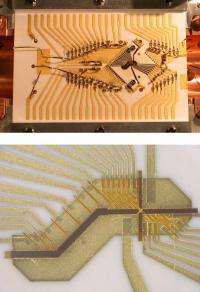
(PhysOrg.com) -- Physicists at the National Institute of Standards and Technology have demonstrated a new ion trap that enables ions to go through an intersection while keeping their cool. Ten million times cooler than in prior similar trips, in fact. The demonstration, described in a forthcoming paper in Physical Review Letters,* is a step toward scaling up trap technology to build a large-scale quantum computer using ions (electrically charged atoms), a potentially powerful machine that could perform certain calculations—such as breaking today’s best data encryption codes—much faster than today’s computers.
NIST’s new trap with a junction solves a key engineering issue for future possible ion-trap quantum computers: how to move ions in a particular quantum mechanical state back and forth between different locations for data storage or logic operations, without heating them up so much that they lose their fragile quantum properties, which are critical to information processing.
The new ion trap, a rectangle roughly 5 by 2 millimeters in outer dimensions, was constructed from laser-machined alumina, with a gold coating to form electrodes. It is more complex than previous NIST ion traps, with 46 electrodes supporting 18 ion trapping zones. Its unique feature is an X-shaped bridge connecting electrodes across a junction between zones. Junctions are required to allow ions to be grouped together efficiently for logic operations. As voltages are applied to different electrodes to move the ions, the electric fields restrain an ion as it moves between trapping zones. The fields created by the X-bridge are required for smooth transport through the junction and to keep ions from popping out at the junction.
NIST scientists transported single beryllium ions through the X-junction more than 1 million times while maintaining the properties critical to information processing with greater than 99.99 percent success. Pairs of ions were transported over 100,000 times. Ion transport through a junction has been reported once before, but the ions in the NIST trap received over 10 million times less heat than the earlier effort. The low heating, achieved through careful control and reductions in electrical noise, minimizes a major source of computation errors and processing slowdowns.
Over the past 15 years, NIST has demonstrated the basic building blocks for a computer based on ion traps, a promising design for a quantum computer. Now, the latest demonstration shows how information might be moved through a quantum processor rapidly and reliably enough for computing. It takes about 20 microseconds to move an ion across the junction and about 50 to 100 microseconds for transport between zones—times compatible with logic operations using ions. The trap design makes large-scale information processing possible while keeping the number of ions in each trap zone relatively small, such that individual ions can be manipulated without unwanted effects.
More information: * R.B. Blakestad, C. Ospelkaus, A.P. VanDevender, J.M. Amini, J. Britton, D. Leibfried, and D.J. Wineland. High fidelity transport of trapped-ion qubits through an X-junction trap array. Physical Review Letters. Forthcoming.
Source: National Institute of Standards and Technology (news : web)


