Study compares sound from exploding volcanoes with jet engines
April 8, 2009 Study compares sound from exploding volcanoes with jet engines

Enlarge

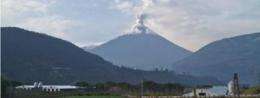
Scripps researchers are using infrasound recording to study Tungurahua volcano in Ecuador. Credit: D.Fee/University of Hawaii

New research on infrasound from volcanic eruptions shows an unexpected connection with jet engines. Researchers at Scripps Institution of Oceanography at UC San Diego speeded up the recorded sounds from two volcanoes and uncovered a noise very similar to typical jet engines. These new research findings provide scientists with a more useful probe of the inner workings of volcanic eruptions. Infrasound is sound that is lower in frequency than 20 cycles per second, below the limit of human hearing.

The study led by Robin Matoza, a graduate student at Scripps Oceanography, will be published in an upcoming issue of the journal , a publication of the American Geophysical Union (AGU). Matoza measured infrasonic sound from Mount St. Helens in Washington State and Tungurahua volcano in Ecuador, both of which are highly active volcanoes close to large population centers.

"We hypothesized that these very large natural volcanic jets were making very low frequency jet noise," said Matoza, who conducts research in the Scripps Laboratory for Atmospheric Acoustics.
Study compares sound from exploding volcanoes with jet engines
Enlarge

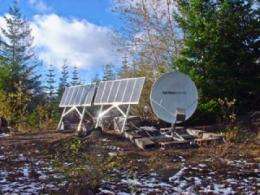
Scripps researchers installed an array of microbarometers at Mount St. Helens in November 2004 to collect infrasound near the site. Credit: Scripps Institution of Oceanography, UC San Diego

Using 100-meter aperture arrays of microbarometers, similar to weather barometers but sensitive to smaller changes in and low-frequency infrasonic microphones, the research team tested the hypothesis, revealing the physics of how the large-amplitude signals from eruptions are produced. Jet noise is generated by the turbulent flow of air out of a jet engine. Matoza and colleagues recorded these very large-amplitude infrasonic signals during the times when ash-laden gas was being ejected from the volcano. The study concluded that these large-scale volcanic jets are producing sound in a similar way to smaller-scale man-made jets.

"We can draw on this area of research to speed up our own study of volcanoes for both basic research interests, to provide a deeper understanding of eruptions, and for practical purposes, to determine which eruptions are likely ash-free and therefore less of a threat and which are loaded with ash," said Michael Hedlin, director of Scripps' Atmospheric Acoustics Lab and a co-author on the paper.

Large-amplitude infrasonic signals from are currently used in a prototype real-time warning system that informs the Volcanic Ash Advisory Center (VAAC) when large infrasonic signals have come from erupting volcanoes. Researchers hope this new information can improve hazard mitigation and inform pilots and the aviation industry.

"The more quantitative we can get about how the sound is produced the more information we can provide to the VAAC," said Matoza. "Eventually it could be possible to provide detailed information such as the size or flow rate of the volcanic jet to put into ash-dispersal forecasting models."

Source: University of California - San Diego (news : web)


Rate this story - 3.8 /5 (5 votes)


April 8, 2009 all stories

Comments: 0

3.8 /5 (5 votes)

  • hide
  • Related Stories

  • Wireless system to monitor volcanoes
    created Sep 23, 2004 | popularity not rated yet | comments 0
  • New eruptions at Alaska's Mount Redoubt volcano
    created Mar 27, 2009 | popularity not rated yet | comments 0
  • Volcanic blast influences climate
    created Aug 12, 2005 | popularity not rated yet | comments 0
  • Double volcanic eruption in Eastern Russia
    created Mar 10, 2005 | popularity not rated yet | comments 0
  • Alaska's Mount Redoubt has another large eruption
    created Apr 05, 2009 | popularity not rated yet | comments 0


  • hide
  • Relevant PhysicsForums posts

  • Carbon Dioxide emissions question
    created Feb 08, 2010
  • Photosynthesis vs. carbonization
    created Feb 07, 2010
  • Sheep's footprints
    created Feb 05, 2010
  • How did Victorians estimate the ages of fossils?
    created Feb 03, 2010
  • More from Physics Forums - Earth

Other News

Space shuttle Endeavour pulls in at space station (AP)

Space shuttle Endeavour pulls in at space station

Space & Earth / Space Exploration

created 7 minutes ago | popularity not rated yet | comments 0

(AP) -- Shuttle Endeavour arrived to a warm welcome at the International Space Station early Wednesday, delivering a new room and observation deck that will come close to completing construction 200 miles ...


Rho Ophiuchus cloud

Professor: We have a 'moral obligation' to seed universe with life

Space & Earth / Astronomy

created 21 hours ago | popularity 3.1 / 5 (27) | comments 53 | with audio podcast report

(PhysOrg.com) -- Eventually, the day will come when life on Earth ends. Whether that’s tomorrow or five billion years from now, whether by nuclear war, climate change, or the Sun burning up its fuel, the last ...


Climate 'Tipping Points' May Arrive Without Warning, Says Top Forecaster

Space & Earth / Environment

created 10 hours ago | popularity 3 / 5 (8) | comments 7 | with audio podcast

(PhysOrg.com) -- A new University of California, Davis, study by a top ecological forecaster says it is harder than experts thought to predict when sudden shifts in Earth's natural systems will occur -- a worrisome finding ...


38 percent of world's surface in danger of desertification

38 percent of world's surface in danger of desertification

Space & Earth / Environment

created 7 hours ago | popularity 2.3 / 5 (3) | comments 5

A team of Spanish researchers has measured the degradation of the planet's soil using the Life Cycle Assessment (LCA), a scientific methodology that analyses the environmental impact of human activities, and ...


A new 3-D map of the interstellar gas within 300 parsecs from the sun

A new 3D map of the interstellar gas within 300 parsecs from the Sun

Space & Earth / Astronomy

created 12 hours ago | popularity 5 / 5 (5) | comments 0 | with audio podcast

(PhysOrg.com) -- Astronomy & Astrophysics is publishing new 3D maps of the interstellar gas in the local area around our Sun. A French-American team of astronomers presents new absorption measurements toward ...