Research identifies importance of diet in snake venom evolution
April 8, 2009
Research identifies importance of diet in snake venom evolution

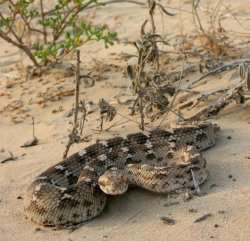
Axel Barlow's paper in Proceedings of the Royal Society B on saw-scaled vipers shows that snakes which have evolved to feed on scorpions have also evolved venom which is more lethal to scorpions, demonstrating that changes in diet have been an important factor in snake venom evolution.

The significance of this discovery lies in the medical treatment of snake bites. Variation in composition between different species or populations of can complicate antivenom treatment. Understanding the evolutionary processes that produce venom variation can therefore lead to better antivenom design and effectiveness. This is particularly relevant in the case of saw-scaled vipers, which are probably responsible for the majority of snakebite deaths in Africa. However, many West African hospitals still rely on imported antivenom from Asia, where the saw-scaled vipers have very different venom composition, and the failure of this imported antivenom has led to many unnecessary deaths.

"This study provides one of the most convincing pieces of evidence to date for the role of natural selection for diet in shaping snake venom composition, a key question in our understanding of venom in snakes," commented Dr Wolfgang Wüster, an expert in snakes and snake venoms and a lecturer at Bangor University's School of Biological sciences.

Currently a first year PhD student at Bangor University, Axel compiled much of the work for his undergraduate final year project, which was part of a wider project on venom evolution funded by the Leverhulme Trust.

"Saw-scaled vipers provide a good model to study venom variation as different species have extremely different diets," explains Axel, "this allows us to investigate the effects of evolutionary changes in diet within a single group of related snake species".

Now 28, Axel studied for his first degree in Zoology at Bangor, followed by a MSc in Ecology also at Bangor. He is currently funded by the NERC to follow a PhD investigating genetic variation in Southern African snakes. He comes originally from Dewsbury in West Yorkshire.

More information: Work begun as part of an undergraduate Honours project is to be published in the prestigious journal, . (available online at http://rspb.royalsocietypublishing.org/content/early/2009/03/26/rspb.2009.0048.abstract)

Provided by Bangor University


Rank 3 /5 (1 vote)
Related Stories
Relevant PhysicsForums posts
  • Factors affecting beet root cell membrane
    created2 hours ago
  • Stem cell question.
    createdFeb 10, 2012
  • Protease cleavage
    createdFeb 10, 2012
  • Pertubance in a model
    createdFeb 10, 2012
  • Cancer drugs and Alzheimer's, Oh my!
    createdFeb 09, 2012
  • Squishing cells
    createdFeb 09, 2012
  • More from Physics Forums - Biology

More news stories

Entire genome of extinct human decoded from fossil

(PhysOrg.com) -- In 2010, Svante Pääbo and his colleagues presented a draft version of the genome from a small fragment of a human finger bone discovered in Denisova Cave in southern Siberia. The ...

Biology / Biotechnology

created Feb 07, 2012 | popularity 4.7 / 5 (58) | comments 46 | with audio podcast

Why are there so few fish in the Earth's oceans?

(PhysOrg.com) -- A Stony Brook University researcher has found that, contrary to popular belief, there are not plenty of fish in the sea.

Biology / Plants & Animals

created Feb 08, 2012 | popularity 4.3 / 5 (17) | comments 26 | with audio podcast

Miami battling invasion of giant African snails

No one knows how they got there. But an invasion of African giant snails has southern Florida in a panic over potential crop damage, disease and general yuckiness surrounding the slimy gastropods.

Biology / Ecology

created Feb 10, 2012 | popularity 4.5 / 5 (2) | comments 5

Deciding to go left or right: Researchers use device to determine that lower animals can navigate too

For decades, scientists have associated binary decision making — opting to go left or right — with higher-ranking animals, including humans. A team of Harvard researchers, however, is rewriting that ...

Biology / Plants & Animals

created Feb 09, 2012 | popularity 4 / 5 (1) | comments 4 | with audio podcast

Study shows chimps able to understand needs of others

(PhysOrg.com) -- By setting up a unique experiment, a small team of researchers has found that chimpanzees are able to understand need in other chimps, despite their general disinclination to offer aid when ...

Biology / Plants & Animals

created Feb 07, 2012 | popularity 5 / 5 (2) | comments 4 | with audio podcast report


Google might launch Drive for cloud storage soon

(PhysOrg.com) -- Google's next big move, according to the Wall Street Journal, is a cloud storage service called Drive. Hardly first to the plate, Google is simply catching up to introducing its cloud reposi ...

Latin America mining boom clashes with conservation

Latin America is experiencing a mining boom as prices rise fuelled by a hike in global demand, but the region is also being hit by a wave of violent protests, strikes and rallies by environmentalists.

Love a click away in Indonesia's Twitter Republic

He was a geeky kid from Yogyakarta, she a glamorous city girl in Jakarta. In a country with one of the world's most vibrant social networking scenes they fell in love on Twitter.

Europeans protest controversial Internet pact

Tens of thousands of people marched in protests in more than a dozen European cities Saturday against a controversial anti-online piracy pact that critics say could curtail Internet freedom.

Walney offshore wind farm is world's biggest (for now)

(PhysOrg.com) -- The Walney wind farm on the Irish Sea--characterized by high tides, waves and windy weather--officially opened this week. The farm is treated in the press as a very big deal as the Walney ...

Navy to begin tests on electromagnetic railgun prototype launcher

The Office of Naval Research (ONR)'s Electromagnetic (EM) Railgun program will take an important step forward in the coming weeks when the first industry railgun prototype launcher is tested at a facility ...