World’s First Nanofluidic Device with Complex 3-D Surfaces Built
April 8, 2009 World’s First Nanofluidic Device with Complex 3-D Surfaces Built

Enlarge

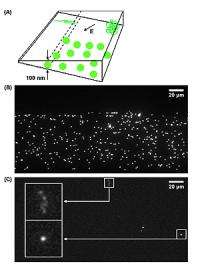
(A) Schematic of the NIST-Cornell nanofluidic device with complex 3-D surfaces. Each “step” of the “staircase” seen on the side marks a different depth within the chamber. The letter “E” shows the direction of the electric field used to move the nanoparticles through the device. The green balls are spheres with diameters of 100 nanometers whose size restricts them from moving into the shallower regions of the chamber. The coil in the deep end of the chamber (upper right corner) is a single DNA strand that elongates (upper left corner) in the shallow end. (B) Photomicrograph showing fluorescently tagged spherical nanoparticles stopped at the 100-nanometer level of the chamber, the depth that corresponds to their diameter. (C) Photomicrograph of a single DNA strand that is coiled in the deep end of chamber (box at far right) and elongated in the shallow end (box at far left). Larger boxes are closeups showing the fluorescently tagged strands. Credit: NIST

(PhysOrg.com) -- Researchers at the National Institute of Standards and Technology and Cornell University have capitalized on a process for manufacturing integrated circuits at the nanometer level to engineer the first-ever nanoscale fluidic device with complex three-dimensional surfaces. As described in a recent paper in the journal Nanotechnology,* the Lilliputian chamber is a prototype for future tools with custom-designed surfaces to manipulate and measure different types of nanoparticles in solution.

Among the potential applications are processing nanoscale materials for manufacturing products such as pharmaceuticals, sorting mixtures of for environmental health and safety investigations, and isolating and confining individual for scientific study.

Nanofluidic devices are usually fabricated by etching tiny channels into a glass or silicon wafer with the same “lithographic” procedures used for making . To date, these flat rectangular channels have had simple surfaces with only a few depths. This limits their ability to separate mixtures of nanoparticles with different sizes or study the nanoscale behavior of biomolecules (such as DNA) in detail.

To solve the problem, the researcher team developed a lithographic process to fabricate complex 3-D surfaces. To demonstrate their method, they constructed a nanofluidic chamber with a “staircase” geometry etched into the floor. The “steps” in this staircase—each level giving the device a progressively increasing depth from 10 nanometers (about 6,000 times smaller than the width of a human hair) at the top to 620 nanometers at the bottom—are what give the device its ability to manipulate nanoparticles by size in the same way a coin sorter separates nickels, dimes and quarters.

In these novel experiments, the researchers tested their device with two different solutions: one containing 100-nanometer-diameter polystyrene spheres and the other containing 20-micrometer (millionth of a meter)-length DNA molecules from a virus. In each experiment, the researchers injected the solution into the chamber’s deep end and then used electric fields to drive their sample across the device from deeper to shallower levels. Both the spheres and DNA strands were tagged with fluorescent dye so that their movements could be tracked with a microscope.

In the trials using rigid nanoparticles, size exclusion occurred when the region of the chamber where the channels were less than 100 nanometers in depth stayed free of the particles. In the viral DNA trials, the genetic material was coiled in the deeper channels and elongated when forced into the shallower ones. These results demonstrate the utility of the NIST-Cornell 3-D nanofluidic device to perform more complicated nanoscale operations.

Currently, the researchers are working to separate and measure mixtures of different-sized nanoparticles and investigate the behavior of DNA captured in a 3-D nanofluidic environment. For more information and images, see “NIST-Cornell Team Builds World’s First Nanofluidic Device with Complex 3-D Surfaces.”

More information: * S.M. Stavis, E.A. Strychalski and M.Gaitan. Nanofluidic structures with complex three-dimensional surfaces. Nanotechnology Vol. 20, Issue 16 (online March 31, 2009; in print April 22, 2009).

Provided by National Institute of Standards and Technology (news : web)


print this article email this article download pdf blog this article bookmark this article     Stumble it Digg this share on Facebook retweet share on Reddit add to delicious
Rate this story - not rated yet

Rank Filter

Move the slider to adjust rank threshold, so that you can hide some of the comments.


Display comments: newest first


April 8, 2009 all stories

Comments: 1

not rated yet
  • Stumble this up

  • Digg this

  • share this

  • hide
  • Related Stories

  • Scientists build world's first nanofluidic device with complex 3-D surfaces
    created Mar 31, 2009 | popularity not rated yet | comments 0
  • 'Nanoglassblowing' Seen as Boon to Study of Individual Molecules
    created Jun 11, 2008 | popularity not rated yet | comments 0
  • 'Stamping' self-assembling nanowires
    created Oct 17, 2008 | popularity not rated yet | comments 0
  • Chemists create two-armed nanorobotic device to maneuver world's tiniest particles
    created Feb 15, 2009 | popularity not rated yet | comments 0
  • Using light to move and trap DNA molecules
    created Jan 02, 2009 | popularity not rated yet | comments 0


  • hide
  • Relevant PhysicsForums posts

Other News

Findings show nanomedicine promising for treating spinal cord injuries

Findings show nanomedicine promising for treating spinal cord injuries

Nanotechnology / Bio & Medicine

created 19 hours ago | popularity 4.5 / 5 (4) | comments 0

(PhysOrg.com) -- Researchers at Purdue University have discovered a new approach for repairing damaged nerve fibers in spinal cord injuries using nano-spheres that could be injected into the blood shortly ...


New Digital 'Electronics' Concept May Continue Moore's Law

New Digital 'Electronics' Concept May Continue Moore's Law

Nanotechnology / Nanophysics

created Nov 05, 2009 | popularity 4.6 / 5 (55) | comments 9

(PhysOrg.com) -- Computers of the future could be operating not on electrons, but on tiny waves traveling through an electron "fluid," if a new proposal is successful. The new circuit design, recently introduced ...


Nanoparticles for gene therapy improve

Nanoparticles for gene therapy improve

Nanotechnology / Bio & Medicine

created Nov 06, 2009 | popularity 5 / 5 (4) | comments 3

(PhysOrg.com) -- About five years ago, Professor Janet Sawicki at the Lankenau Institute in Pennsylvania read an article about nanoparticles developed by MIT's Robert Langer for gene therapy, the insertion ...


Breakthrough in industrial-scale nanotube processing

Breakthrough in industrial-scale nanotube processing

Nanotechnology / Nanomaterials

created Nov 02, 2009 | popularity 4.9 / 5 (20) | comments 3

(PhysOrg.com) -- Rice University scientists today unveiled a method for the industrial-scale processing of pure carbon-nanotube fibers that could lead to revolutionary advances in materials science, power ...


Nanoparticles may cause DNA damage across a cellular barrier

Nanoparticles may cause DNA damage across a cellular barrier

Nanotechnology / Bio & Medicine

created Nov 05, 2009 | popularity 4.3 / 5 (9) | comments 1

(PhysOrg.com) -- Scientists have shown in the laboratory that metal nanoparticles damaged the DNA in cells on the other side of a cellular barrier. The research, by the University of Bristol, is published ...