Dust Cover Jettisoned From NASA's Kepler Telescope
April 8, 2009
Dust Cover Jettisoned From NASA's Kepler Telescope

Enlarge

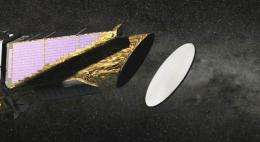
Artist concept of the Kepler spacecraft's dust cover coming off. Image credit: NASA/JPL

(PhysOrg.com) -- Engineers have successfully ejected the dust cover from NASA's Kepler telescope, a spaceborne mission soon to begin searching for worlds like Earth.

"The cover released and flew away exactly as we designed it to do," said Kepler Project Manager James Fanson of NASA's Jet Propulsion Laboratory, Pasadena, Calif. "This is a critical step toward answering a question that has come down to us across 100 generations of human history -- are there other like Earth, or are we alone in the galaxy?"

Kepler, which launched on March 6 from Cape Canaveral, Fla., will spend three-and-a-half years staring at more than 100,000 in our for signs of Earth-size planets. Some of the planets are expected to orbit in a star's "habitable zone," a warm region where water could pool on the surface. The mission's science instrument, called a photometer, contains the largest camera ever flown in space -- its 42 charge-coupled devices (CCDs) will detect slight dips in starlight, which occur when planets passing in front of their stars partially block the light from Kepler's view.

This video is not supported by your browser at this time.

The telescope's oval-shaped dust cover, measuring 1.7 meters by 1.3 meters (67 inches by 52 inches), protected the photometer from contamination before and after launch. The dust cover also blocked stray light from entering the telescope during launch -- light that could have damaged its sensitive detectors. In addition, the cover was important for calibrating the photometer. Images taken in the dark helped characterize noise coming from the instrument's electronics, and this noise will later be removed from the actual science data.

"Now the photometer can see the stars and will soon start the task of detecting the planets," said Kepler's Science Principal Investigator William Borucki at NASA's Ames Research Center, Moffett Field, Calif. "We have thoroughly measured the background noise so that our photometer can detect minute changes in a star's brightness caused by planets."

At 7:13 p.m. PDT on April 7, engineers at Kepler's mission operations center at the Laboratory for Atmospheric and Space Physics, Boulder, Colo., sent commands to pass an electrical current through a "burn wire" to break the wire and release a latch holding the cover closed. The spring-loaded cover swung open on a fly-away hinge, before drifting away from the spacecraft.

With the cover off, starlight is entering the photometer and being imaged onto its focal plane. Engineers will continue calibrating the instrument using images of stars for another several weeks, after which science observations will begin.

Provided by JPL/NASA (news : web)


Rank 5 /5 (2 votes)
Related Stories
Relevant PhysicsForums posts
  • Is Venus Slowing Down?
    created2 hours ago
  • Never ending outer space.....
    createdFeb 11, 2012
  • Neutron Star fragments?
    createdFeb 11, 2012
  • stationary or not?
    createdFeb 11, 2012
  • Scale of the Universe
    createdFeb 10, 2012
  • Titan's lack of impact craters
    createdFeb 09, 2012
  • More from Physics Forums - General Astronomy

More news stories

Planck mission steps closer to the cosmic blueprint

(PhysOrg.com) -- ESA's Planck mission has revealed that our Galaxy contains previously undiscovered islands of cold gas and a mysterious haze of microwaves. These results give scientists new treasure to mine ...

Space & Earth / Astronomy

created 32 minutes ago | popularity 5 / 5 (1) | comments 0 | with audio podcast

New European rocket lifts off on maiden flight

Europe on Monday successfully launched a new lightweight rocket carrying a test payload, culminating a more than 12-year quest to master the entire range of space launchers.

Space & Earth / Space Exploration

created 4 hours ago | popularity 5 / 5 (5) | comments 2

Transforming galaxies

(PhysOrg.com) -- Many of the Universe's galaxies are like our own, displaying beautiful spiral arms wrapping around a bright nucleus. Examples in this stunning image, taken with the Wide Field Camera 3 on ...

Space & Earth / Astronomy

created 1 hour ago | popularity 5 / 5 (1) | comments 0 | with audio podcast

Alien matter in the solar system: A galactic mismatch

This just in: The Solar System is different from the space just outside it.

Space & Earth / Space Exploration

created 2 hours ago | popularity 4 / 5 (5) | comments 7 | with audio podcast

Scientists drill two miles down to ancient Lake Vostok

(PhysOrg.com) -- Russian scientists last week finished penetrating more than two miles through the Antarctic ice sheet to Lake Vostok, a huge freshwater lake that has been buried under the ice for millions ...

Space & Earth / Earth Sciences

created 1 hour ago | popularity 4.5 / 5 (2) | comments 0


Fast photon control brings quantum photonic technologies closer

(PhysOrg.com) -- Using photons instead of electrons to transmit information could lead to faster and more secure ways to communicate, among other advantages. Now a team of physicists has taken another step toward realizing ...

New ability to regrow blood vessels holds promise for treatment of heart disease

(Medical Xpress) -- University of Texas at Austin researchers have demonstrated a new and more effective method for regrowing blood vessels in the heart and limbs — a research advancement that could have ...

Myths and shame keep many from seeking bankruptcy protection

(PhysOrg.com) -- Two interesting facts that may counter modern ideas about bankruptcy: The overwhelming majority of U.S. filings belong to individuals rather than corporations or entities, and most of these ...

Big Society could threaten biodiversity conservation

A study of the Moray Firth Seal Management Plan (MFSMP), in north-east Scotland, identified four key conditions for long-term success, three of which pointed to the importance of direct government involvement.

Motivation to exercise affects behavior

(Medical Xpress) -- For many people, the motivation to exercise fluctuates from week to week, and these fluctuations predict whether they will be physically active, according to researchers at Penn State. In an effort to ...

'It's not nutritious until it's eaten'

As part of her "Let's Move! Initiative," First Lady Michelle Obama unveiled a new web resource highlighting new changes in the Chefs Move to Schools, during a CMST gathering in Dallas, TX today. CMTS advocates ...