Ice Bridge Supporting Wilkins Ice Shelf Collapses
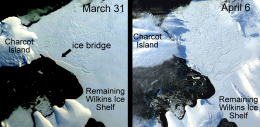
April 8, 2009 Ice Bridge Supporting Wilkins Ice Shelf Collapses

Enlarge

This before and after image shows the collapse of the ice bridge connecting the remainder of Wilkins Ice Shelf to Charcot Island. NSIDC processed these images from the NASA Moderate Resolution Imaging Spectroradiometer (MODIS) sensor, which flies on NASA's Earth Observing System Aqua and Terra satellites. Credit: National Snow and Ice Data Center

(PhysOrg.com) -- An ice bridge connecting the Wilkins Ice Shelf on the Antarctic Peninsula to Charcot Island has disintegrated. The event continues a series of breakups that began in March 2008 on the ice shelf, and highlights the effect that climate change is having on the region.

Images from the Moderate Resolution Imaging Spectroradiometer (MODIS) sensors on the Terra and Aqua satellites showed the shattering of the between March 31, 2009 and April 6, 2009. The loss of the ice bridge, which was bracing the remaining portions of the Wilkins , will now allow a mass of broken ice and icebergs to drift into the Southern Ocean.

Scientists at NSIDC and around the world have been watching the ice bridge since last March, anticipating its collapse. Now that it has broken up, researchers are closely monitoring the remaining portion of the Wilkins Ice Shelf to see if the loss of the ice bridge allows the ice shelf to collapse further.

The Wilkins is following a pattern of instability and rapid collapse that many ice shelves have experienced in recent years. Scientists think that the dramatic loss of these ice shelves, which have existed for hundreds to thousands of years, is an important sign of in the Southern Hemisphere. The loss of an ice shelf can also allow the glaciers that feed into it to start flowing ice into the ocean at an accelerated rate, contributing to a rise in global sea levels.

The Wilkins Ice Shelf first began to break up in the mid-1990s. Last March, the Wilkins lost another 400 square kilometers (160 square miles) in a rapid retreat, and the ice shelf continued to form new cracks over the winter.

The Wilkins Ice Shelf is located on the southwestern Antarctic Peninsula, the fastest-warming region of the Earth. In the past 50 years, the Antarctic Peninsula has warmed by 2.5 degrees Celsius (4 degrees Fahrenheit). In the early 1990s, the Wilkins Ice Shelf had a total area of 17,400 square kilometers (6,700 square miles). Events in 1998 and the early years of this decade reduced that to roughly 13,680 square kilometers (5,280 square miles). In 2008, a series of disintegrations (rapid repeated calvings in which the ice shelf pieces are small enough to topple over) and break-up events (rifting of large sections of the shelf, leading to large tabular iceberg calvings) shrunk the area of stable shelf to roughly 10,300 square kilometers (4,000 square miles), a net loss within a year of approximately 3,600 square kilometers (1,400 square miles).

Provided by University of Colorado at Boulder


print this article email this article download pdf blog this article bookmark this article     Stumble it Digg this share on Facebook retweet share on Reddit add to delicious
Rate this story - 4.7 /5 (34 votes)

Rank Filter

Move the slider to adjust rank threshold, so that you can hide some of the comments.


Display comments: newest first

  • GrayMouser - Apr 10, 2009
    • Rank: 5 / 5 (1)
    Did I miss the end of the world as we know it on April 6th?

April 8, 2009 all stories

Comments: 1

4.7 /5 (34 votes)
  • Stumble this up

  • Digg this

  • share this

  • hide
  • Related Stories

  • 'Webcam' from Space: Envisat observing Wilkins Ice Shelf
    created Dec 12, 2008 | popularity not rated yet | comments 0
  • Wilkins Ice Shelf under threat
    created Nov 28, 2008 | popularity not rated yet | comments 0
  • Antarctic ice shelf disintegrating as result of climate change, say scientists
    created Mar 25, 2008 | popularity not rated yet | comments 0
  • Antarctic ice shelf 'hangs by a thread'
    created Mar 25, 2008 | popularity not rated yet | comments 0
  • Antarctic losing ice at historic pace
    created Aug 05, 2005 | popularity not rated yet | comments 0


  • hide
  • Relevant PhysicsForums posts

  • Which countries around the world cause the most destruction to the rain forest
    created 7 hours ago
  • HadleyCru data hacked
    created Nov 20, 2009
  • Younger Dryas Caused by Ice Dam Collapse?
    created Nov 17, 2009
  • Modeling rainfall and flooding
    created Nov 15, 2009
  • More from Physics Forums - Earth

Other News

Astronauts finish another spacewalk, still no baby (AP)

Astronauts finish another spacewalk, still no baby

Space & Earth / Space Exploration

created 6 hours ago | popularity 3 / 5 (2) | comments 0

(AP) -- A spacewalking astronaut put aside the impending birth of his daughter and blazed through his first-ever venture outside the International Space Station on Saturday.


Unseasonably hot and dry weather combined with strong winds to fan scores of blazes in the country's southeastern states

Australia issues 'catastrophic' alerts as fires rage

Space & Earth / Environment

created 12 hours ago | popularity 4.5 / 5 (2) | comments 0

Australia has issued "catastrophic" alerts after record-breaking temperatures and wild lightning storms sparked more than 100 fires across the country, officials said Saturday.


Commuters wait on the platform shrouded by fog in London

Climate change not man-made, say majority of Britons: poll

Space & Earth / Environment

created Nov 15, 2009 | popularity 3.3 / 5 (15) | comments 45

Less than half of Britons believes that human activity is to blame for global warming, according to a poll carried out for The Times newspaper and published on Saturday.


Mysteriously warm times in Antarctica

Mysteriously warm times in Antarctica

Space & Earth / Earth Sciences

created Nov 18, 2009 | popularity 4.2 / 5 (21) | comments 28

(PhysOrg.com) -- A new study of Antarctica's past climate reveals that temperatures during the warm periods between ice ages (interglacials) may have been higher than previously thought. The latest analysis ...


UN: Fight climate change with free condoms (AP)

UN: Fight climate change with free condoms

Space & Earth / Environment

created Nov 18, 2009 | popularity 3.1 / 5 (11) | comments 23

(AP) -- The battle against global warming could be helped if the world slowed population growth by making free condoms and family planning advice more widely available, the U.N. Population Fund said Wednesday.