US firm investing billions in crisis-hit chip industry
April 9, 2009 by Martin Abbugao
Jim Doran of GlobalFoundaries

Enlarge

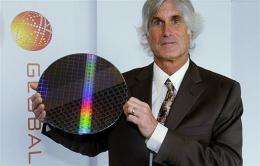
Jim Doran, senior vice president of US chipmaker GlobalFoundries and general manager of the company's current primary manufacturing facility in Dresden, poses with a 300mm test wafer from the AMD production at the Globalfoundries plant in Dresden in March 2009. GlobalFoundries, formed in March, is investing billions of dollars in a bid to catch the next wave of growth.

Despite the economic slump that has battered the semiconductor business, a new player from the United States' Silicon Valley technology belt is investing billions of dollars in a bid to catch the next wave of growth.

GlobalFoundries, formed in March, will focus on making next-generation chips, which it hopes will accelerate competition in a global foundry market dominated by Taiwanese and Singaporean firms.

The company will spend 3.3 billion dollars to build a manufacturing plant in New York's Saratoga County, which will be fully operational by 2012. Another 2.7 billion dollars will be invested to upgrade its operations in the German city of Dresden and boost overall processes as well as sales, marketing and design activities.

Full production at the plants should come progressively on stream just in time for an economic rebound, company executives say.

"If we start working with customers this year, it won't be until 2010 before they start manufacturing with us. So who knows what the economic climate is going to look like in 2010?" GlobalFoundries chief executive Douglas Grose told AFP in an interview.

"Our view is that it's going to start to turn and the timing is such that our investments will be ready," he said.

"When you are sitting at the bottom of an economic thing it may not look good. But in reality the timing is good."

Grose was in Singapore as part of a global tour to meet with potential clients.

The firm plans to blaze ahead by making smaller and higher-performance chips in the range of 45, 32 and 28 nanometres, leaping from the current standard of 90 and 65 nanometres, Grose said.

"I think this is a game-changer," said Grose.

A nanometre is a metric unit of linear measure that equals one-billionth of a metre. Hundreds of these nanometre-sized semiconductors, popularly known as chips, can fit in the width of a single strand of human hair.

Chips are used in most electronic devices and systems but wary consumers worldwide are buying fewer electronic goods and analysts forecast chip sales to further contract this year before starting a feeble recovery in 2010.

GlobalFoundries says long-term growth prospects remain strong, driven by a rising number of firms outsourcing manufacturing to independent foundries -- companies like itself that make custom chips for clients.

But the company faces an uphill battle against Taiwan Semiconductor Manufacturing Company (TSMC), United Microelectronics Corp (UMC) also of Taiwan, Singapore's Chartered Semiconductor and other established foundries.

One of its main shareholders, US firm Advanced Micro Devices (AMD), is locked in a dispute with Intel Corporation over what Intel said is a breach of a 2001 patent cross-licensing agreement.

GlobalFoundries is a spinoff of AMD's manufacturing operations, and AMD is currently its main client.

The other GlobalFoundries shareholder is Advanced Technology Investment Company, oil-rich Abu Dhabi's investment vehicle in the high-tech sector.

"Intel believes that GlobalFoundries is not a subsidiary under terms of that agreement and so can't be licensed under its terms to manufacture products that use Intel intellectual property," said Shane Rau, a research director with industry consultancy IDC.

"That needs to be worked out," he told AFP.

GlobalFoundries' other challenge is convincing major semiconductor firms that do not have their own wafer fabrication plants to switch sides.

"Even though GlobalFoundries will have AMD as a customer to generate early revenue, over time, GlobalFoundries will have to prove its independence from AMD in order to gain the confidence of other potential leading-edge customers," Rau said.

Grose said his company offers a choice.

"In any industry, there's got to be alternatives and we're going to provide some choice to customers on the leading edge," he said.

He also said he was encouraged after his initial meetings with potential customers.

"Is it a bad time to invest? I think it is a good time," he said.

(c) 2009 AFP

4.2 /5 (5 votes)  

Rank 4.2 /5 (5 votes)
Relevant PhysicsForums posts
  • Static-E Attraction on Kittin' Needle
    created1 hour ago
  • combining two audio sources, digitally
    created2 hours ago
  • metal-insulator-metal capacitor J-V characteristics
    created2 hours ago
  • Electrical tecqniques in food Sterilization
    created2 hours ago
  • shorting of digital high and ground
    created13 hours ago
  • Thermostat spark suppression
    created15 hours ago
  • More from Physics Forums - Electrical Engineering

More news stories

Netflix light on flicks as viewers soak up TV shows

Like most fresh faces that arrive in Hollywood, Netflix wanted to be a movie star. But now it's learning what many in Tinseltown have known for decades: Movies are sexy, but the real money is in television.

Technology / Business

created 1 hour ago | popularity not rated yet | comments 1

Zuckerberg's focus drives Facebook's ascent

When Mark Zuckerberg showed up to rent Judy Fusco's Los Altos, Calif., house in the fall of 2004, soon after he'd arrived in Silicon Valley, the landlord was immediately struck by his confidence.

Technology / Internet

created 6 minutes ago | popularity not rated yet | comments 0

Sony's Hirai refuses to abandon dire TV business

Struggling Japanese entertainment giant Sony will not abandon its cash-bleeding television business, its incoming CEO says, but he acknowledges tough decisions lie ahead including over redundancies.

Technology / Business

created 1 hour ago | popularity not rated yet | comments 0

New error-correcting codes guarantee the fastest possible rate of data transmission

Error-correcting codes are one of the triumphs of the digital age. They’re a way of encoding information so that it can be transmitted across a communication channel — such as an optical fiber o ...

Technology / Computer Sciences

created 4 hours ago | popularity 5 / 5 (3) | comments 2 | with audio podcast

Small modular reactor design could be a 'SUPERSTAR'

(PhysOrg.com) -- Though most of today's nuclear reactors are cooled by water, we've long known that there are alternatives; in fact, the world's first nuclear-powered electricity in 1951 came from a reactor ...

Technology / Energy & Green Tech

created 3 hours ago | popularity 5 / 5 (5) | comments 10 | with audio podcast


Antidepressants and pregnancy: Women must consider the impact of drugs on baby, and of depression on baby, themselves

Upon learning they are pregnant, most women dutifully nix the alcohol, sushi and caffeine. But what about antidepressants?

Both maternal and paternal age linked to autism

Older maternal and paternal age are jointly associated with having a child with autism, according to a recently published study led by researchers at The University of Texas Health Science Center at Houston (UTHealth).

Curry spice component may help slow prostate tumor growth

Curcumin, an active component of the Indian curry spice turmeric, may help slow down tumor growth in castration-resistant prostate cancer patients on androgen deprivation therapy (ADT), a study from researchers ...

The power of estrogen -- male snakes attract other males

A new study has shown that boosting the estrogen levels of male garter snakes causes them to secrete the same pheromones that females use to attract suitors, and turned the males into just about the sexiest ...

Humans may have helped the decline of African rainforests 3000 years ago

(PhysOrg.com) -- Large areas of rainforests in Central Africa mysteriously disappeared over three thousand years ago, to be replaced by savannas. The prevailing theory has been that the cause was a change ...

Fool's gold may prove an unlikely alternative to overexploited catalytic materials

Catalytic materials, which lower the energy barriers for chemical reactions, are used in everything from the commercial production of chemicals to catalytic converters in car engines. However, with current catalytic materials ...