Solomon Islands earthquake sheds light on enhanced tsunami risk
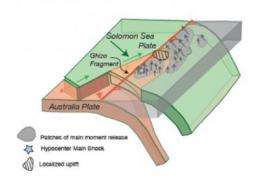
The 2007 Solomon Island earthquake may point to previously unknown increased earthquake and tsunami risks because of the unusual tectonic plate geography and the sudden change in direction of the earthquake, according to geoscientists.
On April 1, 2007, a tsunami-generating earthquake of magnitude 8.1 occurred East of Papua New Guinea off the coast of the Solomon Islands. The subsequent tsunami killed about 52 people, destroyed much property and was larger than expected.
"This area has some of the fastest moving plates on Earth," said Kevin P. Furlong, professor of geoscience, Penn State. "It also has some of the youngest oceanic crust subducting anywhere."
Subduction occurs when one tectonic plate moves beneath another plate. In this area, there are actually three plates involved, two of them subducting beneath the third while sliding past each other. The Australia Plate and the Solomon Sea/Woodlark Basin Plate are both moving beneath the Pacific Plate. At the same time, the Australia and Solomon Sea/Woodlark Basin Plates are sliding past each other. The Australia Plate moves beneath the Pacific Plate at about 4 inches a year and the Solomon Sea Plate moves beneath the Pacific Plate at about 5.5 inches per year. As if this were not complicated enough, the Australia and Solomon Sea plates are also moving in slightly different directions.
The researchers who include Furlong; Thorne Lay, professor of Earth and planetary sciences, University of California, Santa Cruz, and Charles J. Ammon, professor of geoscience, Penn State, were intrigued by the occurrence of a great earthquake where the three plates meet and investigated further. They report their findings in today's (Apr. 10) issue of Science.
The researchers found that the earthquake crossed from one plate boundary -- the Australia-Pacific boundary -- into another -- the Solomon/Woodlark-Pacific boundary. The event began in the Australia Plate and moved across into the Solomon Sea Plate and had two centers of energy separated by lower energy areas.
"Normally we think earthquakes should stop at the plate boundaries," said Furlong
More importantly, when the earthquake moved from one plate to the other, it quickly changed direction, mimicking the different plate motion directions of the plates involved.
"We are confident that the fault slip in the two main locations are different by 30 to 40 degrees," said Furlong. "I do not know of any other place where we have observed that behavior during an earthquake before, but it most certainly has happened here before."
The two motion directions during the earthquake caused the Pacific plate to bunch up and uplift. This localized atypical uplift during this earthquake reached a maximum of a couple of yards. This uplift is proposed to be the cause of a local increase in tsunami heights. It may also be what has produced these near-trench islands.
"This event, repeated enough times may be why islands in this area are plentiful," said Furlong. "They are coral islands, not volcanic ones, and so are created by uplift."
Another unusual component of this earthquake is the abruptness at which the earthquake's direction changed. Seismic data indicate that the change occurred in 12.5 miles or less.
Furlong notes, however that the change could have happened in even less distance, but the seismic data are only sensitive enough to recognize changes on that scale.
According to Furlong, seismologists do not expect young sections of the Earths crust to be locations of major earthquakes, so the Solomon Island earthquake was unusual from the beginning. He also believes that similar areas exist or existed.
"Other places along subduction zones had this type of geography in the past and might show up geologically," said Furlong. "At present there are locations along the margins of Central America and southern South America that could potentially host similar earthquakes."
A better understanding of earthquakes zones like the Solomon Islands may help residents along other complex plate boundaries to better prepare for localized regions of unusually large uplift and tsunami hazards.
Source: Pennsylvania State University (news : web)


