New Laser Technique Advances Nanofabrication Process
April 9, 2009
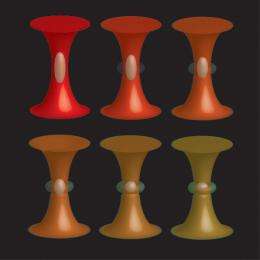
Schematic depictions of RAPID lithography, the technique developed by John Fourkas and colleagues which enables the creation of features 2500 times smaller than the width of a human hair.
(PhysOrg.com) -- The ability to create tiny patterns is essential to the fabrication of computer chips and many other current and potential applications of nanotechnology. Yet, creating ever smaller features, through a widely-used process called photolithography, has required the use of ultraviolet light, which is difficult and expensive to work with.
John Fourkas, Professor of Chemistry and Biochemistry in the University of Maryland College of Chemical and Life Sciences, and his research group have developed a new, table-top technique called RAPID (Resolution Augmentation through Photo-Induced Deactivation) lithography that makes it possible to create small features without the use of ultraviolet light. This research is to be published in Science magazine and released on Science Express on April 9, 2009.
Photolithography uses light to deposit or remove material and create patterns on a surface. There is usually a direct relationship between the wavelength of light used and the feature size created. Therefore, nanofabrication has depended on short wavelength ultraviolet light to generate ever smaller features.
"The RAPID lithography technique we have developed enables us to create patterns twenty times smaller than the wavelength of light employed,"explains Dr. Fourkas, "which means that it streamlines the nanofabrication process. We expect RAPID to find many applications in areas such as electronics, optics, and biomedical devices."
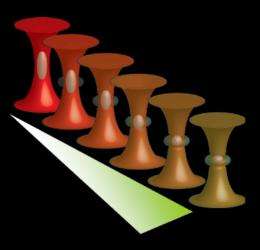
"If you have gotten a filling at the dentist in recent years,"says Fourkas, "you have seen that a viscous liquid is squirted into the cavity and a blue light is then used to harden it. A similar process of hardening using light is the first element of RAPID. Now imagine that your dentist could use a second light source to sculpt the filling by preventing it from hardening in certain places. We have developed a way of using a second light source to perform this sculpting, and it allows us to create features that are 2500 times smaller than the width of a human hair."
Both of the laser light sources used by Fourkas and his team were of the same color, the only difference being that the laser used to harden the material produced short bursts of light while the laser used to prevent hardening was on constantly. The second laser beam also passed through a special optic that allowed for sculpting of the hardened features in the desired shape.
"The fact that one laser is on constantly in RAPID makes this technique particularly easy to implement,"says Fourkas, "because there is no need to control the timing between two different pulsed lasers."
Fourkas and his team are currently working on improvements to RAPID lithography that they believe will make it possible to create features that are half of the size of the ones they have demonstrated to date.
More information: Achieving lambda/20 Resolution by One-Color Initiation and Deactivation of Polymerization was written by Linjie Li, Rafael R. Gattass, Erez Gershgorem, Hana Hwang and John T. Fourkas. (published in Science Express)
-
UM Team Devises Way to Use Metal in Micromachines
Feb 09, 2006 |
not rated yet |
0
-
Researchers Use Laser To Build Micro-Structures On A Human Hair
May 27, 2004 |
not rated yet |
0
-
Scientists coax gold particles to emit light strong enough to view single nanoparticles
May 23, 2005 |
not rated yet |
0
-
Researchers Invent Way to Mass Produce Microscopic Plastic Components
May 23, 2006 |
not rated yet |
0
-
Two-photon absorbing molecules fabricate polymer features just 65 nanometers wide
Mar 26, 2007 |
not rated yet |
0
-
Engineers build first sub-10-nm carbon nanotube transistor
Feb 01, 2012 |
4.9 / 5 (33) |
30
-
Something old, something new: Evolution and the structural divergence of duplicate genes
Jan 31, 2012 |
4.6 / 5 (7) |
1
-
The hidden nanoworld of ice crystals: Revealing the dynamic behavior of quasi-liquid layers
Jan 30, 2012 |
5 / 5 (4) |
1
-
Stock market network reveals investor clustering
Jan 27, 2012 |
3.9 / 5 (23) |
8
-
Of microchemistry and molecules: Electronic microfluidic device synthesizes biocompatible probes
Jan 26, 2012 |
5 / 5 (2) |
0
-
Can Plasma Be Solid
4 hours ago
-
What is delta Δ ?
4 hours ago
-
Need some help understanding HertzĀKnudsen formula
5 hours ago
-
Anatomy of Fat man: implosion-critical bomb
7 hours ago
-
what makes two sounds similar???
7 hours ago
-
What would happen when a jet travelling at Mach 10 experiences engine failure
14 hours ago
- More from Physics Forums - General Physics
More news stories
Lab study raises questions over nano-particle impact
Tests involving chickens have raised questions about the impact on health from engineered nano-particles, the ultra-fine grains commonly used in drugs and processed foods, scientists said on Sunday.
Nanotechnology / Bio & Medicine
9 hours ago |
5 / 5 (5) |
0
New kind of solar cell could capture significantly more energy than current cells
New solar cells could increase the maximum efficiency of solar panels by over 25%, according to scientists from the University of Cambridge.
Feb 08, 2012 |
4.5 / 5 (13) |
14
|
Nanoshell whispering galleries improve thin solar panels
Visitors to Statuary Hall in the U.S. Capitol Building may have experienced a curious acoustic feature that allows a person to whisper softly at one side of the cavernous, half-domed room and for another on ...
Nanotechnology / Nanomaterials
Feb 07, 2012 |
4.4 / 5 (7) |
6
|
'Dark plasmons' transmit energy
Microscopic channels of gold nanoparticles have the ability to transmit electromagnetic energy that starts as light and propagates via "dark plasmons," according to researchers at Rice University.
Feb 09, 2012 |
4.8 / 5 (10) |
1
|
Revealing how a battery material works
Since its discovery 15 years ago, lithium iron phosphate (LiFePO4) has become one of the most promising materials for rechargeable batteries because of its stability, durability, safety and ability to deliver ...
Nanotechnology / Nanomaterials
Feb 08, 2012 |
5 / 5 (6) |
0
|
Scientists discover molecular secrets of 2,000-year-old Chinese herbal remedy
For roughly two thousand years, Chinese herbalists have treated Malaria using a root extract, commonly known as Chang Shan, from a type of hydrangea that grows in Tibet and Nepal. More recent studies suggest that halofuginone, ...
New method to examine batteries -- MRI from the inside
There is an ever-increasing need for advanced batteries for portable electronics, such as phones, cameras, and music players, but also to power electric vehicles and to facilitate the distribution and storage of energy derived ...
Google might launch Drive for cloud storage soon
(PhysOrg.com) -- Google's next big move, according to the Wall Street Journal, is a cloud storage service called Drive. Hardly first to the plate, Google is simply catching up to introducing its cloud reposi ...
A mitosis mystery solved: How chromosomes align perfectly in a dividing cell
Although the process of mitotic cell division has been studied intensely for more than 50 years, Whitehead Institute researchers have only now solved the mystery of how cells correctly align their chromosomes during symmetric ...
Starve a virus, feed a cure? Findings show how some cells protect themselves against HIV
A protein that protects some of our immune cells from the most common and virulent form of HIV works by starving the virus of the molecular building blocks that it needs to replicate, according to research published online ...
Researchers find extensive RNA editing in human transcriptome
In a new study published online in Nature Biotechnology, researchers from BGI, the world's largest genomics organization, reported the evidence of extensive RNA editing in a human cell line by analysis of RNA-seq data, demons ...

Apr 09, 2009
Rank: 5 / 5 (2)
Apr 09, 2009
Rank: 5 / 5 (2)