Autonomous Antarctic Observatories Gather Space Weather Data
April 9, 2009
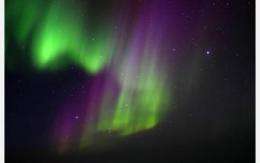
The Aurora Australis over the South Pole. Credit: Keith Vanderlinde / NSF
(PhysOrg.com) -- An international scientific consortium has developed a series of autonomous observatories in Antarctica that for the first time provide critical year-round "space weather" data from the Earth's harshest environment.
Recently, data from these observatories were used in conjunction with the National Aeronautics and Space Administration's array of THEMIS satellites to reveal new information about magnetospheric substorms--the sudden release of energy that causes auroral displays.
"The Antarctic is magnetically connected to vast regions of space and the solar wind, and provides a unique window to observe dynamic processes in Earth's upper atmosphere and beyond," said Allan Weatherwax of Siena College.
Weatherwax and Marc Lessard, of the Institute for the Study of Earth, Oceans and Space at the University of New Hampshire, are co-principal investigators for the multi-institutional project known as the Polar Experiment Network for Geospace Upper-atmosphere Investigations (PENGUIn).
In addition to the University of New Hampshire and Siena College, the PENGUIn science and engineering team includes investigators from Augsburg College, the University of California-Berkeley, Dartmouth College, the University of Maryland, the New Jersey Institute of Technology, Stanford University, Virginia Polytechnic Institute and State University, the University of Michigan and Japan's Tohoku University.
The U.S. investigators were supported by the National Science Foundation, which administers the U.S. Antarctic Program.
The suite of remote observatories range in size and complexity from multi-instrumented platforms that run on solar and wind power and provide around-the-clock, real-time data to microwatt units that collect and store data for retrieval.
The observatories gather data on the interaction of solar-wind energy with Earth's magnetic field lines, which arc high above our atmosphere and connect at both the North and South poles. Gathering such information in Antarctica is significantly more challenging in comparison to the more populous and relatively milder Arctic.
"In order to fully understand the phenomena we're studying, you have to know what happens with the field lines at both the poles," notes Lessard.
Earth's magnetic field extends far into space, where energy from the solar wind can be readily transferred to our "magnetosphere." A vast amount of energy follows magnetic field lines to the vicinity of the poles, driving aurora and other phenomena at high latitudes. By measuring such things as magnetic field variations, auroral emissions and other phenomena, scientists are learning more about space weather.
The term "space weather" generally refers to conditions on the Sun, in the solar wind, and within Earth's magnetosphere and upper atmosphere that can influence the performance and reliability of space-borne and ground-based technological systems and can pose risks to astronauts and people onboard aircraft in polar regions.
Besides emitting a continuous stream of plasma (solar wind), the Sun periodically releases billions of tons of matter via coronal mass ejections. These immense clouds of material, when directed toward Earth, can cause large magnetic storms in the space environment around Earth or "geospace"--the magnetosphere and the upper atmosphere.
The automated observatories have been developed over a period of years, evolving from platforms that ran on fossil fuels and required frequent maintenance to the more efficient, modular observatories that can be easily transported and installed at remote locations with extreme climates. In addition, the new-generation observatories operate by solar and wind energy alone and transfer data via satellite uplinks.
As energy from the solar wind is transferred to Earth's magnetic field it is sometimes stored for a period of time and then released to deliver large fluxes of energetic particles. The combined satellite and observatory data showed for the first time that some of these energetic particles reach very high latitudes as they collide with Earth's upper atmosphere.
Provided by NSF
-
University of Alberta space research to solve aurora mystery
Jan 10, 2007 |
not rated yet |
0
-
Study finds Earth's auroras are not mirror images
Apr 06, 2005 |
not rated yet |
0
-
Mercury's magnetosphere fends off the solar wind
Jan 30, 2008 |
not rated yet |
0
-
Scientists solve 30-year-old aurora borealis mystery
Jul 24, 2008 |
not rated yet |
0
-
NASA Satellites Discover What Powers Northern Lights
Jul 24, 2008 |
not rated yet |
0
-
Engineers build first sub-10-nm carbon nanotube transistor
Feb 01, 2012 |
4.9 / 5 (33) |
30
-
Something old, something new: Evolution and the structural divergence of duplicate genes
Jan 31, 2012 |
4.6 / 5 (7) |
1
-
The hidden nanoworld of ice crystals: Revealing the dynamic behavior of quasi-liquid layers
Jan 30, 2012 |
5 / 5 (4) |
1
-
Stock market network reveals investor clustering
Jan 27, 2012 |
3.9 / 5 (23) |
8
-
Of microchemistry and molecules: Electronic microfluidic device synthesizes biocompatible probes
Jan 26, 2012 |
5 / 5 (2) |
0
-
Never ending outer space.....
20 hours ago
-
Neutron Star fragments?
22 hours ago
-
stationary or not?
Feb 11, 2012
-
Scale of the Universe
Feb 10, 2012
-
Titan's lack of impact craters
Feb 09, 2012
-
Real pictures of black hole eating a star?
Feb 08, 2012
- More from Physics Forums - General Astronomy
More news stories
Salvage workers begin pumping fuel from Italian shipwreck
Salvage workers Sunday began pumping fuel from the shipwrecked Italian cruise liner Costa Concordia, a day ahead of schedule, officials said.
5 hours ago |
not rated yet |
0
Latin America mining boom clashes with conservation
Latin America is experiencing a mining boom as prices rise fuelled by a hike in global demand, but the region is also being hit by a wave of violent protests, strikes and rallies by environmentalists.
13 hours ago |
5 / 5 (1) |
1
Political leaders play key role in how worried Americans are by climate change: study
More than extreme weather events and the work of scientists, it is national political leaders who influence how much Americans worry about the threat of climate change, new research finds.
Feb 06, 2012 |
5 / 5 (6) |
73
NASA budget will axe Mars deal with Europe: scientists
US President Barack Obama's budget proposal to be submitted next week for 2013 will cut NASA's budget by 20 percent and eliminate a major partnership with Europe on Mars exploration, scientists said Thursday.
Space & Earth / Space Exploration
Feb 10, 2012 |
5 / 5 (3) |
58
Humans may have helped the decline of African rainforests 3000 years ago
(PhysOrg.com) -- Large areas of rainforests in Central Africa mysteriously disappeared over three thousand years ago, to be replaced by savannas. The prevailing theory has been that the cause was a change ...
Scientists discover molecular secrets of 2,000-year-old Chinese herbal remedy
For roughly two thousand years, Chinese herbalists have treated Malaria using a root extract, commonly known as Chang Shan, from a type of hydrangea that grows in Tibet and Nepal. More recent studies suggest that halofuginone, ...
Overeating may double risk of memory loss
New research suggests that consuming between 2,100 and 6,000 calories per day may double the risk of memory loss, or mild cognitive impairment (MCI), among people age 70 and older. The study was released today and will be ...
New method to examine batteries -- MRI from the inside
There is an ever-increasing need for advanced batteries for portable electronics, such as phones, cameras, and music players, but also to power electric vehicles and to facilitate the distribution and storage of energy derived ...
A mitosis mystery solved: How chromosomes align perfectly in a dividing cell
Although the process of mitotic cell division has been studied intensely for more than 50 years, Whitehead Institute researchers have only now solved the mystery of how cells correctly align their chromosomes during symmetric ...
Lab study raises questions over nano-particle impact
Tests involving chickens have raised questions about the impact on health from engineered nano-particles, the ultra-fine grains commonly used in drugs and processed foods, scientists said on Sunday.
Starve a virus, feed a cure? Findings show how some cells protect themselves against HIV
A protein that protects some of our immune cells from the most common and virulent form of HIV works by starving the virus of the molecular building blocks that it needs to replicate, according to research published online ...