Join STEREO and Explore Gravitational 'Parking Lots' That May Hold Secret of Moon's Origin
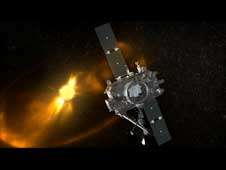
Two places on opposite sides of Earth may hold the secret to how the moon was born. NASA's twin Solar Terrestrial Relations Observatory (STEREO) spacecraft are about to enter these zones, known as the L4 and L5 Lagrangian points, each centered about 93 million miles away along Earth's orbit.
As rare as free parking in New York City, L4 and L5 are among the special points in our solar system around which spacecraft and other objects can loiter. They are where the gravitational pull of a nearby planet or the sun balances the forces from the object's orbital motion. Such points closer to Earth are sometimes used as spaceship "parking lots", like the L1 point a million miles away in the direction of the sun. They are officially called Libration points or Lagrangian points after Joseph-Louis Lagrange, an Italian-French mathematician who helped discover them.
L4 and L5 are where an object's motion can be balanced by the combined gravity of the sun and Earth. "These places may hold small asteroids, which could be leftovers from a Mars-sized planet that formed billions of years ago," said Michael Kaiser, Project Scientist for STEREO at NASA's Goddard Space Flight Center in Greenbelt, Md. "According to Edward Belbruno and Richard Gott at Princeton University, about 4.5 billion years ago when the planets were still growing, this hypothetical world, called Theia, may have been nudged out of L4 or L5 by the increasing gravity of the other developing planets like Venus and sent on a collision course with Earth. The resulting impact blasted the outer layers of Theia and Earth into orbit, which eventually coalesced under their own gravity to form the moon."
This theory is a modification of the "giant impact" theory of the moon's origin, which has become the dominant theory because it explains some puzzling properties of the moon, such as its relatively small iron core. According to giant impact, at the time of the collision, the two planets were large enough to be molten, so heavier elements, like iron, sank to their centers to form their cores.
The impact stripped away the outer layers of the two worlds, which contained mostly lighter elements, like silicon. Since the moon formed from this material, it is iron-poor.
STEREO will look for asteroids with a wide-field-of-view telescope that's part of the Sun Earth Connection Coronal and Heliospheric Investigation instrument. Any asteroid will probably appear as just a point of light. Like a picky person circling the mall for the perfect parking space, the asteroids orbit the L4 or L5 points. The team will be able to tell if a dot is an asteroid because it will shift its position against stars in the background as it moves in its orbit. The team is inviting the public to participate in the search by viewing the data and filing a report at: >
Kaiser said, "If we discover the asteroids have the same composition as the Earth and moon, it will support Belbruno and Gott's version of the giant impact theory. The asteroids themselves could well be left-over from the formation of the solar system. Also, the L4/L5 regions might be the home of future Earth-impacting asteroids."
Analyses of lunar rocks brought to Earth by the Apollo missions reveal that they have the same isotopes (heavier versions of an element) as terrestrial rocks. Scientists believe that the sun and the worlds of our solar system formed out of a cloud of gas and dust that collapsed under its gravity. The composition of this primordial cloud changed with temperature. Since the temperature decreased with distance from the sun, whatever created the moon must have formed in the same orbital location as Earth in order for them to have the same isotope composition.
In a planetary version of "the rich get richer", Earth's gravity should have swept up most of the material in its orbit, leaving too little to create our large moon or another planet like Theia. "However, computer models by Belbruno and Gott indicate that Theia could have grown large enough to produce the moon if it formed in the L4 or L5 regions, where the balance of forces allowed enough material to accumulate," said Kaiser.
The STEREO spacecraft are designed to give 3D views of space weather by observing the sun from two points of view and combining the images in the same way your eyes work together to give a 3D view of the world. STEREO "A" is moving slightly ahead of Earth and will pass through L4, and STEREO "B" is moving slightly behind Earth and will pass through L5. "Taking the time to observe L4 and L5 is kind of cool because it's free. We're going through there anyway -- we're moving too fast to get stuck," said Kaiser. "In fact, after we pass through these regions, we will see them all the time because our instruments will be looking back through them to observe the sun - they will just happen to be in our field of view."
Although L4 and L5 are just points mathematically, their region of influence is huge - about 50 million miles along the direction of Earth's orbit, and 10 million miles along the direction of the sun. It will take several months for STEREO to pass through them, with STEREO A making its closest pass to L4 in September, and STEREO B making its closest pass to L5 in October.
"L4 or L5 are excellent places to observe space weather. With both the sun and Earth in view, we could track solar storms and watch them evolve as they move toward Earth. Also, since we could see sides of the sun not visible from Earth, we would have a few days warning before stormy regions on the solar surface rotate to become directed at Earth," said Kaiser.
Source: NASA's Goddard Space Flight Center (news : web)


