US wages war on bugs afflicting troops abroad
April 10, 2009 By JANET McCONNAUGHEY , Associated Press Writer US wages war on bugs afflicting troops abroad (AP)

Enlarge

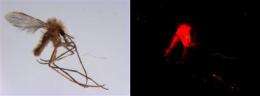
These undated photos provided by the Louisiana State University AgCenter and taken by post-doctoral researcher Tom Mascari, show a female sand fly marked with Rhodamine B, a fluorescent dye, using brightfield microscopy, left, and using fluorescence microscopy, right. The images were taken as part of research to learn whether sandflies could be killed by feeding rats on bait laced chemicals toxic to the flies but harmless to the rodents. (AP Photo/LSU AgCenter, Tom Mascari)

(AP) -- Fluorescent rodent feces, a promising new mosquito repellant and a better flytrap are all part of a war on bugs designed to protect U.S. troops around the world.

Researchers in the Pentagon's Deployed Warfighter Protection Research Program highlighted pest-fighting innovations this week at the American Mosquito Control Association convention attended by some 800 scientists and insect control experts. Their aim: to take no prisoners among disease-carrying flies, and other bugs that threaten Americans in uniform abroad.

Even the common fly is counted among the enemy.

"When you're deployed, I would say 90 percent of all soldiers, service members, are going to have issues with filth flies," said Army Lt. Col. Jason Pike, executive officer of the 65th Medical Brigade's Force Health Protection and Preventive Medicine program headquartered in South Korea.

"Filth flies carry many organisms which cause diarrhea ... It might not be fatal, but one soldier out of commission affects a lot of other people," he said.

Begun in 2004, the Deployed Warfighter Protection Research Program dispenses $5 million a year to find new ways to combat disease-carrying insects that threaten the troops - applications that ultimately could protect the public at large.

Military-driven research has produced past innovations against malaria and dengue and helped develop DEET, a key ingredient in most modern repellants. It even has led to chemical-treated fabrics that ward off ticks and mosquitoes.

Fighting bugs is a "global perpetual need," said program coordinator Graham B. White of the Armed Forces Pest Management Board. "Even if nobody went to war for a long time, these things would still need to be developed."

He said small insecticide sprayers developed through the program are now in use. The program also backed testing that secured recent Environmental Protection Agency approval of an insecticide spray that is highly toxic at low doses to adult mosquitoes but safe for mammals.

Now Navy Corpsman Joe Diclaro II is taking aim at the housefly. "I like to think of it as a death device," Diclaro said of a fold-up flytrap designed to ship flat and be rolled into bug-catching tubes in the field.

For starters, he changed the color of the trap.

"Almost everything on the market is yellow," said Diclaro, who is working on a doctorate in medical entomology at the University of Florida in conjunction with the Agriculture Department's Mosquito and Fly Research Unit.

When Diclaro released house flies in a dark tunnel between boxes lit in different colors, he found flies prefer blue or white over yellow.

So his trap is made of blue signboard. Tests show it has killed about 3,000 flies in 24 hours. Diclaro said his university's technology office has applied for a patent.

The research is among nearly three dozen studies funded by the Pentagon program since 2004.

Stephen Duke, of the National Center for Natural Products Research in Oxford, Miss., described possible bug repellents derived from American beautyberry, a shrub common to the Gulf coast. Duke said work began after a botanist remarked that relatives had rubbed farm mules with beautyberry leaves for bug protection.

Two colorless, odorless compounds in the leaves - callicarpenal and intermedeol - seem about as good as DEET against mosquitoes and repel black-leg ticks and fire ants, Duke said. He said a decision on possible commercial uses is still a few years away.

The fluorescent feces are being used at Louisiana State University to learn whether sandflies can be killed by feeding sand rats a chemical harmless to the rodents but lethal to larvae that eat their feces.

Leishmaniasis, which causes disfiguring open sores and is spread by sandfly bites, is an enormous concern in the Middle East, White said. The disease infects an estimated 2 million people a year, according to the World Health Organization.

More than 2,000 U.S. troops in Iraq and Afghanistan have suffered from the disease, said Kenneth Linthicum, director of the Agriculture Department's Center for Medical, Agricultural and Veterinary Entomology.

To show that something eaten by a rodent could affect a sandfly, LSU researchers fed hamsters a dye that glows hot pink under fluorescent light. Sandfly larvae that ate the rodents' feces glowed, too.

They then fed hamsters two different chemicals known to kill sandfly larvae. Larvae ate their feces and died.

The fluorescent bait is being tested in Kenya and more work is planned on it, said researcher Thomas Mascari, a postdoctoral student in entomology at the LSU AgCenter.

"In 2010, we'll be going to Egypt to work with the Navy," he said.

---

On the Net:

Deployed Warfighter Protection Program: http://www.afpmb.org/dwfpresearch.htm

©2009 The Associated Press. All rights reserved. This material may not be published, broadcast, rewritten or redistributed.


print this article email this article download pdf blog this article bookmark this article     Stumble it Digg this share on Facebook retweet share on Reddit add to delicious
Rate this story - not rated yet

Rank Filter

Move the slider to adjust rank threshold, so that you can hide some of the comments.


Display comments: newest first

  • jonnyboy - Apr 10, 2009
    • Rank: not rated yet
    "Now Navy Corpsman Joe Diclaro II is taking aim at the housefly. "I like to think of it as a death device," Diclaro said of a fold-up flytrap designed to ship flat and be rolled into bug-catching tubes in the field.


    For starters, he changed the color of the trap.


    "Almost everything on the market is yellow," said Diclaro, who is working on a doctorate in medical entomology at the University of Florida in conjunction with the Agriculture Department's Mosquito and Fly Research Unit.


    When Diclaro released house flies in a dark tunnel between boxes lit in different colors, he found flies prefer blue or white over yellow.


    So his trap is made of blue signboard. Tests show it has killed about 3,000 flies in 24 hours. Diclaro said his university's technology office has applied for a patent.


    The research is among nearly three dozen studies funded by the Pentagon program since 2004. "


    The lead researcher is in the navy, working at U of Florida(subsidized by the govt), on a project being ran by the Ag Dept, and funded by the Pentagon.


    Why in all h$ll is the University applying for a patent (that they will undoubtedly use to make money for the University) instead of this research belonging to the government (meaning taxpayers)?

April 10, 2009 all stories

Comments: 1

not rated yet
  • Stumble this up

  • Digg this

  • share this

  • hide
  • Related Stories

  • Troops in Iraq fight bugs, parasites
    created May 07, 2007 | popularity not rated yet | comments 0
  • Scientists Confirm Folk Remedy Repels Mosquitoes
    created Jun 29, 2006 | popularity not rated yet | comments 0
  • Smaller mosquitoes are more likey to be infected with viruses causing human diseases
    created Nov 03, 2008 | popularity not rated yet | comments 0
  • Wet or dry, Montana still threatened by West Nile
    created Jun 11, 2008 | popularity not rated yet | comments 0
  • A natural, alternative insect repellent to DEET
    created Feb 05, 2009 | popularity not rated yet | comments 0


  • hide
  • Relevant PhysicsForums posts

  • What is transpulmonary pressure?
    created Nov 24, 2009
  • Is there a gay gene?
    created Nov 23, 2009
  • Super quick question about Starling forces?
    created Nov 22, 2009
  • Questions about diffusion
    created Nov 22, 2009
  • Human Leukocyte Antigen (HLA) typing
    created Nov 21, 2009
  • Breeding program
    created Nov 20, 2009
  • More from Physics Forums - Biology

Other News

Variable Temperatures Leave Insects wtih a Frosty Reception

Biology / Plants & Animals

created 5 hours ago | popularity not rated yet | comments 0

(PhysOrg.com) -- For the first time, scientists at The University of Western Ontario have shown that insects exposed to repeated periods of cold will trade reproduction for immediate survival.


When camouflage is a plant's best protection

Rare woodland plant uses 'cryptic coloration' to hide from predators

Biology / Plants & Animals

created 7 hours ago | popularity 4.3 / 5 (3) | comments 0

It is well known that some animal species use camouflage to hide from predators. Individuals that are able to blend in to their surroundings and avoid being eaten are able to survive longer, reproduce, and ...


Cells defend themselves from viruses, bacteria with armor of protein errors

Biology / Cell & Microbiology

created 9 hours ago | popularity 5 / 5 (5) | comments 0

When cells are confronted with an invading virus or bacteria or exposed to an irritating chemical, they protect themselves by going off their DNA recipe and inserting the wrong amino acid into new proteins to defend them ...


'Safety valve' protects photosynthesis from too much light

Biology / Cell & Microbiology

created 8 hours ago | popularity 5 / 5 (2) | comments 0

Photosynthetic organisms need to cope with a wide range of light intensities, which can change over timescales of seconds to minutes. Too much light can damage the photosynthetic machinery and cause cell death. Scientists ...


Researchers discover biological basis of 'bacterial immune system'

Biology / Cell & Microbiology

created 9 hours ago | popularity 4.5 / 5 (2) | comments 0

Bacteria don't have easy lives. In addition to mammalian immune systems that besiege the bugs, they have natural enemies called bacteriophages, viruses that kill half the bacteria on Earth every two days.