CSI: Pisco, Peru -- Study uncovers tectonic events behind earthquake
April 10, 2009 CSI: Pisco, Peru

Enlarge

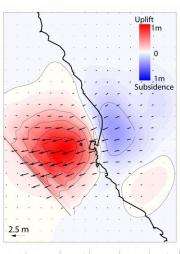
Three-dimensional deformation following the 2007 Pisco, Peru earthquake. The red areas show ~1m of uplift offshore and the blues areas about 50 cm of subsidence on land. The hinge-line between uplift and subsidence closely matches the location of the coastline. Credit: UM Rosenstiel School

A magnitude 8.0. earthquake destroyed 90 percent of the city of Pisco, Peru on August 16, 2007. The event killed 595 people, while another 318 were missing. Tsunami waves were observed locally, off the shore of Chile, and as far away as New Zealand.

In a study published in the Geophysical Journal International, scientists from the University of Miami's Rosenstiel School of Marine and Atmospheric Science, in collaboration with scientists from the University of Oxford (U.K.) have analyzed data on this and its impact on regional topography. Using InSAR-based geodetic data and teleseismic data, the scientists were able to use satellite images to identify details of this major plate boundary event.

"Unfortunately, historical earthquakes in Central Peru show a complex repeat pattern making it difficult to identify which area will be affected in the future," said Rosenstiel School Postdoctoral Fellow and Principal Investigator Dr. Juliet Biggs. "The convergence of the Nazca and the South American plates is slowly building the Andes, but the relationship between great earthquakes and mountain building processes is still unclear."

Intriguingly, models developed as a result of this event in 2007 demonstrated no upper lifting of the region after this major earthquake. Long-term uplift of the upper plate must either occur aseismically or as 'slow earthquakes' during the interseismic or postseismic part of the earthquake cycle.

Support for the project came from the U.S. National Science Foundation. The earthquake confirmed a common feature for earthquakes in central Peru: maximum intensity and damage occur few tens of kilometers south of the epicenter. This is a key observation for disaster management and prediction.

"Visiting Peru immediately after the earthquake together with fellow researcher Kim Outerbridge provided us with a desolating picture of the affected region, but it was critically important for data-gathering," Biggs said.

The collaboration with Dr. Edmundo Norabuena, a former graduate from the Rosenstiel School now at Instituto Geofísico del Perú, to deploy GPS equipment in the region permitted collection of essential data, which will be the subject of a new study. This will provide details on the movement generated deep inside the earth after the , which is another crucial part of the puzzle in terms of our understanding of the recurrence intervals of major earthquakes.

Source: University of Miami Rosenstiel School of Marine & Atmospheric Science


print this article email this article download pdf blog this article bookmark this article     Stumble it Digg this share on Facebook retweet share on Reddit add to delicious
Rate this story - 5 /5 (2 votes)


April 10, 2009 all stories

Comments: 0

5 /5 (2 votes)
  • Stumble this up

  • Digg this

  • share this

  • hide
  • Related Stories

  • Slow slip and slide dynamics
    created Mar 05, 2008 | popularity not rated yet | comments 0
  • Faulted modeling
    created Mar 23, 2007 | popularity not rated yet | comments 0
  • Tonga quake not conducive to tsunami
    created Mar 06, 2007 | popularity not rated yet | comments 0
  • Paired earthquakes separated in time and space
    created Jan 30, 2008 | popularity not rated yet | comments 0
  • Magmatically triggered slow earthquake discovered at Kilauea Volcano, Hawaii
    created Aug 29, 2008 | popularity not rated yet | comments 0


  • hide
  • Relevant PhysicsForums posts

  • cycles
    created 16 hours ago
  • The Origin of the term 'fossil' fuels
    created Nov 05, 2009
  • co2
    created Nov 03, 2009
  • Early Earths Sulfidic Ocean Conditions
    created Oct 30, 2009
  • More from Physics Forums - Earth

Other News

Deep creep means milder, more frequent earthquakes along Southern California's San Jacinto fault

Deep creep means milder, more frequent earthquakes along Southern California's San Jacinto fault

Space & Earth / Earth Sciences

created 15 hours ago | popularity 4.5 / 5 (4) | comments 0

With an average of four mini-earthquakes per day, Southern California's San Jacinto fault constantly adjusts to make it a less likely candidate for a major earthquake than its quiet neighbor to the east, the ...


Success in 'space elevator' competition (AP)

Success in 'space elevator' competition (Update 3)

Space & Earth / Space Exploration

created Nov 05, 2009 | popularity 4.3 / 5 (33) | comments 50

(AP) -- A robot powered by a ground-based laser beam climbed a long cable dangling from a helicopter on Wednesday to qualify for prize money in a $2 million competition to test the potential reality of the ...


In a Galaxy Far, Far Away...

In a Galaxy Far, Far Away...

Space & Earth / Astronomy

created Nov 06, 2009 | popularity 4.8 / 5 (5) | comments 17

(PhysOrg.com) -- Astronomers have published the discovery of the farthest known object in the cosmos: a star that exploded when the universe was only 630 million years old -- only 4.6% of its current age. ...


'Dropouts' pinpoint earliest galaxies

'Dropouts' pinpoint earliest galaxies

Space & Earth / Astronomy

created Nov 06, 2009 | popularity 4.2 / 5 (10) | comments 13

Astronomers, conducting the broadest survey to date of galaxies from about 800 million years after the Big Bang, have found 22 early galaxies and confirmed the age of one by its characteristic hydrogen signature ...


Space hotel taking bookings for 2012 opening

Space hotel taking bookings for 2012 opening

Space & Earth / Space Exploration

created Nov 05, 2009 | popularity 4.4 / 5 (21) | comments 11

(PhysOrg.com) -- The first orbiting space hotel is on track to open for its first customers in 2012, but hurry, as bookings are filling fast.