Molecule prompts damaged heart cells to repair themselves after a heart attack
April 10, 2009 Molecule prompts damaged heart cells to repair themselves after a heart attack

Enlarge

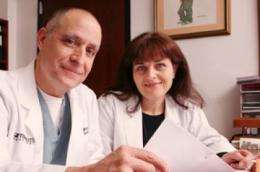
Drs. J. Michael DiMaio and Ildiko Bock-Marquette have found in mice that the molecule Thymosin beta-4 affects developmental gene expression in heart cells as early as 24 hours after systemic injection. The new findings suggest that introducing TB4 after a heart attack encourages new growth and repair of these cells. Credit: UT Southwestern Medical Center

A protein that the heart produces during its early development reactivates the embryonic coronary developmental program and initiates migration of heart cells and blood vessel growth after a heart attack, researchers at UT Southwestern Medical Center have found.

The molecule, Thymosin beta-4 (TB4), is expressed by during the heart's development and encourages migration of heart cells. The new findings in mice suggest that introducing TB4 systemically after a heart attack encourages new growth and repair of heart cells. The research findings indicate that the molecule affects developmental gene expression as early as 24 hours after systemic injection. The UT Southwestern study is online and will appear in an upcoming issue of the Journal of Molecular and Cellular Cardiology.

"This molecule has the potential to reprogram cells in the body to get them to do what you want them to do," said Dr. J. Michael DiMaio, associate professor of cardiothoracic surgery at UT Southwestern and senior author of the study. Obviously, the clinical implications of this are enormous because of the potential to reverse damage inflicted on heart cells after a heart attack."

Tremendous medical progress has been made to counter the damaging effects of heart attacks, but ordinarily, mammalian hearts are incapable of repairing themselves following damage. They are also limited in their ability to form new blood vessels. Earlier studies demonstrated that TB4 is expressed in the embryonic heart and stimulates cardiac vessels to form. It was therefore thought that introduction of TB4 might activate new in the adult heart.

In this mouse study researchers found that TB4 initiates capillary tube formation of adult coronary endothelial cells in tissue culture. The molecule also encourages cardiac regeneration by inhibiting death in after an injury such as a heart attack and by stimulating new vessel growth.

"We observed that by injecting this protein systemically, there was increased cardiac function after a heart attack," said Dr. Ildiko Bock-Marquette, assistant professor of cardiothoracic surgery at UT Southwestern and the study's lead author. "We hope this protein can inhibit cell death that occurs during a heart attack in the short term, and that it may initiate new growth of coronary vessels by activating progenitor cells in the long term."

Researchers assessed the effect of TB4 on new vessel growth in adult mice after inducing heart attacks and then following up by introducing TB4 into the animals. An examination of the capillary smooth muscle cells following treatment with TB4 showed a significant increase in capillary density in the three days afterward near the site of the , the scientists reported.

Further studies will examine whether the same events occur in larger mammals and which receptors are responsible for the action of this molecule.

Source: UT Southwestern Medical Center (news : web)


print this article email this article download pdf blog this article bookmark this article     Stumble it Digg this share on Facebook retweet share on Reddit add to delicious
Rate this story - 5 /5 (5 votes)


April 10, 2009 all stories

Comments: 0

5 /5 (5 votes)
  • Stumble this up

  • Digg this

  • share this

  • hide
  • Related Stories

  • Molecule prompts blood stem cells to help repair heart damage in animal model
    created Apr 15, 2008 | popularity not rated yet | comments 0
  • Adult pig stem cells repair heart damage
    created Nov 14, 2006 | popularity not rated yet | comments 0
  • Stem cells train heart following heart attack
    created Nov 21, 2007 | popularity not rated yet | comments 0
  • Heart attacks and nerves
    created Nov 15, 2007 | popularity not rated yet | comments 0
  • Tiny molecule controls stress-induced heart disease
    created Mar 22, 2007 | popularity not rated yet | comments 0


  • hide
  • Relevant PhysicsForums posts

  • Swine flu vaccination
    created 54 minutes ago
  • Improving the brain through chemistry
    created Nov 07, 2009
  • Sleep / REM Sleep and homeostasis
    created Nov 07, 2009
  • The Biceps Reflex
    created Nov 05, 2009
  • More from Physics Forums - Medical Sciences

Other News

The upside of feeling down

The upside of feeling down

Medicine & Health / Psychology & Psychiatry

created 9 hours ago | popularity 4 / 5 (4) | comments 4

A chill wind chases you into the door of your local newsagent. Rain is drumming down outside. As you pay for your newspaper, you briefly notice a number of strange items on the checkout counter - a matchbox ...


Words, gestures are translated by same brain regions, says new research

Medicine & Health / Neuroscience

created 14 hours ago | popularity 5 / 5 (3) | comments 0

Your ability to make sense of Groucho's words and Harpo's pantomimes in an old Marx Brothers movie takes place in the same regions of your brain, says new research funded by the National Institute on Deafness and Other Communication ...


Implantable Glucose Sensor Could Spell Relief for Millions of Diabetics (w/ Video)

Implantable Glucose Sensor Could Spell Relief for Millions of Diabetics (w/ Video)

Medicine & Health / Research

created 10 hours ago | popularity not rated yet | comments 0

(PhysOrg.com) -- UConn researchers have developed a tiny wireless device that can be inserted under a patient?s skin to monitor blood glucose levels over a period of several months.


Diet switching can activate brain's stress system, lead to 'withdrawal' symptoms

Medicine & Health / Research

created 11 hours ago | popularity not rated yet | comments 0

In research that sheds light on the perils of yo-yo dieting and repeated bouts of sugar-bingeing, researchers from The Scripps Research Institute have shown in animal models that cycling between periods of eating sweet and ...


Deepening the search  for clues to rheumatoid arthritis

Deepening the search for clues to rheumatoid arthritis

Medicine & Health / Genetics

created 22 hours ago | popularity 5 / 5 (1) | comments 7

(PhysOrg.com) -- The gnawing pain of rheumatoid arthritis is a signal that the body’s immune system has hit the wrong target: its own cartilage and bone.