Climate Change and Atmospheric Circulation Will Make for Uneven Ozone Recovery
April 10, 2009 by Michael Carlowicz Climate Change and Atmospheric Circulation Will Make for Uneven Ozone Recovery

Enlarge

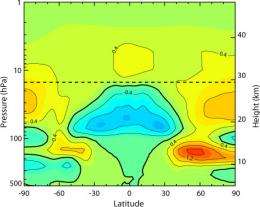
This plot of ozone concentration by latitude and altitude shows the net gain (oranges and reds) and net loss of ozone from years 1975-84 to 2060-69. Credit: Feng Li et al, NASA, published in Atmospheric Chemistry and Physics

(PhysOrg.com) -- Earth's ozone layer should eventually recover from the unintended destruction brought on by the use of chlorofluorocarbons (CFCs) and similar ozone-depleting chemicals in the 20th century. But new research by NASA scientists suggests the ozone layer of the future is unlikely to look much like the past because greenhouse gases are changing the dynamics of the atmosphere.

Previous studies have shown that while the buildup of greenhouse gases makes it warmer in troposphere - the level of atmosphere from Earth’s surface up to 10 kilometers (6 miles) altitude - it actually cools the upper stratosphere - between 30 to 50 kilometers high (18 to 31 miles). This cooling slows the chemical reactions that deplete ozone in the upper stratosphere and allows natural ozone production in that region to outpace destruction by CFCs.

But the accumulation of greenhouse gases also changes the circulation of stratospheric air masses from the tropics to the poles, NASA scientists note. In Earth's middle latitudes, that means ozone is likely to "over-recover," growing to concentrations higher than they were before the mass production of CFCs. In the tropics, stratospheric circulation changes could prevent the from fully recovering.

"Most studies of ozone and global change have focused on cooling in the upper stratosphere," said Feng Li, an atmospheric scientist at the Goddard Earth Sciences and Technology Center at the University of Maryland Baltimore County, Baltimore, Md. and lead author of the study. "But we find circulation is just as important. It's not one process or the other, but both."

FLV player

This simulation shows the seasonal rise and fall of ozone over the northern hemisphere from 1974 to 2065. Note how the geographic extent and the concentrations of ozone -- deep reds are the highest levels -- decrease around the turn of the century, then rise again. Credit: Trent Schindler, NASA's Goddard Space Flight Center

The findings are based on a detailed computer model that includes atmospheric chemical effects, wind changes, and changes. Li's experiment is part of an ongoing international effort organized by the United Nations Environment Programme's Scientific Assessment Panel to assess the state of the ozone layer. Li and colleagues published their analysis in March in the journal Atmospheric Chemistry and Physics.

Working with Richard Stolarski and Paul Newman of NASA's Goddard Space Flight Center, Greenbelt, Md., Li adapted the Goddard Earth Observing System Chemistry-Climate Model (GEOS-CCM) to examine how climate change will affect ozone recovery. The team inserted past measurements and future projections of ozone-depleting substances and greenhouse gases into the model. Then the model projected how ozone, the overall chemistry, and the dynamics of the stratosphere would change through the year 2100.

"In the real world, we have observed statistically significant turnaround in ozone depletion, which can be attributed to the banning of ozone-depleting substances," said Richard Stolarski, an atmospheric chemist at Goddard and a co-author of the study. "But making that connection is complicated by the response of ozone to greenhouse gases."

The researchers found that greenhouse gases alter a natural circulation pattern that influences ozone distribution. Brewer-Dobson circulation is like a pump to the stratosphere, moving ozone from the lower parts of the atmosphere, into the upper stratosphere over the tropics. Air masses then flow north or south through the stratosphere, away from the tropics toward the poles.

In Li’s experiment, this circulation pump accelerated to a rate where the ozone flowing upward and outward from the tropics created a surplus at middle latitudes. Though the concentration of chlorine and other ozone-depleting substances in the stratosphere will not return to pre-1980 levels until 2060, the ozone layer over middle latitudes recovered to pre-1980 levels by 2025.

The Arctic - which is better connected to mid-latitude air masses than the Antarctic -- benefitted from the surplus in the northern hemisphere and from the overall decline of ozone-depleting substances to recover by 2025. Globally averaged ozone and Antarctic concentrations catch up by 2040, as natural atmospheric production of ozone resumes.

This recovery in the middle and polar latitudes has mixed consequences, Li noted. It might have some benefits, such as lower levels of ultraviolet radiation reaching the Earth's surface and correspondingly lower rates of skin cancer. On the other hand, it could have unintended effects, such as increasing ozone levels in the troposphere, the layer of atmosphere at Earth’s surface. The model also shows a continuing ozone deficit in the stratosphere over the tropics. In fact, when the model run ended at year 2100, the ozone layer over the tropics still showed no signs of recovery.

In February, researchers from Johns Hopkins University, Baltimore, teamed with Stolarski and other NASA scientists on a similar paper suggesting that increasing would delay or even postpone the recovery of ozone levels in the lower stratosphere over some parts of the globe. Using the same model as Li, Stolarski, and Newman, the researchers found that the lower stratosphere over tropical and mid-southern latitudes might not return to pre-1980s levels of for more than a century, if ever.

Provided by NASA Earth Science Team


print this article email this article download pdf blog this article bookmark this article     Stumble it Digg this share on Facebook retweet share on Reddit add to delicious
Rate this story - 4.4 /5 (28 votes)

Rank Filter

Move the slider to adjust rank threshold, so that you can hide some of the comments.


Display comments: newest first

  • vanderMerwe - Apr 10, 2009
    • Rank: 2.7 / 5 (6)
    Yeah, this is called cover your arse. When they started measuring ozone concentrations and discovered that ozone dropped in the antarctic in the winter the enviroNazis immediately grabbed onto it and declared that it was evil people dumping CNC's at fault even though they didn't have a long enough historical time line to even chart a decline properly.

    After a few years Dow Chemical discovered a "green" refrigerant that cost four times as much as the old R-12 that it replaced and jumped on the bandwagon of true believers.

    So we had a big world conference and banned all of the evil refrigerants. Now it's twenty years later and the ozone levels haven't miraculously been restored in over antarctica and the enviroNazis are having to invent new reasons, hooked to their latest environmental jihad, to explain why buying into their last jihad hasn't done anything.
  • Trippy - Apr 10, 2009
    • Rank: 3.3 / 5 (4)
    Yeah, this is called cover your arse. When they started measuring ozone concentrations and discovered that ozone dropped in the antarctic in the winter the enviroNazis immediately grabbed onto it and declared that it was evil people dumping CNC's at fault even though they didn't have a long enough historical time line to even chart a decline properly.


    After a few years Dow Chemical discovered a "green" refrigerant that cost four times as much as the old R-12 that it replaced and jumped on the bandwagon of true believers.


    So we had a big world conference and banned all of the evil refrigerants. Now it's twenty years later and the ozone levels haven't miraculously been restored in over antarctica and the enviroNazis are having to invent new reasons, hooked to their latest environmental jihad, to explain why buying into their last jihad hasn't done anything.


    This has to be one of the stupidist, narrowminded, most ignorant diatribes I have ever come across - ever.

    Here's a bunch of links to some graphs which say you're wrong:
    http://www.atm.da...zone.gif
    http://www.physic...area.jpg
    http://whyfiles.o...atch.gif

    The Montreal Protocol was intorduced in 1987, and referenced the 1986 levels of CFC's. As can be clearly seen in any of those graphs, clear trends had developed by 1985.

    As can also be seen from the graphs, the Montreal Protocol has been far from ineffective. Phase I was to have been implimented by 1991 - 1992, and we can see by these graphs that by about 1989-1990 the rate of increase in ozone depletion had begun to reduce.

    Phase III was to have been impliemnted by 1996 (reduction to zero, with reduction to 25% of 1986 emissions by 1994 being phase II). Since approximately 1995, the size of the ozone hole has stabilized (roughly speaking) with some studies indicating that it may be beginning to show signs of recovery:
    http://www.niwa.c...arge.jpg
    With the original predictions being that if the Montreal Protocol was adhered to, we would see a full recover of antarctic Ozone by about 2050.

    I should also point out that this article deals with northern hemisphere ozone depletion, but the Antarctic is in the southern hemisphere.

    I also think that if you genuinely believe this is all hocum, then perhaps you should pack your bags and move to the southern hemisphere and live with your mess.
  • GrayMouser - Apr 13, 2009
    • Rank: 2.3 / 5 (3)
    Trippy seems to have missed some history, the original scare on the ozone hole was about the South polar hole. Nobody ever explained why the South Pole had this gigantic ozone hole (when the prevalent usage of the supposed causative agent was being used in the Northern Hemisphere.) More recent research has pointed to a different cause of ozone depletion (http://www.scienc...RL.pdf).
  • Choice - Apr 13, 2009
    • Rank: not rated yet
    Don't forget to take your medication and then pee it into the hydrosphere.
  • rubberman - Apr 13, 2009
    • Rank: not rated yet
    Interesting, perhaps they will also find a different cause for all the plastic garbage floating in the ocean... you know, other than humans...
  • Trippy - Apr 15, 2009
    • Rank: 5 / 5 (1)
    Trippy seems to have missed some history, the original scare on the ozone hole was about the South polar hole. Nobody ever explained why the South Pole had this gigantic ozone hole (when the prevalent usage of the supposed causative agent was being used in the Northern Hemisphere.) More recent research has pointed to a different cause of ozone depletion (http://www.scienc...RL.pdf).


    Right - I missed it, which is why I mentioned moving down to the southern hemisphere, and all the graphs/sources I linked to were for the antarctic hole and why I stated "I should also point out that this article deals with northern hemisphere ozone depletion, but the Antarctic is in the southern hemisphere."

    Oh, and it has been explained why the Antarctic ozone hole is bigger than the arctic - it has to do with the stability of the polar vortex during the winter months, something to do with the fact that at the north pole you have a water mass surrounded by land masses, and at the south pole you have a land mass surrounded by water.

April 10, 2009 all stories

Comments: 6

4.4 /5 (28 votes)
  • Stumble this up

  • Digg this

  • share this

  • hide
  • Related Stories

  • Global warming may delay recovery of stratospheric ozone
    created Feb 04, 2009 | popularity not rated yet | comments 0
  • Study Finds Clock Ticking Slower On Ozone Hole Recovery
    created Jun 30, 2006 | popularity not rated yet | comments 0
  • Antarctic ozone - not a hole lot worse or better
    created Nov 10, 2005 | popularity not rated yet | comments 0
  • Winds trigger increases in ozone destroying gases in upper stratosphere
    created Sep 28, 2006 | popularity not rated yet | comments 0
  • Record cold winter may increase ozone hole over North Europe
    created Jan 31, 2005 | popularity not rated yet | comments 0


  • hide
  • Relevant PhysicsForums posts

  • cycles
    created 13 hours ago
  • The Origin of the term 'fossil' fuels
    created Nov 05, 2009
  • co2
    created Nov 03, 2009
  • Early Earths Sulfidic Ocean Conditions
    created Oct 30, 2009
  • vegetation
    created Oct 29, 2009
  • climate change
    created Oct 29, 2009
  • More from Physics Forums - Earth

Other News

Deep creep means milder, more frequent earthquakes along Southern California's San Jacinto fault

Deep creep means milder, more frequent earthquakes along Southern California's San Jacinto fault

Space & Earth / Earth Sciences

created 12 hours ago | popularity 4.7 / 5 (3) | comments 0

With an average of four mini-earthquakes per day, Southern California's San Jacinto fault constantly adjusts to make it a less likely candidate for a major earthquake than its quiet neighbor to the east, the ...


Success in 'space elevator' competition (AP)

Success in 'space elevator' competition (Update 3)

Space & Earth / Space Exploration

created Nov 05, 2009 | popularity 4.3 / 5 (33) | comments 50

(AP) -- A robot powered by a ground-based laser beam climbed a long cable dangling from a helicopter on Wednesday to qualify for prize money in a $2 million competition to test the potential reality of the ...


In a Galaxy Far, Far Away...

In a Galaxy Far, Far Away...

Space & Earth / Astronomy

created Nov 06, 2009 | popularity 4.8 / 5 (5) | comments 16

(PhysOrg.com) -- Astronomers have published the discovery of the farthest known object in the cosmos: a star that exploded when the universe was only 630 million years old -- only 4.6% of its current age. ...


'Dropouts' pinpoint earliest galaxies

'Dropouts' pinpoint earliest galaxies

Space & Earth / Astronomy

created Nov 06, 2009 | popularity 4.2 / 5 (10) | comments 13

Astronomers, conducting the broadest survey to date of galaxies from about 800 million years after the Big Bang, have found 22 early galaxies and confirmed the age of one by its characteristic hydrogen signature ...


Space hotel taking bookings for 2012 opening

Space hotel taking bookings for 2012 opening

Space & Earth / Space Exploration

created Nov 05, 2009 | popularity 4.4 / 5 (21) | comments 11

(PhysOrg.com) -- The first orbiting space hotel is on track to open for its first customers in 2012, but hurry, as bookings are filling fast.