Life Sticks: Bioengineer Publishes Sticky Insights in journal Science
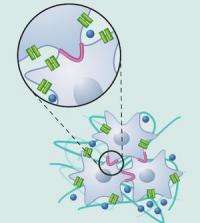
(PhysOrg.com) -- Sticky is good. A University of California, San Diego bioengineer is the first author on an article in the journal Science that provides insights on the “stickiness of life.” The big idea is that cells, tissues and organisms hailing from all limbs of the tree of life respond to stimuli using basic biological “modules.” For example, the researchers outlined similar strategies across biology for fulfilling the tasks of “sticking together” (cell-cell interactions), “sticking to their surroundings” (cell-extracellular matrix [ECM] interactions), and responding to forces.
Adam Engler, a bioengineering assistant professor from UC San Diego’s Jacobs School of Engineering, is the first author of the Review article entitled “Multiscale Modeling of Form and Function” published in the April 10 issue of the journal Science. According to Engler, there is something inherent in the nature of the ever-present tasks of sticking together and responding to forces that causes common form and function to emerge. For example, even though the cells within bacteria, fungi, sponges, nematodes and humans do not use exactly the same proteins to stick together, all of these organisms rely on fundamental components of cell-cell adhesions for survival. For this reason, the capacity to form complex multilayer organisms through cell-cell interactions is likely based on the evolutionary advantage to adhere to new environments and survive in potentially hostile environments, the authors say.
The team also described a universal need for cells, tissues, organs and organisms to respond to forces. Two examples of very different biological structures that nevertheless rely on responsiveness to forces for proper function are leg bones and breast acini. Breast acini are hollow spherical objects at the ends of breast ducts that are made of a layer of cells that secrete milk proteins. Breast acini form hollow spheres, according to Engler, because this form maximizes the surface to volume ratio. When pressure builds up, acini can hold more and more volume until they need to push the milk proteins down the duct.
“This kind of structure is conserved in a variety of dissimilar systems that respond to forces in a manner similar,” said Engler. The long bones of the human skeleton are another example, where their elongated and cylindrical form optimizes the distribution of body weight while remaining very light.
Thinking Wide
Engler hopes that the observations and connections he and his coauthors make regarding the ubiquitous need for vastly different cells, tissues, organs and organisms to use common biological modules will encourage other scientists and engineers to think beyond their specific areas of specialization.
“In our Science paper, I think we have arrived at an interesting way to describe known biological processes and bring concepts together that are traditionally not considered,” said Engler. “I hope this paper will encourage researchers to interact with disciplines previously assumed to be dissimilar and foster new interdisciplinary interactions like we have here at UCSD with the Institute for Engineering in Medicine.”
Engler’s primary appointment is in the Department of Bioengineering at UC San Diego’s Jacobs School of Engineering. The Department of Bioengineering ranks 2nd in the nation for biomedical engineering, according to the latest US News rankings. The bioengineering department has ranked among the top five programs in the nation every year for the past decade.
Engler has secondary appointments in Material Science and Biomedical Sciences. He is a member of the UCSD Stem Cell Institute and the UCSD Institute for Engineering in Medicine.
Engler is a bioengineer and mechanical engineer by training. He earned a Ph.D. in mechanical engineering from the University of Pennsylvania, and went on to a post doctoral fellowship in molecular biology at Princeton University before coming to UC San Diego in 2008. He is already involved in a number of interdisciplinary collaborations at UC San Diego.
One collaboration involves Engler, Shu Chien, who is University Professor of Bioengineering and Medicine, and Director of UC San Diego’s Institute of Engineering in Medicine (IEM), and materials science professor Sungho Jin from the Jacobs School of Engineering’s Mechanical and Aerospace Engineering (MAE) and NanoEngineering departments. In a January 2009 paper in the journal PNAS, researchers led by this team unveiled a new way to help accelerate bone growth through the use of nanotubes and stem cells. This new finding could lead to quicker and better recovery, for example, for patients who undergo orthopedic surgery.
Engler’s lab recently began a collaboration with Rick Lieber, Ph.D., Professor and Vice Chair of UC San Diego’s Department of Orthopedic Surgery and Director of the National Center for Skeletal Muscle Rehabilitation Research, based at UC San Diego. Lieber is also Senior Research Career Scientist at the Veterans Affairs San Diego Health System. The team is trying to uncover the cause of unexplained lower back pain in patients with no obvious disk degeneration, pinched nerves or other known causes of lower back pain.
“No matter what your area of expertise, there is someone that has a complementary area of expertise that can really help you ask new and interesting questions,” said Engler.
Interdisciplinary Research
Mathematicians, engineers and stem cell biologists have not traditionally worked together, but these kinds of interdisciplinary collaborations have been the key to developing new techniques and new disciplines, explained Engler, who told a story of how his own dabbling into interdisciplinary research led to fruitful results.
As a graduate student, Engler helped put an experimental stem-cell-based surgical technique into a more appropriate mechanical context. The project began when he was approached by a surgeon puzzled by the results he was getting after injecting stem cells into damaged rat heart tissue in hopes of regenerating healthy heart tissue.
“As a matrix biologist and a mechanical engineer I said, ‘Perhaps we need to look at what the host tissue is actually doing. What is being damaged and what is changing within the tissue due to the lack of oxygen?’” Engler and his collaborators found the cells in the damaged heart tissue were excreting collagen and making stiff scar tissue. “The engineer in me then analyzed the mechanical properties of the tissue and found out it was three to four times more rigid than the background healthy muscle. The biologist in me then characterized the cells in vitro and was able to show that these cells do respond to the mechanical properties of their environment.”
Engler published his findings in 2006 in the high profile journal Cell and in the American Journal of Physiology. (Read New Scientist’s description of Engler’s findings.) One idea for improving such cell-based therapies, according to Engler, could involve injecting “smarter stem cells” that have been programmed to respond to some environmental stimuli but ignore other stimuli.
More information: “Multiscale Modeling of Form and Function,” by Adam J. Engler from the University of California, San Diego; Patrick O. Humbert from Peter MacCallum Cancer Center; Bernhard Wehrle-Haller from Centre Medical Universitaire; and Valerie M. Weaver from University of California, San Francisco; appears in the 10 April 2009 issue of the journal Science, published by AAAS.
Provided by University of California - San Diego (news : web)


