Biochemists to study how crops can increase protein production
April 10, 2009 UC Riverside biochemist to study how crops can increase protein production

Enlarge

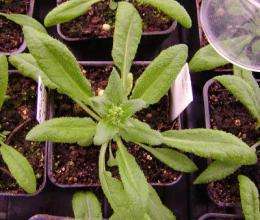
This is the Arabidopsis plant. Credit: Gallie lab, UC Riverside.

The small flowering plant Arabidopsis is widely used in laboratories as a model organism in plant biology.

A member of the mustard family, Arabidopsis offers researchers several advantages such as a completely sequenced genome, a compact size, a life-cycle of about only six weeks from seed to seed, easy cultivation and high seed production.

Now Daniel Gallie, a professor of biochemistry at UC Riverside, has received a three-year grant of nearly $1.75 million from the National Science Foundation to study how each Arabidopsis gene is converted into protein and how plants control this process.

The research can help improve in crops. Protein-rich crops improve the diet of humans directly and promote livestock productivity for a growing world population. Besides their nutritional advantages, these crops also reduce the environmental impact of livestock production by potentially reducing the acreage required for agriculture.

"Understanding how most genes, out of the more than 25,000 genes in Arabidopsis, are converted into protein will be important in understanding how plants control protein synthesis," Gallie said. "This knowledge is essential in improving in crops."

With the advent of the complete sequence of the genome of Arabidopsis and other plant species, researchers are now in a position of being able to understand how every gene in an organism is converted into protein.

"This, in conjunction with the development of other recent technologies, such as the ability to identify mutants in most genes as well as to analyze virtually all genes in Arabidopsis on a chip no larger than a fingertip, makes such a study possible for the first time," Gallie said.

He explained that the process of protein production involves many steps and requires multiple factors to carry out the synthesis.

"Our approach will identify which steps and which factors are involved for every gene," he said.

Gallie is the principal investigator of the National Science Foundation grant. UCR will manage the multi-investigator project that also involves researchers at three other universities: The University of Texas at Austin; the University of Tennessee, Knoxville; and the University of Arizona.

UCR has received $569,681 from the National Science Foundation for the first year of Gallie's research project. Funding in subsequent years ($581,775 in 2010 and $592,854 in 2011) is contingent on the availability of funds and scientific progress.

A portion of the grant will support graduate students and postdoctoral researchers in Gallie's lab.

Source: University of California - Riverside


print this article email this article download pdf blog this article bookmark this article     Stumble it Digg this share on Facebook retweet share on Reddit add to delicious
Rate this story - 5 /5 (2 votes)


April 10, 2009 all stories

Comments: 0

5 /5 (2 votes)
  • Stumble this up

  • Digg this

  • share this

  • hide
  • Related Stories

  • When leaves fall, more is occurring than a change of weather
    created Sep 22, 2008 | popularity not rated yet | comments 0
  • Discovery in plant virus may help prevent HIV and similar viruses
    created Jul 31, 2007 | popularity not rated yet | comments 0
  • First draft of transgenic papaya genome yields many fruits
    created Apr 23, 2008 | popularity not rated yet | comments 0
  • Tracking Genes for Self-pollination in Arabidopsis
    created Apr 27, 2007 | popularity not rated yet | comments 0
  • Tool helps identify gene function in soybeans
    created Dec 01, 2008 | popularity not rated yet | comments 0


  • hide
  • Relevant PhysicsForums posts

  • MO diagram of NO
    created 8 hours ago
  • limiting reagent
    created 11 hours ago
  • preparation of acetanilide
    created 11 hours ago
  • Putting every element in a box
    created Nov 25, 2009
  • More from Physics Forums - Chemistry

Other News

Sandia CR5

Machine Converts CO2 into Gasoline, Diesel, and Jet Fuel

Chemistry / Biochemistry

created Nov 23, 2009 | popularity 4.6 / 5 (31) | comments 20

(PhysOrg.com) -- Researchers at Sandia National Laboratories have built a machine that uses the sun's energy to convert carbon dioxide waste from power plants into transportation fuels such as gasoline, diesel, ...


New hydrogen-storage method discovered

New hydrogen-storage method discovered

Chemistry / Materials Science

created Nov 22, 2009 | popularity 4.3 / 5 (42) | comments 15

Scientists at the Carnegie Institution have found for the first time that high pressure can be used to make a unique hydrogen-storage material. The discovery paves the way for an entirely new way to approach ...


New chemical reaction offers opportunities for drug development

Chemistry / Biochemistry

created Nov 26, 2009 | popularity not rated yet | comments 2

Researchers led by Conway Fellow, Professor Pat Guiry have solved a chemistry problem that has stumped researchers worldwide for more than a decade. The results have earned the group the cover story of the leading scientific ...


Research sheds light on workings of anti-cancer drug

Chemistry / Analytical Chemistry

created Nov 26, 2009 | popularity not rated yet | comments 0

(PhysOrg.com) -- The copper sequestering drug tetrathiomolybdate (TM) has been shown in studies to be effective in the treatment of Wilson disease, a disease caused by an overload of copper, and certain metastatic cancers. ...


Chemists get custom-designed microscopic particles to self-assemble in liquid crystal

Chemists get custom-designed microscopic particles to self-assemble in liquid crystal

Chemistry / Materials Science

created Nov 25, 2009 | popularity 5 / 5 (5) | comments 0

(PhysOrg.com) -- The scientists anticipate their "LithoParticles" will have significant applications in photonics, optical communications and other areas.