Galapagos volcano erupts, could threaten wildlife
April 12, 2009 Galapagos volcano erupts, could threaten wildlife (AP)

Enlarge

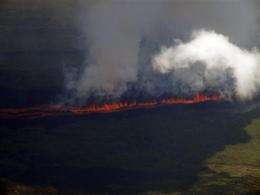
In this photo released by Galapagos National Park, La Cumbre volcano erupts in Fernandina Island, in the Galapagos islands, Ecuador, Saturday, April 11, 2009. The Galapagos National Park says La Cumbre volcano began spewing lava, gas and smoke on uninhabited Fernandina Island on Saturday after four years of inactivity. (AP Photo/Galapagos National Park)

(AP) -- Ecuador officials say a volcano is erupting in the Galapagos Islands and could harm unique wildlife.

The Galapagos National Park says La Cumbre volcano began spewing lava, gas and smoke on uninhabited Fernandina Island on Saturday after four years of inactivity.

The park says in a statement the eruption is not a threat to people living on nearby Isabela Island.

But it says lava flowing to the sea will likely affect marine and terrestrial iguanas, wolves and other fauna.

The Galapagos are home to unique animal and plant species that became the basis for Charles Darwin's theory of evolution.

Scientists say Fernandina is the island with the most in the archipelago. La Cumbre last erupted in May 2005.

©2009 The Associated Press. All rights reserved. This material may not be published, broadcast, rewritten or redistributed.


print this article email this article download pdf blog this article bookmark this article     Stumble it Digg this share on Facebook retweet share on Reddit add to delicious
Rate this story - 4.7 /5 (27 votes)

Rank Filter

Move the slider to adjust rank threshold, so that you can hide some of the comments.


Display comments: newest first

  • Modernmystic - Apr 12, 2009
    • Rank: 3.7 / 5 (6)
    Maybe they should pass a regulation on how many eruptions should occur per year and where...
  • snwboardn - Apr 12, 2009
    • Rank: 3.7 / 5 (6)
    or at least a volcano tax
  • zevkirsh - Apr 12, 2009
    • Rank: 4 / 5 (4)
    what about just trying to plant trees to offset the volcanoes carbon and greenhouse gas emissions? or why not just plug it up?
  • Bob_B - Apr 12, 2009
    • Rank: 1 / 5 (3)
    I'm sure Karl Rove can find a way to interrogate this terrorist event. Maybe waterboard it to help save the animals?
  • k_m - Apr 12, 2009
    • Rank: 3 / 5 (2)
    What do you mean the island didn't sign on to kyoto?
    Should cap and trade to another country that doesn't have their own volcano
  • Suzu - Apr 12, 2009
    • Rank: 1 / 5 (2)
    Their carbon footprint increased by 0.9%
  • theophys - Apr 13, 2009
    • Rank: 5 / 5 (2)
    I don't think anybody actualy gives a crap about the gasses. It's all those nifty plants and animals unique to that region that give us greenies a heart attack. Then again, evolution dictates that if you're not genetically fit enough to survive a swim in lava flow, you probably shouldn't be dirtying up the gene pool anyway.
  • rwinners - Apr 14, 2009
    • Rank: not rated yet
    Hilarious isn't it? Look at the Gallapagos in Google Earth. The whole chain is one huge volcanic hotspot. Whatever happens, we won't be able to effect it one bit.
    These guys need to step back and get bigger picture.

April 12, 2009 all stories

Comments: 8

4.7 /5 (27 votes)
  • Stumble this up

  • Digg this

  • share this

  • hide
  • Related Stories

  • A new baseline of invasive plants in Isabela
    created Oct 17, 2007 | popularity not rated yet | comments 0
  • Lonesome George may not be so lonesome after all
    created May 02, 2007 | popularity not rated yet | comments 0
  • Development threatens Galapagos Islands
    created Aug 25, 2006 | popularity not rated yet | comments 0
  • Tongan inspection team heads to undersea volcano
    created Mar 19, 2009 | popularity not rated yet | comments 0
  • Land iguanas under continuing threat on Galapagos archipelago
    created Nov 26, 2008 | popularity not rated yet | comments 0


  • hide
  • Relevant PhysicsForums posts

  • cycles
    created 7 hours ago
  • The Origin of the term 'fossil' fuels
    created Nov 05, 2009
  • co2
    created Nov 03, 2009
  • Early Earths Sulfidic Ocean Conditions
    created Oct 30, 2009
  • More from Physics Forums - Earth

Other News

Deep creep means milder, more frequent earthquakes along Southern California's San Jacinto fault

Deep creep means milder, more frequent earthquakes along Southern California's San Jacinto fault

Space & Earth / Earth Sciences

created 6 hours ago | popularity 4.7 / 5 (3) | comments 0

With an average of four mini-earthquakes per day, Southern California's San Jacinto fault constantly adjusts to make it a less likely candidate for a major earthquake than its quiet neighbor to the east, the ...


Success in 'space elevator' competition (AP)

Success in 'space elevator' competition (Update 3)

Space & Earth / Space Exploration

created Nov 05, 2009 | popularity 4.3 / 5 (33) | comments 50

(AP) -- A robot powered by a ground-based laser beam climbed a long cable dangling from a helicopter on Wednesday to qualify for prize money in a $2 million competition to test the potential reality of the ...


'Dropouts' pinpoint earliest galaxies

'Dropouts' pinpoint earliest galaxies

Space & Earth / Astronomy

created Nov 06, 2009 | popularity 4.2 / 5 (10) | comments 12

Astronomers, conducting the broadest survey to date of galaxies from about 800 million years after the Big Bang, have found 22 early galaxies and confirmed the age of one by its characteristic hydrogen signature ...


Space hotel taking bookings for 2012 opening

Space hotel taking bookings for 2012 opening

Space & Earth / Space Exploration

created Nov 05, 2009 | popularity 4.4 / 5 (20) | comments 11

(PhysOrg.com) -- The first orbiting space hotel is on track to open for its first customers in 2012, but hurry, as bookings are filling fast.


In a Galaxy Far, Far Away...

In a Galaxy Far, Far Away...

Space & Earth / Astronomy

created Nov 06, 2009 | popularity 4.8 / 5 (5) | comments 13

(PhysOrg.com) -- Astronomers have published the discovery of the farthest known object in the cosmos: a star that exploded when the universe was only 630 million years old -- only 4.6% of its current age. ...