Most koalas in Japan carry leukemia virus: report
April 12, 2009
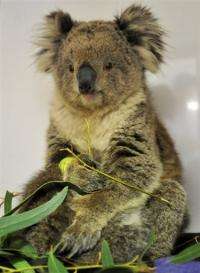
Nearly 90 percent of koalas in Japanese zoos are infected with a virus believed to cause leukemia in the marsupials, a report said
Nearly 90 percent of koalas in Japanese zoos are infected with a virus believed to cause leukemia in the marsupials, a report said.
Researchers at the Institute for Virus Research Kyoto University and the Japanese Association of Zoos and Aquariums tested the blood of 50 of the 62 koalas kept in Japan, the Daily Yomiuri said.
The koala retrovirus -- believed to cause leukemia and lymphoma -- was detected in all 39 northeastern koalas, and in four of 11 southern koalas, the English version of the mass-circulation Yomiuri Shimbun reported.
There are two main subspecies of wild koala -- the northeast Australian koala and the south Australian koala.
The retrovirus poses no danger to humans, but there is concern that it could lead to a dramatic decline in the number of koalas in captivity in Japan, the daily said.
While the sources of the infections were not identified, it is thought most likely they already were infected before being imported from Australia, it said.
Scientists say it is difficult to prevent koalas becoming infected with the virus as it infects the reproductive cells of the koalas and is passed down to their offspring, the daily said.
Of the 38 koalas born in Japan, 36 were found to have been infected, it added.
(c) 2009 AFP
-
Vaccine for koala chlamydia close
Jul 17, 2008 |
not rated yet |
0
-
Koala Chlamydia vaccine to be tested
Jul 17, 2007 |
not rated yet |
0
-
Vaccine trials inject hope into koala's future
Jul 16, 2007 |
not rated yet |
0
-
Research finds koalas are no dwarves
Dec 11, 2008 |
not rated yet |
0
-
A koala's guide to the treetop buffet
May 26, 2005 |
not rated yet |
0
-
Engineers build first sub-10-nm carbon nanotube transistor
Feb 01, 2012 |
4.9 / 5 (31) |
30
-
Something old, something new: Evolution and the structural divergence of duplicate genes
Jan 31, 2012 |
4.6 / 5 (7) |
1
-
The hidden nanoworld of ice crystals: Revealing the dynamic behavior of quasi-liquid layers
Jan 30, 2012 |
5 / 5 (3) |
1
-
Stock market network reveals investor clustering
Jan 27, 2012 |
3.9 / 5 (23) |
8
-
Of microchemistry and molecules: Electronic microfluidic device synthesizes biocompatible probes
Jan 26, 2012 |
5 / 5 (1) |
0
-
Stem cell question.
Feb 10, 2012
-
Protease cleavage
Feb 10, 2012
-
Pertubance in a model
Feb 10, 2012
-
Cancer drugs and Alzheimer's, Oh my!
Feb 09, 2012
-
Squishing cells
Feb 09, 2012
-
Any books/articles for evolutionary stable strategy models in humans?
Feb 09, 2012
- More from Physics Forums - Biology
More news stories
Entire genome of extinct human decoded from fossil
(PhysOrg.com) -- In 2010, Svante Pääbo and his colleagues presented a draft version of the genome from a small fragment of a human finger bone discovered in Denisova Cave in southern Siberia. The ...
Feb 07, 2012 |
4.7 / 5 (58) |
44
|
Why are there so few fish in the Earth's oceans?
(PhysOrg.com) -- A Stony Brook University researcher has found that, contrary to popular belief, there are not plenty of fish in the sea.
Feb 08, 2012 |
4.3 / 5 (17) |
26
|
Miami battling invasion of giant African snails
No one knows how they got there. But an invasion of African giant snails has southern Florida in a panic over potential crop damage, disease and general yuckiness surrounding the slimy gastropods.
Feb 10, 2012 |
4.5 / 5 (2) |
5
Deciding to go left or right: Researchers use device to determine that lower animals can navigate too
For decades, scientists have associated binary decision making opting to go left or right with higher-ranking animals, including humans. A team of Harvard researchers, however, is rewriting that ...
Feb 09, 2012 |
4 / 5 (1) |
4
|
Study shows chimps able to understand needs of others
(PhysOrg.com) -- By setting up a unique experiment, a small team of researchers has found that chimpanzees are able to understand need in other chimps, despite their general disinclination to offer aid when ...
Google might launch Drive for cloud storage soon
(PhysOrg.com) -- Google's next big move, according to the Wall Street Journal, is a cloud storage service called Drive. Hardly first to the plate, Google is simply catching up to introducing its cloud reposi ...
Latin America mining boom clashes with conservation
Latin America is experiencing a mining boom as prices rise fuelled by a hike in global demand, but the region is also being hit by a wave of violent protests, strikes and rallies by environmentalists.
Love a click away in Indonesia's Twitter Republic
He was a geeky kid from Yogyakarta, she a glamorous city girl in Jakarta. In a country with one of the world's most vibrant social networking scenes they fell in love on Twitter.
Walney offshore wind farm is world's biggest (for now)
(PhysOrg.com) -- The Walney wind farm on the Irish Sea--characterized by high tides, waves and windy weather--officially opened this week. The farm is treated in the press as a very big deal as the Walney ...
GPS court ruling leaves US phone tracking unclear
A US Supreme Court decision requiring a warrant to place a GPS device on the car of a criminal suspect leaves unresolved the bigger issue of police tracking using mobile phones, legal experts say.
Europeans protest controversial Internet pact
Tens of thousands of people marched in protests in more than a dozen European cities Saturday against a controversial anti-online piracy pact that critics say could curtail Internet freedom.