Startup embeds Web photos with shopping links
(AP) -- Inspiration comes in many forms, and in the case of James Everingham, it appeared as a pair of knockoff Christian Dior shoes.
Everingham's vision ultimately became Pixazza, an online advertising startup that converts photos on Web sites into interactive advertisements.
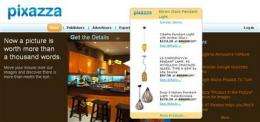
Mouse over an image, and tiny price tags appear over handbags, dresses and other items. Hover on top of one, and a balloon pops up with images and links to similar items you can buy online. Move your mouse away, and the balloon disappears.
Even Google Inc. is interested: The online advertising and search leader, through its new venture-capital fund, is among those that have recently invested a combined $5.8 million in the company.
Everingham came up with the idea after his wife spent hours figuring out what shoes "Sex and the City" star Sarah Jessica Parker was wearing in a photo ($1,000 Christian Diors) and hours more looking for a similar, cheaper version.
When the shoes arrived in the mail, the two sifted through a number of blogs and spotted comments from consumers who also wanted to know where they could get celebrities' looks.
Everingham figured he hit on an online void. If all those people were spending that much time seeking out products they could buy, why not find a way to bring the products to them, without coming across as an obnoxious intrusion?
After all, ads work best when they don't resemble ads but rather a feature that helps shoppers find items they may already be interested in buying.
Pixazza was born out of that inspiration last August and has since added a number of Web site publishers, merchant advertisers and investors to its stable.
By working with the company, Web sites can earn money from the images they would have displayed anyhow. And while it introduces another type of advertising, Pixazza believes its flavor is different.
"Unlike other means of monetizing their sites, which come at the expense of the user's satisfaction, Pixazza increases the user's satisfaction while increasing (the site's) incremental revenue," Chief Executive Bob Lisbonne said.
Pixazza, based a few miles from Google's headquarters in Mountain View, Calif., is modeled somewhat after Google's AdSense advertising program, which lets Web sites share revenue from Google ads targeted to the keywords in specific articles and Web pages.
But while AdSense is highly automated, Pixazza needs people to tag images because computers are not good at recognizing what is in a photo and determining which parts are interesting, said Everingham, Pixazza's chief technology officer.
Pixazza currently works with about 10 sites, including the celebrity gossip and fashion blog I'm Not Obsessed. Working from home, taggers link photos on those sites to more than 2 million products from dozens of merchants that have signed on as advertisers, including Amazon.com Inc., Overstock.com Inc. and Macy's Inc. Taggers aren't necessarily looking for originals, but rather similar items in a range of prices.
Users who run across an item of interest simply hover over it and click on the link to buy the product at the merchant's site. Image taggers are paid with a small portion of the merchant's commission; the remainder is split evenly between Pixazza and the Web site running the image with the embedded tag. Advertising merchants only pay a commission when a purchase is made, an appealing approach because they only pay when the ad works.
For now, Pixazza is focusing on fashion-geared images, but it plans to expand to other categories like travel, sports and home design later this year.
Bill Sweeney, who runs I'm Not Obsessed's business operations, began letting Pixazza tag the site's images in February after Pixazza approached the blog a month earlier.
Sweeney said Pixazza essentially offers a jazzier version of the "Fashion Finds" feature his site has already been producing. That feature identifies what celebrities are wearing and gives readers information about where to get those and similar items. Using Pixazza saves time, and its ads are more attractive than "Fashion Finds" was, Sweeney said.
He said readers like that the ads are inconspicuous, and Pixazza's advertising works because they are embedded in the celebrity fashion photos that are already one of the site's main attractions.
It has generated extra revenue for the blog, though it's just a start: Sweeney said Pixazza currently accounts for less than 5 percent of their overall ad revenue.
"We're not getting rid of them any time soon," he said.
Lainey Lui, a Vancouver, Canada-based entertainment reporter, has also been using Pixazza for several months to tag images on her blog, Lainey Gossip.
Lui doesn't yet see the ads as another revenue stream.
But she likes that Pixazza tags shoes, for example, in a photo that shows them as part of a complete outfit. By contrast, she said, a Google search will just give you links to Web sites selling those products.
Like Lui, eMarketer analyst Jeffrey Grau believes Pixazza's appeal is in its ability to show consumers how they could use a product, especially with photos on fashion and celebrity-geared sites.
"You're seeing someone you want to emulate wearing an outfit and think, 'Oh that's cool,'" he said.
Buying that kind of look is just a click away.
It's still too soon to tell what kind of money Pixazza can generate for Web sites, especially as the online advertising market is slowing because of the recession.
Regardless, Lisbonne believes that there's major potential for Pixazza, as Web sites are hungry for new sources of revenue, and images are prominent online but largely untapped for ads.
©2009 The Associated Press. All rights reserved. This material may not be published, broadcast, rewritten or redistributed.


