Scientists demonstrate laser with controlled polarization
April 13, 2009
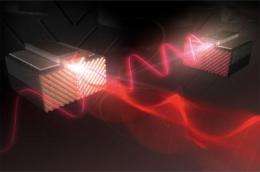
Animation of the demonstration of a laser in which the direction of oscillation of the emitted radiation, known as polarization, can be designed and controlled at will. Credit: Laboratory of Federico Cappaso, Harvard School of Engineering and Applied Sciences
Applied scientists at the Harvard School of Engineering and Applied Sciences (SEAS) in collaboration with researchers from Hamamatsu Photonics in Hamamatsu City, Japan, have demonstrated, for the first time, lasers in which the direction of oscillation of the emitted radiation, known as polarization, can be designed and controlled at will. The innovation opens the door to a wide range of applications in photonics and communications. Harvard University has filed a broad patent on the invention.
Spearheaded by graduate student Nanfang Yu and Federico Capasso, Robert L. Wallace Professor of Applied Physics and Vinton Hayes Senior Research Fellow in Electrical Engineering, both of SEAS, and by a team at Hamamatsu Photonics headed by Dr. Hirofumi Kan, General Manager of the Laser Group, the findings will be published as a cover feature of the April 13 issue of Applied Physics Letters.
"Polarization is one of the key features defining a laser beam. Controlling it represents an important new step towards beam engineering of lasers with unprecedented flexibility, tailored for specific applications," explains Capasso. "The novelty of our approach is that instead of being conducted externally, which requires bulky and expensive optical components, manipulation of the beam polarization is achieved by directly integrating the polarizer on the laser facet. This compact solution is applicable to semiconductor lasers and other solid-state lasers, all the way from communication wavelengths to the mid-infrared and Terahertz spectrum".
Light sources with a desirable polarization state are useful for a wide variety of applications. For example, satellite communications use two orthogonal polarizations to double the capacity of the channel; circularly-polarized light sources are necessary to detect certain biomolecules; and laser sources with a variety of polarization states have relevance for quantum cryptography.
To achieve the results, the researchers sculpted a metallic structure, dubbed a plasmonic polarizer directly on the facet of a quantum cascade (QC) laser. The QC laser emitted at a wavelength of ten microns (in the invisible part of the spectrum known as the mid-infrared where the atmosphere is transparent). The team was able to control the state of polarization by generating both linearly polarized light along an arbitrary direction and circularly polarized light.
-
Scientists demonstrate highly directional semiconductor lasers
Jul 27, 2008 |
not rated yet |
0
-
Scientists Create Quantum Cascade Laser Nanoantenna
Oct 23, 2007 |
not rated yet |
0
-
Compact, wavelength-on-demand Quantum Cascade Laser chip offers ultra-sensitive chemical sensing
Dec 03, 2007 |
not rated yet |
0
-
Compact, wavelength-on-demand Quantum Cascade Laser chip created
Feb 06, 2008 |
not rated yet |
0
-
Engineers demonstrate first room-temperature semiconductor source of coherent Terahertz radiation
May 19, 2008 |
not rated yet |
0
-
Engineers build first sub-10-nm carbon nanotube transistor
Feb 01, 2012 |
4.9 / 5 (31) |
30
-
Something old, something new: Evolution and the structural divergence of duplicate genes
Jan 31, 2012 |
4.6 / 5 (7) |
1
-
The hidden nanoworld of ice crystals: Revealing the dynamic behavior of quasi-liquid layers
Jan 30, 2012 |
5 / 5 (3) |
1
-
Stock market network reveals investor clustering
Jan 27, 2012 |
3.9 / 5 (23) |
8
-
Of microchemistry and molecules: Electronic microfluidic device synthesizes biocompatible probes
Jan 26, 2012 |
5 / 5 (1) |
0
-
Books To Inspire a Beginnig Physics Student
2 hours ago
-
Pith balls problem
2 hours ago
-
Electrostatics
2 hours ago
-
what is phase constant
3 hours ago
-
Basics In electromagnetic wave
3 hours ago
-
How to calculate theoretical initial velocity?
4 hours ago
- More from Physics Forums - General Physics
More news stories
Putting the squeeze on planets outside our solar system
(PhysOrg.com) -- Using high-powered lasers, scientists at Lawrence Livermore National Laboratory and collaborators discovered that molten magnesium silicate undergoes a phase change in the liquid state, abruptly ...
13 hours ago |
4.3 / 5 (7) |
0
|
Hovering not hard if you're top-heavy, researchers find
Top-heavy structures are more likely to maintain their balance while hovering in the air than are those that bear a lower center of gravity, researchers at New York University's Courant Institute of Mathematical Sciences ...
14 hours ago |
5 / 5 (1) |
1
|
SLAC, Stanford team focuses on high-energy electrons to treat cancer
Accelerator physicists at SLAC and cancer specialists from Stanford are working on a new technology that could dramatically reduce the time needed for cancer radiation treatments. The team ran an initial experiment ...
17 hours ago |
5 / 5 (2) |
0
Measurements from high-energy collisions lead to better understanding of why meson particles disappear
For several years, physicists at the Relativistic Heavy Ion Collider (RHIC) at Brookhaven National Laboratory (BNL), USA, have studied an unusual state of matter called the quarkgluon plasma, which they ...
18 hours ago |
4.5 / 5 (4) |
0
Explained: Sigma
It's a question that arises with virtually every major new finding in science or medicine: What makes a result reliable enough to be taken seriously? The answer has to do with statistical significance -- but ...
Feb 09, 2012 |
5 / 5 (16) |
53
Anonymous knocks CIA website offline (Update)
The website of the Central Intelligence Agency was inaccessible on Friday after the hacker group Anonymous claimed to have knocked it offline.
New error-correcting codes guarantee the fastest possible rate of data transmission
Error-correcting codes are one of the triumphs of the digital age. Theyre a way of encoding information so that it can be transmitted across a communication channel such as an optical fiber o ...
Humans may have helped the decline of African rainforests 3000 years ago
(PhysOrg.com) -- Large areas of rainforests in Central Africa mysteriously disappeared over three thousand years ago, to be replaced by savannas. The prevailing theory has been that the cause was a change ...
Google users warned of threat to smartphone wallets
Users of Google smartphone wallets were being warned on Friday that there is a way to crack pass codes intended to thwart thieves from going on illicit shopping sprees.
New power source discovered
(PhysOrg.com) -- Researchers at the Massachusetts Institute of Technology (MIT) and RMIT University have made a breakthrough in energy storage and power generation.
The power of estrogen -- male snakes attract other males
A new study has shown that boosting the estrogen levels of male garter snakes causes them to secrete the same pheromones that females use to attract suitors, and turned the males into just about the sexiest ...
Apr 13, 2009
Rank: 3.3 / 5 (3)
Apr 13, 2009
Rank: 3 / 5 (2)
Apr 13, 2009
Rank: 5 / 5 (2)