When cancer cells can't let go
April 13, 2009 When cancer cells can't let go

Enlarge

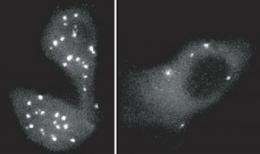
The invadopodia (glowing dots) speckling a cell lacking FAK (left) are rare on a control cell (right). Credit: Chan, K.T., et al. 2009. J. Cell Biol. doi:10.1083/jcb.200809110.

Like a climber scaling a rock face, a migrating cancer cell has to keep a tight grip on the surface but also let go at the right moment to move ahead. Chan et al. reveal that the focal adhesion kinase (FAK) coordinates these processes to permit forward movement. The study will be published online April 13 and will appear in the April 20 print issue of the Journal of Cell Biology.

Crawling send out extensions called invadopodia. By releasing enzymes that dissolve the extracellular matrix (ECM), invadopodia clear a path for the cell to wriggle through. As they move, cancer cells get traction by temporarily attaching to the ECM through focal adhesions. FAK spurs focal adhesions to disengage, and it is more abundant in metastatic tumors. Whether FAK also regulates invadopodia was unknown.

When Chan et al. removed FAK, cells were much less invasive. But to the team's surprise, the FAK-lacking cells sprouted extra invadopodia. The cells also sported large focal adhesions that were particularly sticky. The protein Src serves as FAK's helper. FAK and Src work together to phosphorylate tyrosines in proteins such as paxillin, which then disassemble the focal adhesion. But the team found that in cells missing FAK, the phosphorylated proteins accumulated in invadopodia. Src's localization reflects this difference. In control cells, Src accumulated in focal adhesions. In FAK's absence, Src headed to the invadopodia.

The work suggests that FAK controls movement by balancing the number of invadopodia that create a path for migration and the number of focal adhesions that hold the cell back. The next question, the researchers say, is how FAK and Src integrate these events to promote invasion.

More information: Chan, K.T., et al. 2009. J. Cell Biol. doi:10.1083/jcb.200809110. www.jcb.org

Source: Rockefeller University (news : web)


print this article email this article download pdf blog this article bookmark this article     Stumble it Digg this share on Facebook retweet share on Reddit add to delicious
Rate this story - not rated yet


April 13, 2009 all stories

Comments: 0

not rated yet
  • Stumble this up

  • Digg this

  • share this

  • hide
  • Related Stories

  • Dense tissue promotes aggressive cancers
    created Aug 22, 2008 | popularity not rated yet | comments 0
  • Scientists identify a molecule that coordinates the movement of cells
    created Oct 02, 2008 | popularity not rated yet | comments 0
  • Fibroblasts invade at a snail's pace
    created Feb 02, 2009 | popularity not rated yet | comments 0
  • Turn back, wayward axon
    created Mar 09, 2009 | popularity not rated yet | comments 0
  • Molecular force field helps cancer cells defend against attack
    created Feb 01, 2006 | popularity not rated yet | comments 0


  • hide
  • Relevant PhysicsForums posts

  • Improving the brain through chemistry
    created Nov 07, 2009
  • Sleep / REM Sleep and homeostasis
    created Nov 07, 2009
  • The Biceps Reflex
    created Nov 05, 2009
  • Consequenses of striking a Vein and an artery?
    created Nov 05, 2009
  • More from Physics Forums - Medical Sciences

Other News

The upside of feeling down

The upside of feeling down

Medicine & Health / Psychology & Psychiatry

created 6 hours ago | popularity 4 / 5 (4) | comments 3

A chill wind chases you into the door of your local newsagent. Rain is drumming down outside. As you pay for your newspaper, you briefly notice a number of strange items on the checkout counter - a matchbox ...


Words, gestures are translated by same brain regions, says new research

Medicine & Health / Neuroscience

created 11 hours ago | popularity 5 / 5 (3) | comments 0

Your ability to make sense of Groucho's words and Harpo's pantomimes in an old Marx Brothers movie takes place in the same regions of your brain, says new research funded by the National Institute on Deafness and Other Communication ...


Implantable Glucose Sensor Could Spell Relief for Millions of Diabetics (w/ Video)

Implantable Glucose Sensor Could Spell Relief for Millions of Diabetics (w/ Video)

Medicine & Health / Research

created 7 hours ago | popularity not rated yet | comments 0

(PhysOrg.com) -- UConn researchers have developed a tiny wireless device that can be inserted under a patient?s skin to monitor blood glucose levels over a period of several months.


Diet switching can activate brain's stress system, lead to 'withdrawal' symptoms

Medicine & Health / Research

created 7 hours ago | popularity not rated yet | comments 0

In research that sheds light on the perils of yo-yo dieting and repeated bouts of sugar-bingeing, researchers from The Scripps Research Institute have shown in animal models that cycling between periods of eating sweet and ...


Mood improves on low-fat, but not low-carb, diet plan

Medicine & Health / Health

created 9 hours ago | popularity 5 / 5 (1) | comments 0

After one year, a low-calorie, low-fat diet appears more beneficial to dieters' mood than a low-carbohydrate plan with the same number of calories, according to a report in the November 9 issue of Archives of Internal Me ...