Colon cancer shuts down receptor that could shut it down
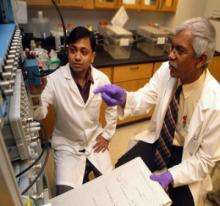
Though a high-fiber diet has long been considered good for you and beneficial in staving off colon cancer, Medical College of Georgia researchers have discovered a reason why: roughage activates a receptor with cancer-killing potential.
Researchers report in the April issue of Cancer Research that the GPR109A receptor is activated by butyrate, a metabolite produced by fiber-eating bacteria in the colon. The receptor puts a double-whammy on cancer by sending signals that trigger cell death, or apoptosis, and shutting down a protein that causes inflammation, a precursor to cancer.
"We know the receptor is silenced in cancer but it's not like the gene goes away," says Dr. Vadivel Ganapathy, corresponding author and chair of the Department of Biochemistry and Molecular Biology in the MCG School of Medicine.
Cancer shuts down the receptor by chemically modifying its gene through a process called DNA methylation. It's a typical MO for cancer to turn genes off to suit its purpose which is why DNA methylation inhibitors already are under study for a variety of cancers.
But cancer patients likely also need something to ensure the receptor gets activated by butyrate, such as eating more roughage or, more likely, getting mega doses of butyrate or a compound with similar properties, Dr. Ganapathy says.
One of those activators, niacin, a B-complex vitamin, led to his discovery of the relationship between butyrate and GPR109A. Research teams at GlaxoSmithKline and the University of Heidelberg, Germany in 2003 showed cloned GPR109A mediated the protective cardiovascular effect of niacin, but was activated only if niacin levels in the blood were 1,000 times normal levels. That got the German research team to search for alternative activators of the receptor, resulting in identification of beta-hydroxybutyrate as a natural receptor activator. The same study showed butyrate also could activate the receptor but with much less potency. That got Dr. Ganapathy thinking about a place where butyrate levels were already high - the colon - which led to his discovery that the receptor was also on colon cells.
Butyrate plays other protective roles in colon cancer. In 2004, MCG researchers identified a gene, SLC5A8, that transports butyrate inside cells where it inhibits the enzyme HDAC, which gets upregulated in cancer to produce the uncontrolled cell growth that is a disease hallmark.
"If you block HDAC, you can kill the cancer cell," Dr. Ganapathy says.
Several synthetic HDAC inhibitors are under study for a variety of cancers at institutions such as the MCG Cancer Center. Unfortunately, just like the newly found GPR109A receptor, cancer also silences the SLC5A8 butyrate transporter. In his current study, the researcher found the receptor was silenced in 15 of 18 colon cancer patients.
"Colon cancer does not want butyrate produced by bacteria to come inside so it silences the transporter. It also does no want butyrate to act on the cell from the outside so it silences the receptor," Dr. Ganapathy says. "It does not want to have anything to do with butyrate."
Because the compounds that reactivate the receptor also reactivate the transporter, finding a way to mitigate cancer's attempts to silence the genes would create a two-prong attack against the cancer.
Mega doses of butyrate reportedly taste bad. But Dr. Ganapathy believes taking large amounts of niacin, something many patients already do for high cholesterol, is a good substitute. In fact, he wants to move ahead with clinical trials that compare the course of colon cancer patients who eat a high fiber diet or receive butyrate or niacin therapy along with taking DNA methylation inhibitors that keep GPR109A open for business.
He also wants to determine if his theory that inflammation also suppresses the receptor holds true. "We think receptor activation by butyrate suppresses inflammation, thereby suppressing progression of inflamed cells into cancer cells." If he's correct, targeting the receptor also may provide a new treatment for inflammatory bowel disease.
Source: Medical College of Georgia


