NASA Heads up Mt. Everest
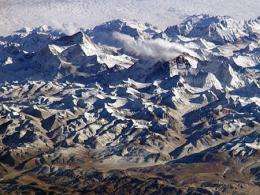
Steve "Ark" Vander Ark takes a deep breath at the foot of the stairs in a lonely, dusky stairwell, then turns and heads up ten long flights of steps - for the eighth time. He'll repeat this ritual thrice more, for a total of 100 flights of stairs, in the NASA Johnson Space Center building where he works. And to top it all off, he's wearing a fully-laden backpack.
Why?
He's getting ready to climb Mount Everest.
Why?
Because it's there - and because he wants to do a NASA research project along the way to benefit future space travelers.
Vander Ark (Section Manager for Wyle's Behavioral Health & Performance group at JSC) and some of his colleagues, along with Jake Maule of Marshall Space Flight Center and several other adventurous NASA and non-NASA souls, share a passion for exploration and a love of beautiful scenery. They also share a burning desire to see the Himalayas, and in mid-April they'll get the chance, paying for this non-work related trip out of their own pockets but dedicated enough to still do some work along the way.
"This trip will be fun, but Jake and I will do some serious research to help astronauts," says Vander Ark. "Mount Everest provides a good space analog; it's similar to the austere, challenging environment of space. So our hike will be comparable in some ways to what astronauts face while engaged in a long spacewalk or an excursion on the surface of the Moon or Mars. Like astronauts, we'll spend long hours doing strenuous work without an abundance of oxygen."
"Mission planners will need to know how long periods in extreme environments affect sleep. Quality sleep is crucial to daytime alertness and performance on critical tasks, and can also impact long-term health. Lack of sleep could even affect safety."
So Vander Ark is taking a device up Mount Everest to monitor what happens with the sleep/wake cycle when the human body is subjected to long periods in challenging environments.
"The device is called an Actiwatch," says Vander Ark. "It resembles a wristwatch and records the wearer’s sleeping and waking movements. It also measures light exposure. Several members of our group will be wearing an Actiwatch during the hike. In general, these devices will show how well the hikers sleep during the trip."
Maule will be conducting a separate experiment during the Mount Everest trip. He'll be using a mini-lab called LOCAD-PTS that resembles a Star Trek tricorder. Short for Lab-On-a-Chip Application Development-Portable Test System, this small tool with a big name has been used to detect bacteria and fungi on surfaces inside the International Space Station. On the climb, Maule will use it to look for snow algae, a cold-tolerant algae that grows on snow, and upon blooming, makes the snow look red.
"This kind of research can help scientists develop efficient procedures for future field studies on the Moon and Mars," says Maule. "They'll need to know how to collect and analyze samples in extreme environments."*
Another NASA team member, EVA (extra-vehicular activity) flight controller Sabrina Singh, whose parents were born and raised in India, is organizing the Everest journey for the group. She arranged and participated in a similar event last year but can't go this year.
Not getting to go hasn't dampened Singh's zeal for the venture.
"I've lived in the Indian Himalayas, and it's a breathtaking part of the world!" says Singh. "This will be quite an expedition for my coworkers and friends. It reflects NASA's theme of exploration and adventure."
To prepare for the trek, all the hikers are training on their own rigorous schedules - some climbing stairs like Vander Ark and others getting up at 6 a.m. to do "boot camp" drills and/or run. A few members of the group are even hiking parts of the Appalachian Trail to get used to the rigors of mountain treks.
"We'll have to be in shape to reach our destination - the base camp, 18,000 feet up," says Vander Ark. "We've purposely timed our trip so we can meet up with another very fit adventurer - mountaineer, medical doctor, former astronaut and spacewalker Scott Parazynski. He'll be at base camp when we arrive."
That's where Parazynski will be taking a planned break during his second attempt to scale the majestic mountain all the way to the top - over 29,000 feet up - the same elevation where commercial airplanes cruise. He tried last year to make it to the summit, but was waylaid by a back injury a mere 24-hour hike from the top. If this year's attempt is successful, he'll become the first person ever to have gazed up at space from the pinnacle of Earth's tallest mountain, and gazed down on that same pinnacle from the black vacuum of space.
"Like others of us, he's wearing an Actiwatch during his expedition. When our paths cross at base camp, we'll give him care packages and letters from family, friends, and well-wishers," says Vander Ark. "And chocolate expresso beans. He likes those!"
Singh adds: "Scott will have the following of a lot of readers, but the members of our group are just everyday people. The non-NASA hikers will see how enthusiastic and adventurous this NASA family is."
"During rest days, they'll use the 'climb high, sleep low' strategy to help prevent altitude sickness," says Singh.
That means they'll gain some altitude daily, then descend a bit and spend the night at a slightly lower altitude to adjust to the reduced oxygen levels gradually. They'll do this vertical zig-zagging more than once. Base camp is as about as high as most of them will go**, but this special strategy is still essential.
Before their mountain challenge, several of the trekkers plan to visit Kathmandu's PA Nepal Orphanage, established by former teacher Indira Rana Magar. (Parazynski will visit the orphanage too, at some point during his time in Nepal.) This orphanage cares for Nepalese village children whose parents have passed away, been imprisoned, disappeared, or are too poor to feed and educate them.
"We want our visit to be special for the kids," says Vander Ark. "We're gathering gifts and supplies to take to them from the NASA community."
Singh adds, "One member of our group, Dr. Keith Manuel, who performed the eye exams for astronauts for a number of years, is doing an eye clinic for close to 100 kids at the orphanage. He’ll get their prescriptions, and later we’ll mail glasses to the kids who need them. Hikers Court Manuel, Jenna Andrews, and Rob Rist [all NASA employees] will help with the eye exams. My mother, Dr. Manjeet Singh, is a dentist and a member of the expedition. She’ll do dental exams on all the children."
Adam Gilmore, a NASA engineer who is not a member of the trekking group, serves as science advisor to this orphanage. He provides the children a few supplies and a lot of lesson plans, including some ideas for science experiments. For one experiment, Jake Maule will show the children the LOCAD-PTS device he'll use on the trek.
"The children idolize astronaut Suni Williams, who has relatives in India, and they know that Suni did a LOCAD experiment on the space station," says Singh. "They'll be thrilled to see and touch the hardware Suni used in space. These children love to learn about the cosmos. They even helped paint stars and planets on the ceiling and walls of the orphanage."
Rana Magar and her space-savvy kids will greet the hikers at the Kathmandu airport with flower garlands and a traditional Nepalese flower ceremony.
"The ceremony and the visit to the orphanage will make this adventure even better," says Vander Ark.
But, hold on Ark, there's still work to do before you leave. You have to get your sea level body ready for the trek to 18,000 feet. (JSC's elevation is only about 30 feet!)
He takes another deep breath and heads back up the stairs.
Source: by Dauna Coulter, Science@NASA


