New DNA sensors could identify cancer using graphene
April 13, 2009
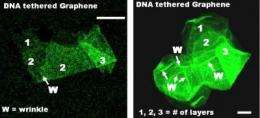
This is DNA-tethered graphene. Credit: Kansas State University department of chemical engineering
Kansas State University engineers think the possibilities are deep for a very thin material.
Vikas Berry, assistant professor of chemical engineering, is leading research combining biological materials with graphene, a recently developed carbon material that is only a single atom thick.
"The biological interfacing of graphene is taking this material to the next level," Berry said. "Discovered only four years ago, this material has already shown a large number of capabilities. K-Staters are the first to do bio-integrated research with graphene."
To study graphene, researchers rely on an atomic force microscope to help them observe and manipulate these single atom thick carbon sheets.
"It's a fascinating material to work with," Berry said. "The most significant feature of graphene is that the electrons can travel without interruptions at speeds close to that of light at room temperature. Usually you have to go near zero Kelvin -- that's about 450 degrees below zero Fahrenheit -- to get electrons to move at ultra high speeds."
One of Berry's developments is a graphene-based DNA sensor. When electrons flow on the graphene, they change speed if they encounter DNA. The researchers notice this change by measuring the electrical conductivity. The work was published in Nano-Letters.
"Most DNA sensors are optical, but this one is electrical," Berry said. "We are currently collaborating with researchers from Harvard Medical School to sense cancer cells in blood."
Another area he is exploring is loading graphene with antibodies and flowing bacteria across the surface.
"Most researchers focus on pristine graphene, but we're making it dirty," he said.
Berry and Nihar Mohanty, a graduate student in chemical engineering, used a type of bacteria commonly found in rice and interfaced it with graphene. They found that the graphene with tethered antibodies will wrap itself around an individual bacterium, which remains alive for 12 hours.
Berry said that possible applications include a high-efficiency bacteria-operated battery, where by using geobater, a type of bacteria known to produce electrons, can be wrapped with graphene to produce electricity. The research was presented at the annual American Physical Society conference in Pittsburgh and the American Institute for Chemical Engineers conference in Philadelphia.
"Materials science is an incredible field with several exploitable quantum effects occurring at molecular scale, and biology is a remarkable field with a variety of specific biochemical mechanisms," Berry said. "But for the most part the two fields are isolated. If you join these two fields, the possibilities are going to be immense. For example, one can think of a bacterium as a machine with molecular scale components and one can exploit the functioning of those components in a material device."
For his doctoral research, Berry used bacteria to make a humidity sensor.
"That was only possible through combining materials science with biological science," he said.
Another area of his current research is compressing and stretching molecular-junctions between nanoparticles. Berry said that his group has developed a molecular-spring device where they can compress and stretch molecules, which then act like springs, allowing researchers to study how they relax back. He said that this technology could be used to create molecular-timers in which the spring action from a decompressed molecule on a chip could trigger a circuit, for instance.
Berry said for stretching the molecules, Kabeer Jasuja, a doctoral student in chemical engineering, came up with the idea to place the device on a centrifuge to stretch the molecules with centrifugal force.
The work was published in the journal Small.
-
Graphene sniffs out dangerous molecules
Jul 30, 2007 |
not rated yet |
0
-
Physicists show electrons can travel over 100 times faster in graphene than in silicon
Mar 24, 2008 |
not rated yet |
0
-
Sheet of carbon atoms acts like a billiard table, physicists find
Sep 14, 2007 |
not rated yet |
0
-
Could Graphene Replace Semiconductors?
Sep 08, 2008 |
not rated yet |
0
-
Graphene oxide paper could spawn a new class of materials
Jul 25, 2007 |
not rated yet |
0
-
Engineers build first sub-10-nm carbon nanotube transistor
Feb 01, 2012 |
4.9 / 5 (31) |
30
-
Something old, something new: Evolution and the structural divergence of duplicate genes
Jan 31, 2012 |
4.6 / 5 (7) |
1
-
The hidden nanoworld of ice crystals: Revealing the dynamic behavior of quasi-liquid layers
Jan 30, 2012 |
5 / 5 (3) |
1
-
Stock market network reveals investor clustering
Jan 27, 2012 |
3.9 / 5 (23) |
8
-
Of microchemistry and molecules: Electronic microfluidic device synthesizes biocompatible probes
Jan 26, 2012 |
5 / 5 (1) |
0
-
Protease cleavage
2 hours ago
-
Pertubance in a model
9 hours ago
-
Cancer drugs and Alzheimer's, Oh my!
17 hours ago
-
Squishing cells
17 hours ago
-
Any books/articles for evolutionary stable strategy models in humans?
Feb 09, 2012
-
Science behind the bore feeling?
Feb 09, 2012
- More from Physics Forums - Biology
More news stories
'Dark plasmons' transmit energy
Microscopic channels of gold nanoparticles have the ability to transmit electromagnetic energy that starts as light and propagates via "dark plasmons," according to researchers at Rice University.
23 hours ago |
5 / 5 (6) |
1
|
What lies beneath: Mapping hidden nanostructures
The ability to diagnose and predict the properties of materials is vital, particularly in the expanding field of nanotechnology. Electron and atom-probe microscopy can categorize atoms in thin sheets of material, ...
7 hours ago |
5 / 5 (1) |
1
New kind of solar cell could capture significantly more energy than current cells
New solar cells could increase the maximum efficiency of solar panels by over 25%, according to scientists from the University of Cambridge.
Feb 08, 2012 |
4.5 / 5 (12) |
14
|
Nanoshell whispering galleries improve thin solar panels
Visitors to Statuary Hall in the U.S. Capitol Building may have experienced a curious acoustic feature that allows a person to whisper softly at one side of the cavernous, half-domed room and for another on ...
Nanotechnology / Nanomaterials
Feb 07, 2012 |
4.3 / 5 (6) |
6
|
Nanotube therapy takes aim at breast cancer stem cells
Wake Forest Baptist Medical Center researchers have again proven that injecting multiwalled carbon nanotubes (MWCNTs) into tumors and heating them with a quick, 30-second laser treatment can kill them.
Nanotechnology / Bio & Medicine
Feb 09, 2012 |
5 / 5 (1) |
0
|
CIA website offline, Anonymous takes credit
The website of the Central Intelligence Agency was unresponsive on Friday after the hacker group Anonymous claimed to have knocked it offline.
Q&A: Obama and the birth control controversy
(AP) -- What birth control debate? A half-century after the introduction of the pill, acceptance of birth control by American women is virtually universal.
Complex wiring of the nervous system may rely on a just a handful of genes and proteins
Researchers at the Salk Institute have discovered a startling feature of early brain development that helps to explain how complex neuron wiring patterns are programmed using just a handful of critical genes. ...
The power of estrogen -- male snakes attract other males
A new study has shown that boosting the estrogen levels of male garter snakes causes them to secrete the same pheromones that females use to attract suitors, and turned the males into just about the sexiest ...
New error-correcting codes guarantee the fastest possible rate of data transmission
Error-correcting codes are one of the triumphs of the digital age. Theyre a way of encoding information so that it can be transmitted across a communication channel such as an optical fiber o ...
Humans may have helped the decline of African rainforests 3000 years ago
(PhysOrg.com) -- Large areas of rainforests in Central Africa mysteriously disappeared over three thousand years ago, to be replaced by savannas. The prevailing theory has been that the cause was a change ...
Apr 13, 2009
Rank: not rated yet
At zero Kelvin you have neither!