Plant Gene Mapping May Lead to Better Biofuel Production
April 13, 2009
Plant Gene Mapping May Lead to Better Biofuel Production

Enlarge

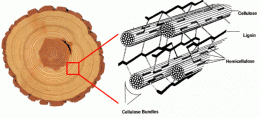
Cell walls.

(PhysOrg.com) -- By creating a 'family tree' of genes expressed in one form of woody plant and a less woody, herbaceous species, scientists at the U.S. Department of Energy’s Brookhaven National Laboratory have uncovered clues that may help them engineer plants more amenable to biofuel production. The study, published in the April 2009 issue of Plant Molecular Biology, also lays a foundation for understanding these genes’ evolutionary and structural properties and for a broader exploration of their roles in plant life.

“We are studying a very large family of that instruct cells to make a variety of enzymes important in a wide range of plant functions,” said Brookhaven biologist Chang-Jun Liu. By searching the genomes of woody Poplar trees and leafy Arabidopsis, the scientists identified 94 and 61 genes they suspected belonged to this family in those two species, respectively. They then looked at how the genes were expressed — activated to make their enzyme products — in different parts of the . Of particular interest to Liu’s group were a number of genes expressed at high levels in the woody plant tissues.

“Wood and other biofibers made of plant cell walls are the most abundant feedstocks for biofuel production,” explained Liu. “One of the first steps of biofuel production is to break down these biofibers, or digest them, to make sugar.”

But plants have strategies to inhibit being digested. For example, Liu explained, small molecules called acyl groups attached to cell-wall fibers can act as barriers to hinder conversion of the fibers to sugar. Acyl groups can also form cross-linked networks that make cell walls extra strong.

“Our long-term interest is to find the enzymes that control the formation of cell-wall-bound acyl groups, so we can learn how to modify plant cell walls to increase their digestibility,” Liu said. “The current study, a thorough investigation of an acyl-modifying enzyme family, provides a starting point for us to pursue this goal.”

In fact, some of the genes the scientists found to be expressed at high levels in woody tissues may carry the genetic instructions for making the enzymes the scientists would like to control.

“Our next step will be to use biochemical and biophysical approaches to characterize these individual genes’ functions to find those directly or indirectly related to modification. Then we could use those genes to engineer new bioenergy crops, and test whether those changes improve the efficiency of converting biomass to biofuel,” Liu said.

Liu’s group also made some interesting observations about gene expression and gene location in their study of the acyl-modifying enzyme genes. “We discovered a few unique pairs of genes that were inversely overlapped with their neighboring genes on the genome,” Liu said. In this unique organization, the paired genes (sequences of DNA) produce protein-encoding segments (RNAs) that are complementary to one another — meaning the two RNA strands would stick to each other like highly specific Velcro. That would prevent the RNA from building its enzyme, so the expression of one gene in the pair appears to inhibit its partner.

Perhaps understanding this natural “anti-sense” regulation for gene expression will assist scientists in their attempts to regulate acyl-modifying enzyme levels.

Provided by Brookhaven National Laboratory (news : web)


Rank 5 /5 (1 vote)
Related Stories
Relevant PhysicsForums posts
  • Factors affecting beet root cell membrane
    created12 hours ago
  • Stem cell question.
    createdFeb 10, 2012
  • Protease cleavage
    createdFeb 10, 2012
  • Pertubance in a model
    createdFeb 10, 2012
  • Cancer drugs and Alzheimer's, Oh my!
    createdFeb 09, 2012
  • Squishing cells
    createdFeb 09, 2012
  • More from Physics Forums - Biology

More news stories

A mitosis mystery solved: How chromosomes align perfectly in a dividing cell

Although the process of mitotic cell division has been studied intensely for more than 50 years, Whitehead Institute researchers have only now solved the mystery of how cells correctly align their chromosomes during symmetric ...

Biology / Cell & Microbiology

created 9 hours ago | popularity 4.3 / 5 (15) | comments 0 | with audio podcast

Researchers find extensive RNA editing in human transcriptome

In a new study published online in Nature Biotechnology, researchers from BGI, the world's largest genomics organization, reported the evidence of extensive RNA editing in a human cell line by analysis of RNA-seq data, demons ...

Biology / Biotechnology

created 8 hours ago | popularity 5 / 5 (4) | comments 0 | with audio podcast

The proteins ensuring genome protection

Researchers from the University of Geneva (UNIGE), Switzerland, have discovered the crucial role of two proteins in developing a cell 'anti-enzyme shield'. This protection system, which operates at the level of molecular ...

Biology / Cell & Microbiology

created 9 hours ago | popularity 5 / 5 (3) | comments 0 | with audio podcast

Entire genome of extinct human decoded from fossil

(PhysOrg.com) -- In 2010, Svante Pääbo and his colleagues presented a draft version of the genome from a small fragment of a human finger bone discovered in Denisova Cave in southern Siberia. The ...

Biology / Biotechnology

created Feb 07, 2012 | popularity 4.7 / 5 (60) | comments 51 | with audio podcast

Why are there so few fish in the Earth's oceans?

(PhysOrg.com) -- A Stony Brook University researcher has found that, contrary to popular belief, there are not plenty of fish in the sea.

Biology / Plants & Animals

created Feb 08, 2012 | popularity 4.2 / 5 (18) | comments 27 | with audio podcast


Scientists discover molecular secrets of 2,000-year-old Chinese herbal remedy

For roughly two thousand years, Chinese herbalists have treated Malaria using a root extract, commonly known as Chang Shan, from a type of hydrangea that grows in Tibet and Nepal. More recent studies suggest that halofuginone, ...

New method to examine batteries -- MRI from the inside

There is an ever-increasing need for advanced batteries for portable electronics, such as phones, cameras, and music players, but also to power electric vehicles and to facilitate the distribution and storage of energy derived ...

Google might launch Drive for cloud storage soon

(PhysOrg.com) -- Google's next big move, according to the Wall Street Journal, is a cloud storage service called Drive. Hardly first to the plate, Google is simply catching up to introducing its cloud reposi ...

Lab study raises questions over nano-particle impact

Tests involving chickens have raised questions about the impact on health from engineered nano-particles, the ultra-fine grains commonly used in drugs and processed foods, scientists said on Sunday.

Starve a virus, feed a cure? Findings show how some cells protect themselves against HIV

A protein that protects some of our immune cells from the most common and virulent form of HIV works by starving the virus of the molecular building blocks that it needs to replicate, according to research published online ...

Overeating may double risk of memory loss

New research suggests that consuming between 2,100 and 6,000 calories per day may double the risk of memory loss, or mild cognitive impairment (MCI), among people age 70 and older. The study was released today and will be ...