Scientist to 'refine' size of Universe with Kepler
April 13, 2009 Kepler

Enlarge

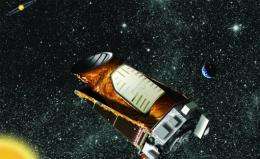
(PhysOrg.com) -- An astronomer at the University of St Andrews will use a powerful planet-hunting telescope to find out the true size of the Universe.

Researcher Dr Alan Penny will use the brightness of half a dozen to refine estimates of how big the Universe actually is. Dr Penny hopes to solve the problem using the 'extreme precision' of NASA's satellite launched into space last month.


Developed for the search for new planets, Kepler's main task is to look for planets by monitoring the brightness of 100,000 stars. But Dr Penny, a member of a 200 strong international team, will use the same data to study a much smaller sample of stars.

He explained, "While Kepler is doing its exciting planet-hunting, we will be using its extreme precision to resolve a possible problem with our measurement of the size of the Universe.

"These variable stars known as 'Cepheids' form the base of a series of steps by which we measure the distance to distant galaxies and, through them, we can measure the size of the Universe".

Since it is likely that scientists' understanding of how these stars vary in brightness is incomplete, Dr Penny will use the six stars as a basic yardstick to work out how much previous estimates of the size of the Universe are wrong. He believes that current estimates of the size of the Universe, at 93 billion light years across, might change up to a few percent.

He explained, "These Cepheid stars which get brighter and fainter by some tens of percent every ten to a hundred days are mostly understood. But recently it has become clear that our theories of what happens in the outer layers of these stars which cause the variations in brightness do not totally agree with what we see.

"The exquisite accuracy of Kepler in measuring star brightness, one hundred times better than we can do from the ground, means we can get such good measurements that we should be able to match theory with observation. Resolving the issue may only change estimates of the size of the by a small amount, but we won't rest easy until the problem is solved," concluded Dr Penny.

Provided by University of St Andrews


print this article email this article download pdf blog this article bookmark this article     Stumble it Digg this share on Facebook retweet share on Reddit add to delicious
Rate this story - 4.5 /5 (15 votes)

Rank Filter

Move the slider to adjust rank threshold, so that you can hide some of the comments.


Display comments: newest first

  • brant - Apr 13, 2009
    • Rank: 1 / 5 (2)
    hahahahahahahahahahahahahaha.

    You guys think you can figure out the size of the universe?????

    Why dont you ask god?????
  • 21stCenturyguy - Apr 13, 2009
    • Rank: 4 / 5 (1)
    "You guys think you can figure out the size of the universe?????

    Why dont you ask god?????'

    Or Zues, or Thor, or Santa - also fictional characters....
  • rwinners - Apr 13, 2009
    • Rank: 1 / 5 (2)
    Bet it turns out to be larger than anyone can now imagine.
    How does one measure what one cannot see?
  • Ethelred - Apr 14, 2009
    • Rank: 5 / 5 (3)
    Why dont you ask god?????


    Which god?

    The one in Genesis which limits the visible Universe to smaller than the Milky Way because we wouldn't be able to see more than 6 to 10,000 light years?

    The Norse gods.

    The Hindu gods?

    The 800 foot tall Jesus that Oral Roberts said would kill him if millions weren't contributed to his school?

    The god that told a tent preacher that it wanted him to have his Cadillac.(Clearly that preacher needed to upgrade his god to a much larger one like Roberts has).

    So why don't you tell us what your god told you? You did ask didn't you?

    Ethelred
  • Stein - Apr 14, 2009
    • Rank: 1 / 5 (1)
    Hello Dr Penny

    It is rather interesting that you estimate the size of the universe to be 93 Billion light years across.

    I would be quite interested to know how the theory differs from the observation and how the size if the universe is estimate from these observations?

    Cheers Zwei Stein
  • happytraining - Apr 14, 2009
    • Rank: 4 / 5 (1)
    Maybe somebody can explain this to me: If...
    --the Universe is 15 billion years old
    --a light-year is the distance light travels in a year
    --nothing can move faster than the speed of light
    --the Universe (I assume) radiated outward from the central point of the Big Bang

    Then how can the Universe be 93 billion light-years across? How can it be bigger than 30 billion (15B X 2)?
  • chewi - Apr 14, 2009
    • Rank: 3.5 / 5 (2)
    happytraining, I was thinking the same thing. As a follow up question, when they say the universe is 13.7 billion years old, and time realitive, are some parts younger and other older?
  • Ethelred - Apr 15, 2009
    • Rank: 4.5 / 5 (2)
    It is rather interesting that you estimate the size of the universe to be 93 Billion light years across.


    I don't think he is going to appear on this discussion. Unless he reads this web site.

    Why didn't Physorg deal with the seemingly strange estimate?

    OK did some searching and now it makes sense. Except for the way the article dealt with it that is. Physorg is not the only site with essentially the same article. They all treat it as if it was obvious. Either it is obvious to the writers or they are oblivious to what it sound like.

    http://en.wikiped...universe

    The age of the universe is about 13.7 billion years, but due to the expansion of space we are now observing objects that are now considerably farther away than a static 13.7 billion light-years distance. The edge of the observable universe is now located about 46.5 billion light-years away.


    Ethelred
  • Stein - Apr 15, 2009
    • Rank: 2 / 5 (3)
    Hello Ethelred

    Thank you for this information.

    Now I have another silly question.

    Given that the universe was 13.7 BLY and now has expanded to 46.5 BLY. Does that not mean that the earth is at the centre of the universe?

    Cheers Zwei Stein
  • Thecis - Apr 15, 2009
    • Rank: 4 / 5 (1)
    Hi Ethelred and Stein,

    It would be fun that the earth would be center but my estimate is that we probably aren't (that important).
    What does matter is the following. Almost every galaxy is moving away from us (except those that are in the same cluster as we are). That is the reason why almost everyone assumes we are living in an expanding universe.
    There is also another fact and that is that it (almost) doesn't matter were we look, the farthest object appear to be about 14 billion years old. That means that the light has traveled 14 billion lightyears and in that meantime, the universe has probably expanded at bit further. I think that that is the reason why they assume that the universe is about 93 billion light years across.

    Some question do arise then:
    - Given the above, are we sure we aren't in the center OR on the centerline (meaning that the universe is maybe eliptical instead of a globe (3D eliptical))
    - Are our readings correct?
    - Is the intepretation of these readings correct (which can be a much tougher question)

    And to most tentative question (which isn't scientific at all, but mostly funny): If there is indeed a restaurant there, would it be worthwhile to pay for the trip just to eat?
  • Thecis - Apr 15, 2009
    • Rank: 4 / 5 (1)
    Just a thought of the size. The farthest galaxies appear to move away from us with speeds up to 90% of the speed of light.
    This means that of those galaxies that are 14 billion light years away are now 14*1.9 = 26,1 billion lightyears away from us. This means that the galaxy could be about 52 billion light years across.
    Can anyone tell me how they came up with the 93?
  • yyz - Apr 15, 2009
    • Rank: not rated yet
    Inflation theory tells us that for a very brief time (before the universe was 10^-23 sec post Big Bang) space itself expanded much faster than the speed of light (remember superluminal expansion of space doesn't violate relativity). At this point in our universe's evolution only light from a distance of about 14 billion light- years has had time to reach us. The true size of the universe is certainly larger than the 14 billion light-years that we can see back to.
  • Stein - Apr 16, 2009
    • Rank: not rated yet
    Hello Thecis

    I am not a gambler but I do agree with your probability if only for Galileo.

    If the big bang is a spherical expansion as you suggest, and if we are not at the centre of this expansion as you suggest, we should be able to observe the centre of this expansion, because the radial expansion would not be identical to its perpendicular expansion.

    The words ALMOST EVERY GALAXY appears to imply that the same rule of expansion does not apply to all galaxies therefore expansion is inconsistent across the universe.

    You say that almost everyone ASSUMES that the universe is expanding. This appears to be a wise choice of words.

    I would think that Astronomical readings are as accurate as we can achieve with the technology we have today, but like you, I do question the correctness of its interpretation.

    Universal food for thought, now I am getting hungry.

    Hmmmm 52BLY? Hmmm 93BLY? My calculator is playing up.

    How far does light travel in 13.7 billion years? And how far does the space expand in that time based in 72km/s? My calculator is getting stuck in 4164.

    Perhaps the calculations are not based on closest distance in flat space, perhaps we measure the distance as longer curved space time?

    The bigger question is how do we know what direction the light is coming from when it curves by such an amount?
    Perhaps we can observe in which direction the light is curving?
    How does that curvature equate to flat space as recently observed in CMB observations?
    Perhaps expansion and inflation is a questionable assumption?

    Cheers Zwei Stein
  • Stein - Apr 16, 2009
    • Rank: not rated yet
    Hello yyz

    Is there observed evidence of inflation of space (that the universe is expanding) other than the Red-Shift of the light observed.

    Is it possible that space itself may have existed before the big bang?

    Am I correct in interpreting from you last statement, that we can only observe back to 14 BLY as Hubble suggests in his volume or sphere?

    Do you know how Dr Penny may be able to observe the distance of 46.5 BLY.

    Is the Kepler satellite able to distinguish the intensity of distant stars from the cosmic microwave background?

    Cheers Zwei Stein

April 13, 2009 all stories

Comments: 14

4.5 /5 (15 votes)
  • Stumble this up

  • Digg this

  • share this

  • hide
  • Related Stories

  • The Pole star comes to life again
    created Jul 21, 2008 | popularity not rated yet | comments 0
  • Kepler Set to Launch Tonight on Planet Finding Mission
    created Mar 06, 2009 | popularity not rated yet | comments 0
  • Hubble shows 'baby' galaxy is not so young after all
    created Oct 16, 2007 | popularity not rated yet | comments 0
  • Hubble Resolves Puzzle about Loner Starburst Galaxy
    created Nov 20, 2008 | popularity not rated yet | comments 0
  • Light echoes whisper the distance to a star
    created Feb 11, 2008 | popularity not rated yet | comments 0


  • hide
  • Relevant PhysicsForums posts

  • The shape of our solar system's orbits.
    created 21 hours ago
  • Above or Below the Line of Nodes
    created Nov 07, 2009
  • Supernova vs. Nova?
    created Nov 07, 2009
  • Supernova's Gamma Rays and Comets
    created Nov 06, 2009
  • More from Physics Forums - General Astronomy

Other News

Deep creep means milder, more frequent earthquakes along Southern California's San Jacinto fault

Deep creep means milder, more frequent earthquakes along Southern California's San Jacinto fault

Space & Earth / Earth Sciences

created 6 hours ago | popularity 4.7 / 5 (3) | comments 0

With an average of four mini-earthquakes per day, Southern California's San Jacinto fault constantly adjusts to make it a less likely candidate for a major earthquake than its quiet neighbor to the east, the ...


Success in 'space elevator' competition (AP)

Success in 'space elevator' competition (Update 3)

Space & Earth / Space Exploration

created Nov 05, 2009 | popularity 4.3 / 5 (33) | comments 50

(AP) -- A robot powered by a ground-based laser beam climbed a long cable dangling from a helicopter on Wednesday to qualify for prize money in a $2 million competition to test the potential reality of the ...


'Dropouts' pinpoint earliest galaxies

'Dropouts' pinpoint earliest galaxies

Space & Earth / Astronomy

created Nov 06, 2009 | popularity 4.2 / 5 (10) | comments 12

Astronomers, conducting the broadest survey to date of galaxies from about 800 million years after the Big Bang, have found 22 early galaxies and confirmed the age of one by its characteristic hydrogen signature ...


Space hotel taking bookings for 2012 opening

Space hotel taking bookings for 2012 opening

Space & Earth / Space Exploration

created Nov 05, 2009 | popularity 4.4 / 5 (20) | comments 11

(PhysOrg.com) -- The first orbiting space hotel is on track to open for its first customers in 2012, but hurry, as bookings are filling fast.


In a Galaxy Far, Far Away...

In a Galaxy Far, Far Away...

Space & Earth / Astronomy

created Nov 06, 2009 | popularity 4.8 / 5 (5) | comments 13

(PhysOrg.com) -- Astronomers have published the discovery of the farthest known object in the cosmos: a star that exploded when the universe was only 630 million years old -- only 4.6% of its current age. ...