Researchers Explore Magnetic Properties of Iron-Based Superconductors
(PhysOrg.com) -- Scientists at the Naval Research Laboratory have proposed theoretical models to explain the normal magnetic properties in iron-based superconductors. This research was published in the December 21, 2008 issue of Nature Physics. Their research builds on earlier research they conducted proposing a theoretical model for superconductivity in newly discovered iron-based superconductors. That earlier research was published in Physical Review Letters.
To set the stage for the NRL researchers' recent accomplishments, looking back over the last 50 years, the following are three very important discoveries in terms of superconducting materials:
• high-Tc cuprates in 1988, with critical temperature up to 160 K,
• Magnesium diboride (MgB2) (2001, 39 K) and
• iron-based superconductors (2008, up to 57 K).

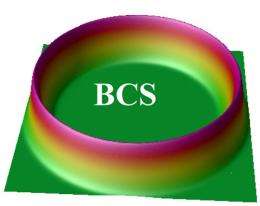
In conventional BCS superconductors, the superconductivity originates from electron-ion interactions and the superconducting order parameter is the same for all electrons, "s-wave", as illustrated in figure 1a.
Superconductivity in cuprates (chemical compounds containing copper oxide) is believed to originate from electron-electron interaction, magnetic or Coulomb. In contrast to conventional superconductivity, the order parameter in cuprates is "d-wave", changing sign depending on the direction in which an electron moves (roughly, like cos2α) as shown in figure 1b. It is worth noting that in 20 years more than 100,000 papers have been published studying the high-Tc cuprates.
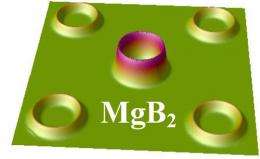
Many believe that MgB2 was the next milestone in the area of superconducting materials for the reason that the mechanism there is conventional (electron-ion), yet the critical temperature is much higher than in any other conventional superconductor, and, at the time of discovery, was second only to the cuprates. It appeared that MgB2 was the first example of a multigap superconductor, where the order parameter is s-wave (never changes sign), but has a different magnitude for different groups of electrons (figure 2). This situation was theoretically predicted at NRL and soon confirmed through experiments. Though the level of excitement around MgB2 never quite reached that of cuprates, MgB2 nonetheless resulted in 4,000 publications in seven years.
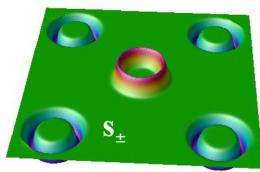
The most recent breakthrough is the discovery of high-temperature superconductivity in iron-based materials such as LaFeAsO, BaFe2As2, and others. Since iron is a strongly magnetic species, these materials promise a new paradigm in the search for new superconductors. Indeed, it has become increasingly clear that superconductivity in these new compounds is very dissimilar to either cuprates or MgB2, and that strong magnetism of iron likely plays a crucial role. Within a few months after the initial discovery, two NRL scientists, Dr. Igor Mazin and Dr. Michelle Johannes from the Materials Science and Technology Division, in collaboration with two researchers at Oak Ridge (both NRL alumni), proposed that a totally new superconducting state is realized in FeAs superconductors, which they dubbed "s±", where two groups of s-wave electrons have not only different magnitude order parameters, but also different signs (figure 3).
Experimental evidence has begun to accumulate in favor of the NRL researchers' proposal, and it is currently considered the most likely scenario. Their paper was posted on March 19, 2008, published in Physical Review Letters on August 1, 2008, and by December 2008 had been cited in other articles and preprints more than a hundred times. These novel materials remain one of the hottest issues in physics; since their discovery, papers on this subject have been appearing at a steady rate of 2.5 per day. Should this rate remain active, the number of publications will surpass that of MgB2 in four years.
It appears that superconductivity is not the only mystery of these so-called ferropnictides. In the undoped state, they demonstrate highly unusual magnetic properties with a very rare magnetic ordering pattern and a highly unstable measurable magnitude of the magnetic moment. In fact, with small modifications, the materials can be driven from a practically nonmagnetic state to strong magnetism comparable to that of pure iron. Most shockingly, the magnetic transition temperature barely changes. Some of the systems feature two transitions: a magnetic one, and a magnetically driven structural one. But, these occur counterintuitively; the structural transition occurs first and the magnetic one lower in temperature. These and many other properties are not adequately addressed by any existing theories.
In the December 2008 Nature Physics article, Drs. Mazin and Johannes propose a highly unusual ground state. They suggest that the Fe ions are always magnetic in ferropnictides, but the observable magnetic moment is strongly reduced or entirely suppressed due to formation of antiferromagnetic domains whose boundaries are dynamic and strongly fluctuating. Observable long-range order appears only when the domains are large and their walls are pinned. A structural transition without observable long-range magnetism occurs when domain boundaries are predominantly antiphase so that the x/y symmetry is broken even though there is no long-range order. The superconducting composition where neither long-range magnetism nor structural distortions are observed corresponds to twin domains, which are small with dynamic boundaries. Should this conjecture be corroborated by experiment, researchers will be entering an entirely new world of magnetic excitations (topological excitations of domain boundaries) that will most likely be very important, if not essential for high-Tc superconductivity in ferropnictides.
Provided by Naval Research Laboratory (news : web)


