Baby's first dreams: Research reveals sleep cycles in early fetus
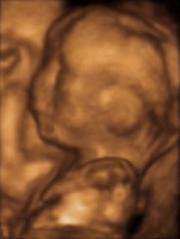
After about seven months growing in the womb, a human fetus spends most of its time asleep. Its brain cycles back and forth between the frenzied activity of rapid eye movement (REM) sleep and the quiet resting state of non-REM sleep. But whether the brains of younger, immature fetuses cycle with sleep or are simply inactive has remained a mystery, until now.
Mathematician Karin Schwab and a team of neuroscientists at Friedrich Schiller University in Jena, Germany, have discovered that very immature sheep fetuses can enter a dreaming sleep-like state weeks before the first rapid eye movements are seen. Their mathematical analysis could lead to a better of understanding of the purpose of sleep. It also provides a tool to study how the brain develops and to identify vulnerable periods in brain development when damage could lead to disease later in life.
The research appears in a special focus issue of the journal Chaos, which is published by the American Institute of Physics (AIP). The special issue is focused on nonlinear dynamics in cognitive and neural systems. It asks how chaos affects certain brain areas and presents interdisciplinary approaches to various problems in neuroscience -- including sleep.
Directly measuring the brain activity of a human fetus in the womb is impossible. What we know about our early sleep habits comes mostly from watching eye movements. Around the seventh month of a fetus' development, the first rapid eye movements are seen. The brain of the developing embryo appears to cycle every 20 to 40 minutes between REM sleep, in which brain activity rivals that of consciousness, and non-REM sleep, in which the brain rests. The functions of these sleep cycles are still a hotly debated topic in the world of sleep research.
Some have tried to measure the brain activity of premature babies by hooking them up to an electroencephogram (EEG) after they are born early. These measurements, according to Schwab, are technically difficult and fraught with errors. So neurologists who study the development of the fetal brain do not know whether sleep cycles simply appear one day, or whether they develop slowly from other forms of brain activity.
To fill this gap in knowledge, Schwab studied sheep, an animal that typically carries one or two fetuses similar in size and weight to a human fetus. The course of brain development is also fairly similar in humans and sheep, lasting about 280 days in humans and 150 days in sheep. They recorded electrical activity in the brain of a 106-day-old developing sheep fetus directly -- something that had never been done before.
Using sophisticated mathematical techniques for detecting patterns, Schwab discovered cycles in the complexity of immature brain activity. Unlike sleep patterns in later stages of development, these cycles fluctuate every 5 to 10 minutes and change slowly as the fetus grows.
While it is difficult to imagine what the fetus experiences during these cycles in terms familiar to adults, the patterns shed new light on the origins of sleep. "Sleep does not suddenly evolve from a resting brain. Sleep and sleep state changes are active regulated processes," says Schwab. The finding fits with other data showing that the brain cells (neurons) that generate sleep states mature long before the rest of the brain is developed enough to fall into REM sleep.
A better understanding of brain development could provide clues about diseases later in life, like neurological disorders or crib death. The research may also shed light on fundamental questions about how the brain develops. Cyclic changes in the activity of neurons, for instance, may stimulate the other nerve cells to find and connect with each other to set up complex networks in the brain. Sophisticated analyses of brain activity could help detect vulnerable phases during this brain development. Other avenues of Schwab's research look at the impact of environmental stimuli such as noise or stress on the developing fetus and whether they can lead to an increased susceptibility to disease in adults.
More information: The article "Nonlinear analysis and modeling of cortical activation and deactivation patterns in the immature fetal electrocorticogram," by K. Schwab et al was published March 31, 2009. [Chaos 19, 015111 (2009)]. The article is available at link.aip.org/link/?CHAOEH/19/015111/1.
Source: American Institute of Physics


