Dubai claims world's first cloned camel
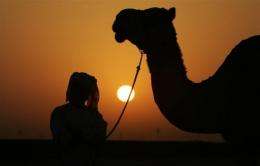
April 14, 2009 The United Arab Emirates has claimed the birth of a cloned camel in Dubai

Enlarge

The United Arab Emirates has claimed its own version of Dolly the sheep, the world's first cloned mammal, after the birth of a cloned camel in Dubai

The United Arab Emirates on Tuesday claimed its own version of Dolly the sheep, the world's first cloned mammal, after the birth of a cloned camel in Dubai this month.

"This is the first cloned camel in the world," said Dr Nisar Wani, researcher at the Camel Reproduction Centre.

Injaz, a female one-humped camel, was born on April 8 after more than five years of work by scientists at the Camel Reproduction Centre and the Central Veterinary Research Laboratory, The National newspaper reported.

"This significant breakthrough in our research programme gives a means of preserving the valuable genetics of our elite racing and milk producing camels in the future," Dr Lulu Skidmore, scientific director at the Camel Reproduction Centre, said in a statement.

Injaz, whose name means achievement in Arabic, is the clone of a camel that was slaughtered for its meat in 2005, the National said.

Scientists used DNA extracted from cells in the ovaries of the slain animal and put it into an egg taken from the surrogate mother to create a reconstructed embryo, it said.

Dolly was born in 1996 in Edinburgh in what was regarded as one of the world's most significant scientific breakthroughs, but was put to sleep in 2003.

(c) 2009 AFP


print this article email this article download pdf blog this article bookmark this article     Stumble it Digg this share on Facebook retweet share on Reddit add to delicious
Rate this story - 3.5 /5 (4 votes)

Rank Filter

Move the slider to adjust rank threshold, so that you can hide some of the comments.


Display comments: newest first

  • RFC - Apr 14, 2009
    • Rank: not rated yet
    Just goes to show, genetic propagation is a biological mandate, and being turned into dinner does not excuse this sacred duty.

    Seriously though... why choose a dead animal to clone? Doesn't that foreclose lots of additional tests that could be run in the future? Clearly, this wasn't about saving a rare or extinct species. Or did someone say, "Damn, that was a fine camel steak... I'd REALLY like to have that again!"

  • Soylent - Apr 14, 2009
    • Rank: not rated yet
    You're not going to build "pleistocene park" right of the bat. If you try doing that it will be very expensive and it will be a dismal failure.

    When you fail, you learn something; you can rapidly and cheaply fail by trying to clone lab mice. You learn a lot, the cost both in time and money is small.

    That way when you're doing more expensive camel cloning you will have already eliminated the most common failure modes using cheap lab mice rather than expensive camels. Each new failure will be something interesting that you couldn't have learned with mice.

    When you finally start trying to clone mammoths using modern elephants' uterous somewhere a long way down the line, you've accumulated most of the necessary knowledge as cheaply as it could be had.

April 14, 2009 all stories

Comments: 2

3.5 /5 (4 votes)
  • Stumble this up

  • Digg this

  • share this

  • hide
  • Related Stories

  • Cloner proposes genetic altering
    created Jun 05, 2006 | popularity not rated yet | comments 0
  • Briefs: Scientists still at odds over cloned sheep
    created Mar 12, 2006 | popularity not rated yet | comments 0
  • Cloned horse gives birth
    created May 01, 2008 | popularity not rated yet | comments 0
  • Rabbit eggs may be used for stem cells
    created Jan 13, 2006 | popularity not rated yet | comments 0
  • IdentiGEN founder says access to DNA from cloned animals should be made public
    created Feb 14, 2008 | popularity not rated yet | comments 0


  • hide
  • Relevant PhysicsForums posts

Other News

Scientists visualize how bacteria talk to one another

Scientists visualize how bacteria talk to one another

Biology / Cell & Microbiology

created 12 hours ago | popularity 4.9 / 5 (8) | comments 1

Using imaging mass spectrometry, researchers at the University of California, San Diego have developed tools that will enable scientists to visualize how different cell populations of cells communicate. Their ...


W. Africa's last giraffes make surprising comeback (AP)

W. Africa's last giraffes make surprising comeback

Biology / Ecology

created 20 hours ago | popularity not rated yet | comments 0

(AP) -- A crisp African dawn is breaking overhead, and Zibo Mounkaila is on the back of a pickup truck bounding across a sparse landscape of rocky orange soil.


W. Africa's last giraffes make surprising comeback (AP)

China sends panda expert to Taiwan to aid breeding

Biology / Plants & Animals

created 20 hours ago | popularity not rated yet | comments 0

(AP) -- Nothing like a little time apart to rekindle the affections that could lead to a baby panda.


Laser etching safe alternative for labeling grapefruit

Laser etching safe alternative for labeling grapefruit

Biology / Other

created Nov 03, 2009 | popularity 4.4 / 5 (14) | comments 8

Laser labeling of fruit and vegetables is a new, patented technology in which a low-energy carbon dioxide laser beam is used to label, or "etch" information on produce, thereby eliminating the need for common ...


Wolves, moose and biodiversity: An unexpected connection

Wolves, moose and biodiversity: An unexpected connection

Biology / Ecology

created Nov 02, 2009 | popularity 4.9 / 5 (7) | comments 4

Moose eat plants; wolves kill moose. What difference does this classic predator-prey interaction make to biodiversity?