New ultrasound-guided biopsy method allows improved diagnosis of endometrial disease
April 14, 2009
New ultrasound-guided biopsy method allows improved diagnosis of endometrial disease

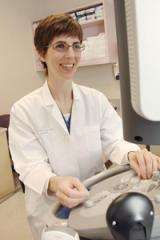
Dr. Elysia Moschos has shown that using saline-infusion sonography, or ultrasound, might make it easier to visualize and diagnose diseases in the lining of the uterus. Credit: UT Southwestern Medical Center

A procedure used in conjunction with a vaginal ultrasound might make it easier to visualize and diagnose diseases in the lining of the uterus, researchers at UT Southwestern Medical Center have found.

Physicians evaluated the endometrium, a cavity that lines the inside of the , in women who were in the midst of or had gone through menopause and who complained of abnormal bleeding. Abnormal bleeding can indicate certain diseases of the endometrium that may or may not be malignant.

The current standard of care is to blindly biopsy the endometrium; however, the biopsy might not always sample the part of the cavity that is diseased.

A study available online and in the April issue of Obstetrics and shows that using saline-infusion sonography (SIS), or ultrasound, a minimally invasive procedure, allows doctors to actually see where in the endometrium a polyp or growth exists and to biopsy it accordingly.

"Saline infusion sonography augments the usual transvaginal sonogram and lets us see what is inside the endometrium," said Dr. Elysia Moschos, associate professor of obstetrics and gynecology at UT Southwestern and the lead author of the study. "Normally, the endometrial cavity is collapsed, but when we infuse it with saline, we can visualize inside the cavity and see if it contains any abnormalities."

On a sonogram, water appears dark and tissue is light, so polyps or tumors look bright in comparison with the surrounding saline solution. Using the SIS procedure, physicians inject saline through a threaded into the uterus through the cervix to fill up and expand the endometrial cavity.

Doctors can then easily visualize and biopsy an existing growth under sono guidance and send it to a pathologist for analysis.

A total of 88 saline-infusion sonography endometrial samples were obtained. In the final outcome of 80 of those samples, saline-infusion endometrial sampling provided a diagnosis 89 percent of the time, compared with 52 percent for endometrial biopsy.

The study showed there were no women for whom blind biopsy of the endometrium would still be an appropriate first step, Dr. Moschos said. The blind biopsies missed 15 of 16 benign polyps and one-third of cancers.

By comparison, two-thirds of benign were correctly diagnosed by saline-infusion sonography endometrial sampling and no premalignant or malignant growths were missed.

Abnormal bleeding is a common complaint among patients, particularly during and after menopause. Women experiencing this symptom need to be evaluated for any kind of gynecologic cancers, Dr. Moschos said. The first step should be imaging of the endometrium by ultrasound.

According to the American College of and Gynecology, postmenopausal women who have an endometrial lining thicker than 4 millimeters need further follow-up.

"In women with abnormal endometrial appearances, SIS should then be performed. If the endometrium is uniformly thickened on the SIS exam, only then is a blind appropriate," Dr. Moschos said. "However, most endometrial pathology is focal, and therefore directed sampling, such as with saline infusion sonography guidance, is necessary."

Source: UT Southwestern Medical Center (news : web)


Rank not rated yet
Relevant PhysicsForums posts
  • Is Everyday Technology Killing Us?
    createdFeb 08, 2012
  • Exercise and weight loss
    createdFeb 08, 2012
  • Why do we have head aches? Our brains can't feel anything.
    createdFeb 07, 2012
  • "The end of diseases" by David Agus, interview from Daily Show with Jon Stewart
    createdFeb 04, 2012
  • Oncolytic adenovirus
    createdFeb 04, 2012
  • Nutrition label stuffs and diets
    createdFeb 02, 2012
  • More from Physics Forums - Medical Sciences

More news stories

Overeating may double risk of memory loss

New research suggests that consuming between 2,100 and 6,000 calories per day may double the risk of memory loss, or mild cognitive impairment (MCI), among people age 70 and older. The study was released today and will be ...

Medicine & Health / Neuroscience

created 5 minutes ago | popularity not rated yet | comments 0 | with audio podcast

Injured boomers beware: Know when to see doctor

(AP) -- It happened to nurse Jane Byron years after an in-line skating fall, business owner Haralee Weintraub while doing "men's" push-ups, and avid cyclist Gene Wilberg while lifting a heavy box.

Medicine & Health / Health

created 5 hours ago | popularity 5 / 5 (1) | comments 0

Starve a virus, feed a cure? Findings show how some cells protect themselves against HIV

A protein that protects some of our immune cells from the most common and virulent form of HIV works by starving the virus of the molecular building blocks that it needs to replicate, according to research published online ...

Medicine & Health / Research

created 3 hours ago | popularity 5 / 5 (1) | comments 0 | with audio podcast

FDA-approved drug rapidly clears amyloid from the brain, reverses Alzheimer's symptoms in mice

Neuroscientists at Case Western Reserve University School of Medicine have made a dramatic breakthrough in their efforts to find a cure for Alzheimer's disease. The researchers' findings, published in the journal Science, show t ...

Medicine & Health / Neuroscience

created Feb 09, 2012 | popularity 4.9 / 5 (56) | comments 15 | with audio podcast

Green tea found to reduce disability in the elderly

(Medical Xpress) -- A lot of research has been done over the past several years looking into the health benefits of green tea. As a result, scientists have found that regular consumption of the beverage leads ...

Medicine & Health / Health

created Feb 07, 2012 | popularity 4.4 / 5 (15) | comments 10 | with audio podcast report


Google might launch Drive for cloud storage soon

(PhysOrg.com) -- Google's next big move, according to the Wall Street Journal, is a cloud storage service called Drive. Hardly first to the plate, Google is simply catching up to introducing its cloud reposi ...

Scientists discover molecular secrets of 2,000-year-old Chinese herbal remedy

For roughly two thousand years, Chinese herbalists have treated Malaria using a root extract, commonly known as Chang Shan, from a type of hydrangea that grows in Tibet and Nepal. More recent studies suggest that halofuginone, ...

New method to examine batteries -- MRI from the inside

There is an ever-increasing need for advanced batteries for portable electronics, such as phones, cameras, and music players, but also to power electric vehicles and to facilitate the distribution and storage of energy derived ...

Lab study raises questions over nano-particle impact

Tests involving chickens have raised questions about the impact on health from engineered nano-particles, the ultra-fine grains commonly used in drugs and processed foods, scientists said on Sunday.

A mitosis mystery solved: How chromosomes align perfectly in a dividing cell

Although the process of mitotic cell division has been studied intensely for more than 50 years, Whitehead Institute researchers have only now solved the mystery of how cells correctly align their chromosomes during symmetric ...

Researchers find extensive RNA editing in human transcriptome

In a new study published online in Nature Biotechnology, researchers from BGI, the world's largest genomics organization, reported the evidence of extensive RNA editing in a human cell line by analysis of RNA-seq data, demons ...