Life Expectancy on the Rise -- Even for Quantum States
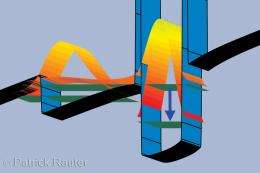
(PhysOrg.com) -- For the first time, scientists have succeeded in measuring and controlling the lifetime of quantum states with potential use in optoelectronic chips. This achievement is highly significant for the ongoing development of this cutting-edge technology. The breakthrough involved measuring the intersubband relaxation time of charge states in silicon-germanium SiGe structures on a picosecond scale. Experiments have also shown that it is possible to control and extend these times. As a result, this body of work - currently published in Physical Review Letters and supported by the Austrian Science Fund FWF - represents a major advance in the development of data processing based on optoelectronic chips.
Transmitting information via light quanta (photons) is nothing new. That is precisely what every fibre optic cable does with exceptional efficiency. But the process that is both ultra fast and reliable over long distances fails when used in close quarters. At present, photon-based chip-to-chip communication is not possible in data processing. The problem is the photon sources. Due to its semiconductor structure, the raw material currently used to manufacture computer chips - silicon - does not allow the generation of photons by conventional means. However, unconventional means may provide a solution - and that is precisely what the group from the Institute of Semiconductor and Solid State Physics at the University of Linz is working on.
Laser on a Chip
One potential solution could be a quantum cascade laser based on a silicon-germanium (SiGe) heterostructure, which could allow the use of quantum-physical effects to generate laser light in the infrared range. "There are currently numerous fundamental issues that need to be clarified in terms of the way that SiGe heterostructures work and how they can be controlled," explains DI Patrick Rauter, a member of the group lead by Dr. Thomas Fromherz that is working on the use of these structures for optical applications. One key parameter is the intersubband relaxation time. This indicates the timeframe within which excited charge carriers of the SiGe remain at an elevated energy level before returning to their original state. The duration of this period is a key factor for the quantum cascade laser, as the length of time the charge carriers are in a state of excitation is closely linked with their capacity to emit light.
DI Rauter and his colleagues have now succeeded in accurately measuring this timeframe. They were supported in their work by the Foundation for Fundamental Research Matter - FOM, based in Rijnhuizen, Netherlands - and its free-electron laser FELIX. The laser beam of this device can be pulsed in picoseconds, which means it can be used to measure extremely fast processes.
Fractions of a Fraction of a Second
Using an experimental design, the group succeeded in determining that the intersubband relaxation time lasts for between 12 and 25 picoseconds, or 12 to 25 trillionths of a second. The laser beam of FELIX was split to allow the group to measure these extraordinarily short spaces of time. One beam was used to excite the charge carriers in the SiGe while the other - after a time delay - performed the actual measurement. During this process, a photoelectric current - which is determined by the intersubband relaxation time - was measured. DI Rauter on the measurements: "We were also able to extend the intersubband relaxation lifetime in a controlled manner. To do this, we applied an external electrical field to the sample. By altering this field, we were able to continuously tune the relaxation time between 12 and 25 picoseconds. In actual fact, we succeeded in doubling the relaxation time - a highly promising result."
Published in Physical Review Letters, the work also forms part of the FWF special research program IR-ON (InfraRed Optical Nanostructures). A total of ten working groups from Austria and Germany contribute to this program, which focuses amongst other semiconductors on SiGe compounds with nanostructures that should be conducive for use in optoelectronic chips. The work conducted by DI Rauter and his colleagues has enabled the program to move a quantum leap - or one small step - closer to this goal.
More information: Continuous Voltage Tunability of Intersubband Relaxation Times in Coupled Well Structures. P. Rauter, T. Fromherz, N. Q. Vinh, B. N. Murdin, G. Mussler, D. Grützmacher & G. Bauer, Phys. Rev. Lett. 102, 147401 (2009) DOI: 10.1103/PhysRevLett.102.147401
Provided by University of Linz


