Quantum Theory May Explain Wishful Thinking
April 14, 2009 By Lisa Zyga feature
Quantum Theory May Explain Wishful Thinking

Enlarge

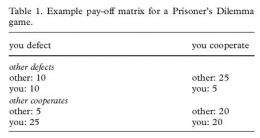
This example pay-off matrix for a Prisoner’s Dilemma game shows that defecting is the rational choice, since a player receives greater pay-offs when defecting (10 or 25) than when cooperating (5 or 20). However, if both players cooperate, each will receive a larger pay-off (20) than if both defect (10). Using a quantum probability model, scientists provide a psychological explanation for why a player might choose to cooperate without any knowledge of his opponent. Image credit: Pothos and Busemeyer.

(PhysOrg.com) -- Humans don’t always make the most rational decisions. As studies have shown, even when logic and reasoning point in one direction, sometimes we chose the opposite route, motivated by personal bias or simply "wishful thinking." This paradoxical human behavior has resisted explanation by classical decision theory for over a decade. But now, scientists have shown that a quantum probability model can provide a simple explanation for human decision-making - and may eventually help explain the success of human cognition overall.

If you were asked to gamble in a game in which you had a 50/50 chance to win $200 or lose $100, would you play? In one study, participants were told that they had just played this game, and then were asked to choose whether to try the same gamble again. One-third of the participants were told that they had won the first game, one-third were told they had lost the first game, and the remaining one-third did not know the outcome of their first game. Most of the participants in the first two scenarios chose to play again (69% and 59%, respectively), while most of the participants in the third scenario chose not to (only 36% played again). These results violate the “sure thing principle,” which says that if you prefer choice A in two complementary known states (e.g., known winning and known losing), then you should also prefer choice A when the state is unknown. So why do people choose differently when confronted with an unknown state?

In a recent study, psychologists Emmanuel M. Pothos of Swansea University in the UK and Jerome R. Busemeyer of Indiana University in the US have presented an alternative framework for modeling decision-making of this kind, based on quantum . As they note, the original motivation for developing in physics was to explain findings that seemed paradoxical from a classical point of view. Possibly, can better explain paradoxical findings in psychology, as well. In recent years, a growing number of researchers have investigated using quantum formalism in cognitive situations, such as in modeling human judgment and perception. Pothos and Busemeyer’s results are published in a recent issue of Proceedings of the Royal Society B.

“A few decades ago, Tversky and Kahneman (1974) challenged ubiquitous assumptions regarding what is the most suitable framework for modeling human cognition,” Busemeyer told PhysOrg.com. “Until then, most sought to understand cognition using classic probability theory. In our paper we raise the question, which mathematical framework is most appropriate for cognitive modeling? In this article, for the first time, we present a fundamentally different, and more powerful, approach to probabilistic models of cognition, based on quantum principles. Employing minimal assumptions, we derive a Hamiltonian directly from the parameters of the problem (e.g., the payoffs associated with different actions) and known general principles of cognition (e.g., a well known phenomenon of cognitive dissonance); every step in our model is psychologically interpreted and rigorously justified.”

Defecting Dilemma

In their study, the scientists compared two models, one based on Markovian classical probability theory and the other based on quantum probability theory. They modeled a game based on the Prisoner’s Dilemma, which is similar to the gambling game. Here, participants were asked if they wanted to cooperate with or defect from an imaginary partner. Overall, each partner would receive larger pay-outs if they defected, making defecting the rational choice. However, if both partners cooperated, they would each receive a higher pay-out than if both defected. Similar to the results from the gambling games, studies have shown that participants who were told that their partner had defected or cooperated on the first round usually chose to defect on the second round (84% and 66%, respectively). But participants who did not know their partner’s previous decision were more likely to cooperate than the others (only 55% defected). It seems as if these individuals were trying to give their partners the benefit of the doubt, at the expense of making the rational choice.

As the scientists showed, both classical and quantum probability models accurately predict an individual’s decisions when the opponent’s choice is known. However, when the opponent’s action is unknown, both models predict that the probability of defection is the average of the two known cases, which fails to explain empirical human behavior. The problem is that the models are purely rational, meaning they try to maximize utility.

To address this problem, the scientists added another component to both models, which they call cognitive dissonance, and can also be thought of as wishful thinking. The idea is that people tend to believe that their opponent will make the same choice that they do; if an individual chooses to cooperate, they tend to think that their opponent will cooperate, as well. If both partners cooperate, both will receive a higher pay-out than if both defected. (And if an individual thought that his opponent would cooperate and so decided to defect to maximize his own pay-out, he would then be compelled to assume that the opponent would also defect, according to cognitive dissonance.) In other words, an individual views his opponent as a mirror of himself.

The difference between the classical and quantum models lies in how the rational component and the cognitive dissonance component are combined. Even after adding the second component, the classical model predicts that the probability in the unknown scenario must equal the average of the probability for the two known cases. As such, the classical model continues to obey the law of total probability, and fails to explain the violations of the sure thing principle.

In the quantum model, on the other hand, the addition of the cognitive dissonance component produces interference effects that cause the unknown probability to deviate from the average of the known probabilities. While in the classical model an individual is committed to exactly one preference at any given time, in the quantum model an individual experiences a superposition of these preferences. Mathematically, the probability (or amplitude) of defecting in the unknown scenario is obtained from the superposition of probabilities (amplitudes) for the two known cases. These interference effects enable the probability of unknown events to be lower than the probability of either event individually, which is observed in the empirical studies.

“Cognitive dissonance can arise in other decision making situations and is not limited to games with an intelligent opponent,” Busemeyer said. “In the gambling game, you play against nature. In this case, however, your belief that you will win the game becomes coordinated with your intentions to play the game. Cognitive dissonance effects are not even limited to adult humans but have also been found with young children and even with nonhuman primates.” (See Egan, L. C., Santos, L. R. & Bloom, P. (2007). The origins of cognitive dissonance: evidence from children and monkeys. Psychological Science, 18, 978- 983.)

Quantum Cognition

While classical probability theory is too restrictive to fully describe human decision-making, this study shows that quantum theory provides a promising framework for modeling human cognition. In addition to making accurate predictions of the gambling game and Prisoner’s Dilemma, the quantum model also agrees with the empirical evidence that people make the same decision in back-to-back identical scenarios. In classical models, on the other hand, back-to-back choices remain probabilistic, which fails to explain human behavior.

“Classic probability theory, including Markov processes, must obey the law of total probability,” said Busemeyer. “However, human judgments often exhibit interference effects which violate the law of total probability. Quantum probability was originally developed specifically for the purpose of explaining interference effects found in physics. This same mathematical formalism provides an explanation for interference of thoughts in human judgments.”

Pothos and Busemeyer hope that further research on quantum probability models of human cognition could help answer fundamental questions about the nature of how we think. For example, what does it mean to be rational? Another example is Schrodinger’s equation, which predicts a periodic oscillation between choices after a minimum length of time. This oscillation matches with electroencephalography signals and may explain why the longer you debate on a decision, the more you fluctuate. Overall, if our brains use quantum principles, and quantum computation is known to be fundamentally faster than classical computation in computers, then perhaps quantum principles can even help explain the success of human cognition.

More information: Pothos, Emmanuel M. and Busemeyer, Jerome R. “A quantum probability explanation for violations of ‘rational’ decision theory.” Proc. R. Soc. B. doi:10.1098/rspb.2009.0121.


Join PhysOrg.com on Facebook!
Follow PhysOrg.com on Twitter!

Copyright 2009 PhysOrg.com.
All rights reserved. This material may not be published, broadcast, rewritten or redistributed in whole or part without the express written permission of PhysOrg.com.

4.1 /5 (47 votes)  

Filter


Move the slider to adjust rank threshold, so that you can hide some of the comments.


Display comments: newest first

thales
Apr 14, 2009

Rank: 4 / 5 (1)
If correct, this has serious implications for Bayesian rationalism.
murray
Apr 15, 2009

Rank: 5 / 5 (1)
It is intriguing as to what might be the source of the cognitive interference, especially at what level it emerges (neuron, network, etc.)
omatumr
Apr 15, 2009

Rank: 3 / 5 (3)
Would the title be equally correct if exactly reversed?
"Wishful Thinking May Explain Quantum Theory"
Oliver K. Manuel
http://www.omatumr.com/
fuseboy
Apr 15, 2009

Rank: 5 / 5 (2)
There are a lot of "are people rational" experiments along these lines, and my gut tells me that many run afoul of an incorrect understanding of the context in which experimental participants are making their decision.

For example, if I choose to defect and screw my opponent, will I be exposed as a cheat when the results of the study are published? What will the experimenter think of me? Will that hurt my chances of an advantageous trade with the experimenter in the future? Am I likely to face reprisal from my opponent? What moral ground will I have gained in subsequent negotiations over an opponent who I knew cheated me? What does it do to my opinion of myself now that I consider myself untrustworthy?

The brain has to balance innumerable factors such as this when considering the consequences of social actions. My suspicion is that these experiments teach us less about whether 'homo economicus' exists, and more about how hard it to design experiments to reveal him.

http://www.trilemma.com/blog
lengould100
Apr 16, 2009

Rank: not rated yet
It's simply not clear to me why tese experimenters use real humans at all in their experiments. They treat their results as if the experiment had been done using a/some programmed computer actor(s), acting on pre-conceived ideas of "rational". So why not simply do the experiments with computer program robots?
_Drew_
Apr 16, 2009

Rank: 5 / 5 (1)
I'm really not sure how the use of quantum mathematics is justified here. Simply because human decisions can be probabilistic or chaotic in nature, layering various psychological states on a single problem, does not demonstrate that actual quantum superposition is relevant to how those decisions are made. Sometimes people are more wishful and empathetic, sometimes their moods are more hard-nosed and rational. While a quantum model is an interesting way to achieve a simple mathematical formulation of this sort of chaos, I honestly don't see how one can possibly claim that quantum effects, and not mere chaotic psychology, are relevant to the question.
Sancho
Apr 17, 2009

Rank: not rated yet
Drew: Neuroscientist John Eccles has suggested that quantum rules govern neuronal behavior. (see his 1993 book, "How the Self Controls the Brain.")
Smitty2
Apr 17, 2009

Rank: 3 / 5 (2)
Wow. These *scientists* found a way to add to existing models a feature that better includes empirical data collected from self-reporting subjects. When will they find a model that does not depend on empirical data from self-reporting subjects, as the attributions of "quantum" and "wishful thinking" requires. I'm sorry. They are only interested in mystifying science writers. I shoulda known.
omatumr
Apr 18, 2009

Rank: 3 / 5 (2)
Is Smitty2 suggesting that even the behavior of *scientists* may be explained by Quantum Theory?

Oliver K. Manuel
http://www.omatumr.com/
rmark
Apr 18, 2009

Rank: 5 / 5 (1)
It is just too bad that the journal wants $40 to let us see what the authors actually said.
superhuman
Apr 18, 2009

Rank: not rated yet
In science you don't reuse models from completely unrelated disciples, you instead devise your own model based on your own data, going the other way around is is both absurd and counterproductive.

The assumption that quantum probability has anything to do with psychology on this level is as stupid as the assumption that humans always act rationally, it is ridiculous that such approaches are even considered.

If psychologists want psychology to stop being pseudoscience they need to stop fooling around and perform serious large scale experiments with thousands of subjects tested in real life situations when the real mechanisms governing our behavior have a chance to manifest themselves. Of course it's much harder work then getting 20 students to play some silly game which has no connection with reality but at least you will have a chance of discovering the proper model of human psychology.

The brain is an extremely complex organ with many levels of organization, a proper model needs to account for all these levels, from the most ancient drives of the primitive brain to the most sophisticated processing of the prefrontal cortex. That psychologists try to model such a complex processing unit with such primitives methods as game theory or wave function is really amusing - a perfect example of wishful thinking.

omatumr
Apr 19, 2009

Rank: 3 / 5 (2)
Does quantum theory (QT) explain anything? Some qualities of the physical universe are quantized, i.e., come only in discrete units. QT fits "what is", but QT doesn't explain why.

With kind regards,
Oliver K. Manuel
http://www.omatumr.com/
justhuman
Apr 21, 2009

Rank: not rated yet
Assuming that something you don't understand or don't like, is not true, is as stupid as assuming that understanding a part of something is not going to help to understanding the whole. Observation of objects in free fall as basis for theory of gravity, use of geometric mathematics (devised for building) for the description of the movement of planets, anybody? As far as I understand, what is generally defined as 'science' has always advanced by creating well defined, repeatable experiments in controlled environments. And people who do this don't use wishfull thinking or jealous gossiping to advance their knowledge or convince others, but the ability to see facts as they are, theories for their merits, the ability to describe and discuss about their thinking in a clear and objective way (usually largely mathematical as language is just too inprecise) and the flexibility to alter their previously held 'opinions' when new 'opinions' are better at describing reality. Of course the brain is a very complex thing, but this is just more reason to try and isolate and observe specific parts of its functioning. Just how do you think 'psychologists' will be able to figure out the whole functioning of the entire brain? With some 'psychological experiments' based on vague questionaires, with thousands of people in situations with uncountable influences outside the 'experimentally controlled parameters'? I would call that wishfull thinking.
Breez991
May 03, 2009

Rank: not rated yet
Just maybe; the scriptures are correct after all.


There has to be a reason; as to why! The following definition is in the dictionary.


human:imperfect: having the imperfections and weaknesses of a human being. To err is human; to forgive divine.


The prophet Isaiah [3:12. & 9:16] tels of the damage done by human leaders. So its nothing new, very definatly genetic.


Just maybe; the scriptures are correct after all.


There has to be a reason; as to why! The following definition is in the dictionary.


human: imperfect: having the imperfections and weaknesses of a human being. To err is human; to forgive divine.


The prophet Isaiah [3:12. & 9:16] tels of the damage done by errors made by human leaders. So its nothing new, very definatly, a genetic flaw; and science appears to be proveing it.

Rank 4.1 /5 (47 votes)
Related Stories
Relevant PhysicsForums posts
  • Is Everyday Technology Killing Us?
    createdFeb 08, 2012
  • Exercise and weight loss
    createdFeb 08, 2012
  • Why do we have head aches? Our brains can't feel anything.
    createdFeb 07, 2012
  • "The end of diseases" by David Agus, interview from Daily Show with Jon Stewart
    createdFeb 04, 2012
  • Oncolytic adenovirus
    createdFeb 04, 2012
  • Nutrition label stuffs and diets
    createdFeb 02, 2012
  • More from Physics Forums - Medical Sciences

More news stories

Complex wiring of the nervous system may rely on a just a handful of genes and proteins

Researchers at the Salk Institute have discovered a startling feature of early brain development that helps to explain how complex neuron wiring patterns are programmed using just a handful of critical genes. ...

Medicine & Health / Research

created 6 hours ago | popularity 4.9 / 5 (9) | comments 0 | with audio podcast

Both maternal and paternal age linked to autism

Older maternal and paternal age are jointly associated with having a child with autism, according to a recently published study led by researchers at The University of Texas Health Science Center at Houston (UTHealth).

Medicine & Health / Psychology & Psychiatry

created 10 hours ago | popularity 4 / 5 (2) | comments 0 | with audio podcast

New understanding of DNA repair could eventually lead to cancer therapy

A research group in the Faculty of Medicine & Dentistry at the University of Alberta is hoping its latest discovery could one day be used to develop new therapies that target certain types of cancers.

Medicine & Health / Cancer

created 10 hours ago | popularity 4.8 / 5 (4) | comments 0 | with audio podcast

Curry spice component may help slow prostate tumor growth

Curcumin, an active component of the Indian curry spice turmeric, may help slow down tumor growth in castration-resistant prostate cancer patients on androgen deprivation therapy (ADT), a study from researchers ...

Medicine & Health / Cancer

created 11 hours ago | popularity 4.4 / 5 (8) | comments 0 | with audio podcast

Human cognitive performance suffers following natural disasters, researchers find

Not surprisingly, victims of a natural disaster can experience stress and anxiety, but a new study indicates that it might also cause them to make more errors - some serious - in their daily lives. In their upcoming Human Fa ...

Medicine & Health / Psychology & Psychiatry

created 7 hours ago | popularity 4 / 5 (1) | comments 0


Google users warned of threat to smartphone wallets

Users of Google smartphone wallets were being warned on Friday that there is a way to crack pass codes intended to thwart thieves from going on illicit shopping sprees.

Anonymous knocks CIA website offline (Update)

The website of the Central Intelligence Agency was inaccessible on Friday after the hacker group Anonymous claimed to have knocked it offline.

New error-correcting codes guarantee the fastest possible rate of data transmission

Error-correcting codes are one of the triumphs of the digital age. They’re a way of encoding information so that it can be transmitted across a communication channel — such as an optical fiber o ...

The power of estrogen -- male snakes attract other males

A new study has shown that boosting the estrogen levels of male garter snakes causes them to secrete the same pheromones that females use to attract suitors, and turned the males into just about the sexiest ...

Humans may have helped the decline of African rainforests 3000 years ago

(PhysOrg.com) -- Large areas of rainforests in Central Africa mysteriously disappeared over three thousand years ago, to be replaced by savannas. The prevailing theory has been that the cause was a change ...

New power source discovered

(PhysOrg.com) -- Researchers at the Massachusetts Institute of Technology (MIT) and RMIT University have made a breakthrough in energy storage and power generation.